Best Handheld Ham Radios: 8 Picks From Under $25 to Under $500
Handhelds are where nearly every licensed operator starts, and where the most money gets wasted. Here is what separates an under-$25 radio from an under-$250 one, and when the difference matters.
The short answer
The Yaesu FT-60R at under $250 is the best all-around handheld ham radio, because its die-cast chassis and receiver front end stay usable near strong commercial transmitters where budget radios fail. For a first radio, the under-$25 Baofeng UV-5R plus an under-$25 Nagoya NA-771C whip and a genuine FTDI programming cable is a complete working setup for under $100.
- Budget range
- Under $25 to under $500
- Typical power
- 4 to 10 W
- Bands
- 2 m and 70 cm
- License needed
- Technician
Every one of these radios will get you onto a local repeater. The differences are in what happens on the bad days: when a paging transmitter two miles away is desensing your receiver, when the radio spends a winter in a truck door pocket, when you drop it on concrete at a public service event. Our pick is the Yaesu FT-60R(under $250), and the reason is a receiver front end and a die-cast chassis rather than any number on the spec sheet.
What actually separates an under-$25 handheld from an under-$250 one
Four things, and only one of them appears on a marketing bullet list.
Receiver selectivity is the ability to hear a weak signal on your frequency while a strong signal sits nearby. It is the single biggest technical difference in this category, and it is why two radios that both show five bars on a repeater behave completely differently a mile from a paging site. A budget superheterodyne with wide front-end filtering hears everything at once, mixes it together, and produces birdies, buzzes and phantom carriers. The Yaesu FT-60R and Icom IC-V86not on amazon are the two radios here that hold up under that condition.
Chassis and connector quality decide whether the radio survives being owned. The SMA connector is the usual failure point: over-torque a cheap one, or hang a 15 inch whip off it and catch the whip in a door, and the connector twists out of the case. A die-cast frame carries that load into metal rather than into plastic.
Programming is the usability difference that stops most new operators cold. Radios that program from a phone over Bluetooth, like the BTECH UV-PRO and the TIDRADIO TD-H8, remove an entire class of problem: no cable, no counterfeit serial chip, no driver hunt. Radios that need a cable need a genuine one, which means a BTECH PC03 FTDI programming cable(under $25).
Battery capacity and charging matter more than transmit power. A stock 1800 mAh pack on a 5 W radio gives roughly a working day of listening with light transmitting. A Baofeng UV-5R 3800 mAh USB-C battery, 2-pack(under $25) with USB-C charging built into the pack roughly triples that and removes the drop-in cradle from your bag.
The full field, compared on the things that matter
Power output is in the table because people ask for it, not because it separates these radios. The columns to read are the receiver note and the programming method.
| Radio | Power | Bands | Programming | Notable | Budget |
|---|---|---|---|---|---|
| Baofeng UV-5R | 4 W | 2 m / 70 cm | CHIRP, cable | 128 memories, the cheapest way in | Under $25 |
| Quansheng UV-K5 | 5 W | 2 m / 70 cm | CHIRP, cable | AM aircraft receive, NOAA alerts, USB-C | Under $50 |
| Baofeng UV-82HP | 8 W | 2 m / 70 cm | CHIRP, cable | Heavier pack, stiffer chassis | Under $100 |
| TIDRADIO TD-H8 | 10 W | 2 m / 70 cm | Bluetooth, phone | Spectrum display, wireless programming | Under $250 |
| BTECH UV-PRO | 5 W | 2 m / 70 cm | Bluetooth, phone | IP67, built-in APRS and GPS, USB-C | Under $250 |
| Icom IC-V86 | 7 W | 2 m only | Software, cable | 1500 mW audio, the loudest in the class | Under $250 |
| Yaesu FT-60R | 5 W | 2 m / 70 cm | Software, cable | Die-cast chassis, 1000 memories | Under $250 |
| Yaesu FT-70DR | 5 W | 2 m / 70 cm | Software, cable | C4FM digital plus analog FM | Under $250 |
| Yaesu VX-6R | 5 W | 2 m / 1.25 m / 70 cm | Software, cable | Submersible, tri-band | Under $500 |
Three tiers
Pick by where you are, not by price
These are three genuinely different radios, not one radio at three prices. The beginner pick is not a lesser version of the expert pick; it is a radio that does the same job in easier conditions.
Newly licensed, or still deciding whether the hobby sticks
Baofeng
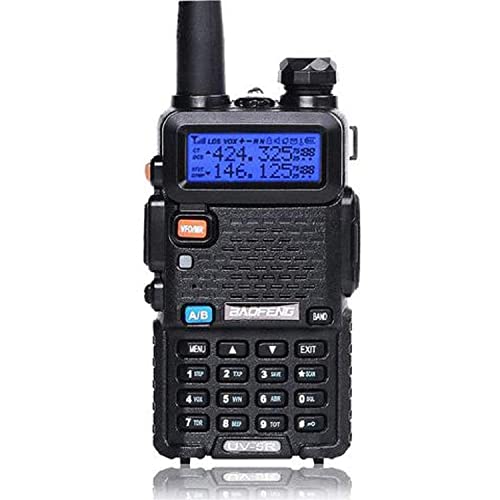
Baofeng UV-5R
Four watts on 2 m and 70 cm, 128 memories, full CHIRP support, for about the price of a large pizza. It is not a compromise on the bands it covers, it is a compromise on receiver quality and build, and neither of those stops you working repeaters.
- Power 4 W
- Memories 128
Tradeoff
The receiver struggles near strong commercial transmitters, and the stock antenna is the worst part of the package. Budget under $50 more for a Nagoya whip, extended batteries and a genuine programming cable.
Anyone who wants APRS and GPS without adding boxes

BTECH
BTECH UV-PRO
IP67 sealed, USB-C charged, and programmed from a phone app over Bluetooth, with APRS and GPS on board rather than bolted on. It removes the programming cable from the equation entirely, which is the step that stops most new operators.
- Sealing IP67
- APRS Built in
Tradeoff
App-dependent configuration means you are trusting a manufacturer app to keep working, and the receiver is good rather than exceptional. If you want the best front end at this money, the FT-60R is the other answer.
Operators who work in weather, on water, or on 222 MHz
Yaesu
Yaesu VX-6R
Submersible tri-band coverage of 144, 222 and 440 MHz at 5 W in a small metal body. The 1.25 m band is the reason to buy it: where a local 222 repeater exists, it is the quietest band in the hobby, and almost nothing else portable covers it.
- Bands 3
- Sealing Submersible
Tradeoff
Skip it if your area has no 222 MHz activity, if you want easy programming, or if you want APRS. It is expensive, the menus are dense, the display is small, and two thirds of the extra money buys a band that may be empty where you live. Check a repeater directory for 222 MHz coverage before spending that much.
Which bands does a handheld actually give you?
A dual-band handheld covers 2 m, from 144.0 to 148.0 MHz, and 70 cm, from 420.0 to 450.0 MHz. Both are open to every license class including Technician, with all authorized modes and a legal limit of 1500 W PEP, which a 5 W radio is in no danger of approaching. That is the whole reason a handheld is the standard first radio: your license grants full privileges on the bands it covers from the day you pass.
A repeater is a station on a hill that listens on one frequency and retransmits on another simultaneously, which is how a 5 W handheld reaches fifty miles. The gap between those two frequencies is the offset, and it is standardized by band.
| Band | Offset | Convention |
|---|---|---|
| 6 m | 1 MHz | Regional variation is common; check the local coordinator |
| 2 m | 600 kHz | Minus below 147.000 MHz, plus above it, as a rule of thumb |
| 1.25 m | 1.6 MHz | Minus offset throughout |
| 70 cm | 5 MHz | Plus offset throughout in most of the United States |
| 33 cm | 12 MHz | Minus offset |
Most repeaters also require a sub-audible CTCSS tone on your transmission before they will open up. Get the offset direction or the tone wrong and the repeater simply does not respond, which is the most common reason a new operator concludes the radio is broken. The offsets and tones reference lists the full standard tone set.
The accessories that turn a radio into a station
A handheld out of the box is not a working station, and this is where the budget actually goes. In rough order of how much difference each one makes:
- A better antenna. The Nagoya NA-771C 15-inch whip(under $25) is a 15 inch flexible SMA-female whip and the single cheapest meaningful upgrade available. Expect 2 to 3 dB over a stock rubber duck on both transmit and receive. If you want something shorter and better made, the Diamond SRJ77CA(under $50) gives up a little gain for a lot of durability.
- A real programming cable. A BTECH PC03 FTDI programming cable(under $25) with a genuine FTDI chip. This is not the place to save a few dollars.
- More battery. A Baofeng UV-5R 3800 mAh USB-C battery, 2-pack(under $25) two-pack with USB-C charging in the pack.
- A speaker mic. A Baofeng BF-850 speaker mic(under $25) keeps the radio and its antenna off the side of your head, which is also the cheapest RF exposure improvement available to a handheld operator.
- A way to carry it. A abcGoodefg radio chest harness(under $25) holds the radio on your chest with the antenna clear of your head, which matters at a public service event where you are wearing it for six hours.
What a handheld cannot do, and what to buy instead
Handhelds are not the right tool for three jobs, and buying one for those jobs is the most common mistake in this category.
Reaching a distant repeater from a fixed location. The answer is a mobile radio and an outdoor antenna, not a better handheld. Twenty-five to fifty watts into a rooftop vertical is 10 dB or more over a handheld with a whip, and it costs less than a premium handheld. See the mobile radio roundup and the honest three-way comparison at handheld versus mobile versus base.
Talking across the country or overseas. That is HF, and no handheld in this roundup covers HF at all. A Technician has CW privileges on parts of 80, 40 and 15 m plus CW, digital and SSB on 28.300 to 28.500 MHz, all at 200 W maximum, and reaching any of it needs a different radio entirely. Start at best HF transceivers for beginners.
Driving an amplifier. Cheap VHF and UHF amplifiers sold for handheld use are frequently dirty on the output and a handheld cannot key them cleanly. Buy a mobile radio instead. It is cheaper, cleaner and legal.
Analog, C4FM or DMR: which one do you need?
Analog FM is the universal language of VHF and UHF amateur radio. Every repeater supports it, every radio here does it, and nothing about a digital mode makes a contact easier to make. Buy analog first.
Digital modes matter when your local repeater network runs one. The Yaesu FT-70DR(under $250) is the simplest route onto a Yaesu System Fusion repeater, because C4FM needs no code plug and the radio falls back to analog FM automatically. DMR, on the AnyTone and Retevis radios, is the most capable and the least friendly: it needs a code plug, a talkgroup list and a DMR ID before it transmits anything. That is covered separately in best DMR and digital handhelds and analog versus DMR versus Fusion.
How we chose these radios
We research equipment from published manufacturer specifications, FCC regulatory documents and Part 97 itself, and verified owner reviews read at volume. We did not test these units in person and we do not claim to have. Where a figure here comes from a datasheet rather than a measurement, treat it as the manufacturer figure it is, and assume published gain and sensitivity numbers are optimistic by a small margin across the whole category.
Ranking criteria, in the order we weighted them: receiver behaviour in a crowded RF environment, because that is the failure mode owners complain about most and the one that cannot be fixed with accessories. Then build quality at the antenna connector and the chassis, because that is what breaks. Then programming path, because a radio nobody can program is a radio nobody uses. Transmit power came last deliberately, since the entire spread from 4 W to 10 W is under 4 dB and every antenna decision on the page is worth more than that.
We excluded radios marketed primarily for unlicensed FRS or GMRS use, radios with no CHIRP or manufacturer software support, and anything sold only as a sealed bundle where the antenna and battery cannot be replaced. Prices were researched at time of writing, are set by the retailer at checkout, and move constantly in this category.
Buying tips
- Budget the radio and the accessories as one number. An under-$25 radio is an under-$100 radio once it has a working antenna, a real cable and a battery you can trust. Compare that total against an under-$250 radio, not the sticker.
- Check the antenna connector type before buying a whip. Most budget handhelds use SMA-female on the radio, meaning the antenna carries the male pin. Reverse-polarity SMA turns up often enough to catch people out, and a normal SMA antenna will not mate with it.
- Buy two of the cheap radio, not one of each. Handhelds are useless alone. If nobody near you is licensed, a pair means you can actually use them simplex while you learn the local repeaters.
- Look up your local repeaters before you choose digital. A Fusion radio in a DMR area, or either in an analog-only area, is money spent on a feature you cannot use.
- Do not buy a high-gain whip longer than about 17 inches. The extra gain is real and small, and the antenna becomes awkward enough that the radio stays home. A radio you carry beats a radio with a better antenna that you do not.
- Verify what your license class allows before you transmit. Every band a dual-band handheld covers is fully open to Technicians, but the band plan by license class is worth reading once anyway, because the HF picture is where people get it wrong.
Common questions
Questions people ask about this
Is a budget Baofeng good enough, or should I spend more on a Yaesu?
Both answers are correct for different people. A Baofeng UV-5R with a better whip and a real programming cable will work every repeater a Yaesu FT-60R works, in a quiet radio environment. The FT-60R earns its price where the environment is noisy: near paging transmitters, broadcast towers or busy commercial sites, the cheap receiver front end hears signals that are not there. Buy the cheap one first if you are unsure, then upgrade knowing exactly what annoys you.
How far can a 5 watt handheld actually reach?
Simplex to another handheld, roughly half a mile to two miles in suburban terrain and five to ten miles with line of sight. Through a repeater on a hill, twenty to fifty miles is routine, because the repeater has the height and the antenna. Power barely matters here: going from 4 W to 8 W is 3 dB, while stepping outside, standing on high ground or fitting a longer whip is worth more. Height beats watts every time.
Do I need a programming cable, or can I enter frequencies by hand?
You can enter them by hand, and almost nobody does twice. Programming a repeater by keypad means setting the receive frequency, the offset direction, the offset size, the transmit tone and the memory name through a menu system with no labels. A genuine FTDI cable and the free CHIRP software load fifty repeaters in two minutes. Cables with counterfeit serial chips are the single most common reason CHIRP will not connect.
What is the difference between a 4 watt and an 8 watt handheld?
About 3 dB, which is half an S unit on the receiving end and almost never the difference between making a contact and missing it. The 8 W radios do usually carry heavier batteries and stiffer chassis, and those are worth having. If you are choosing between more power and a better antenna, take the antenna: a 15 inch whip in place of a stock rubber duck is a comparable gain and it improves receive as well as transmit.
Which handheld should I buy if I want APRS and GPS built in?
The BTECH UV-PRO at under $250 is the straightforward answer, because APRS, GPS, Bluetooth and phone-app programming are all built in and no external tracker or cable is needed. The AnyTone AT-D878UVII Plus also has GPS and APRS and adds DMR, at a higher price and a much steeper learning curve. Older Yaesu handhelds can do APRS only with an external device, which usually costs more than the radio.
Are cheap handhelds legal to use on the amateur bands?
Yes, provided they are amateur equipment operated by a licensed amateur within the amateur allocations. The FCC has acted against importers marketing the same radios for unlicensed use on FRS and GMRS channels, which is a marketing problem rather than a hardware one. What is not legal is transmitting anywhere without a license, or transmitting outside the segments your license class authorizes. Receiving needs no license at all.
Keep going
Related on this site
- AnyTone AT-D878UVII Plus review What an under-$250 handheld buys over an under-$25 one.
- The complete Technician starter station The radio plus the four things that make it usable, with a stated total.
- How to program a Baofeng with CHIRP Cable to first repeater contact, step by step.
- Baofeng versus Yaesu, honestly What the extra money actually buys you.
- Best handheld antennas The cheapest meaningful upgrade to any handheld.
- How to use a repeater Offsets, tones, and what to say first.
- The Technician license Thirty-five questions, and what it grants you.
Disclaimer Researched guidance for planning purposes, not professional engineering, electrical or legal advice. Antenna work, RF exposure, mast and tower work, grounding and battery handling all carry real risk that depends on your specific site and installation. Verify anything safety-critical against current FCC rules, the National Electrical Code and the manufacturer's own documentation, and hire a professional where the job calls for one. We research equipment from published specifications, regulatory documents and verified owner reviews rather than claiming hands-on testing we have not done.