Best DMR and Digital Handhelds: 3 Radios That Actually Get You On the Network
Digital handhelds are not harder radios, they are radios with a configuration file. Here is which one to buy, and how much of an evening you are signing up for.
The short answer
The AnyTone AT-D878UVII Plus at under $250 is the best DMR handheld, because it has GPS and roaming built in and the deepest library of community code plugs, which is what actually determines whether you get on the air. If you want digital with no configuration work at all, the Yaesu FT-70DR at under $250 runs C4FM on Fusion repeaters and falls back to analog FM automatically.
- Budget range
- Under $100 to under $250
- Modes
- DMR, C4FM, analog FM
- DMR ID
- Free, required
- License needed
- Technician
Digital voice on VHF and UHF is not a performance upgrade. It is a network upgrade, and which network you join is decided entirely by what is on the air within range of your antenna. Our pick is the AnyTone AT-D878UVII Plus(under $250), and the reason has more to do with the size of the community publishing code plugs for it than with anything in its specification.
What digital voice actually changes
Digital voice means your speech is digitized, compressed by a vocoder, wrapped in error correction and transmitted as data rather than as a frequency-modulated audio signal. Three incompatible systems dominate amateur use: DMR, which came from commercial land mobile radio, Yaesu System Fusion using C4FM, and D-STAR, developed through the Japanese amateur league. None of them decode each other on the air.
What you gain is a network. A DMR repeater is typically linked into a worldwide system of talkgroups, so a 5 W handheld in a parking lot reaches a conversation in another country with no propagation involved at all. You also get text messaging, position reporting and caller identification that shows the other operator name and call sign on your display before they finish their first sentence.
What you lose is graceful failure. Analog FM fades into hiss you can still copy with effort, and operators regularly work each other at signal levels where nothing digital would decode. Digital voice is perfect until it is not, with a narrow band of robotic warbling in between. Near the edge of coverage, analog is the better mode, and every radio here does analog too.
The three digital handhelds worth buying, compared
| Radio | Digital mode | Power | GPS | Setup effort | Budget |
|---|---|---|---|---|---|
| Retevis RT3S | DMR (Tier I and II) | 5 W | Yes, with APRS | High, and the software is the weak point | Under $100 |
| Yaesu FT-70DR | C4FM, System Fusion | 5 W | No | Low, no code plug required | Under $250 |
| AnyTone AT-D878UVII Plus | DMR (Tier I and II) | 5 W | Yes, with roaming | Moderate, community code plugs exist | Under $250 |
The setup effort column is the one that decides how this purchase feels. The Yaesu FT-70DR is programmed like an analog radio: frequency, offset, tone, done, and digital happens automatically when the repeater is digital. The AnyTone AT-D878UVII Plus needs a code plug, but somebody in your region has almost certainly published one. The Retevis RT3S needs a code plug and its stock software is the least pleasant of the three, which is why the OpenGD77 community firmware exists and why the radio is worth it anyway.
Three tiers
Pick by how much configuration you will tolerate
The technical differences between these radios are smaller than the differences in what you have to do before they work. Be honest about which of those you are buying.
Anyone who wants to find out whether DMR is active near them
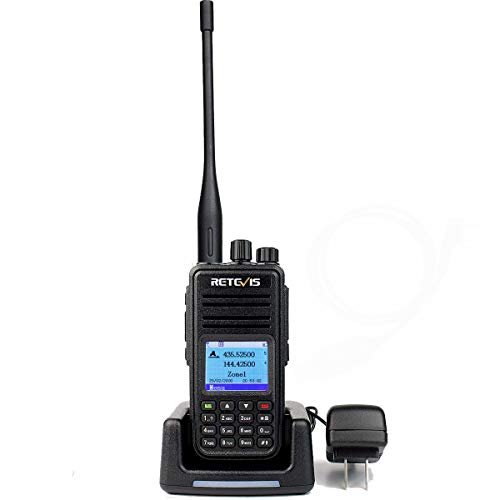
Retevis
Retevis RT3S
A dual-band DMR handheld with GPS and APRS for well under $100, and the usual entry point for the OpenGD77 community firmware that replaces the stock code plug workflow with something much friendlier. Cheap enough that discovering your area has no DMR repeater is not an expensive mistake.
- Power 5 W
- Firmware OpenGD77 capable
Tradeoff
The manufacturer software is the worst part of the package and the reason people reflash it. Programming is genuinely harder than on the AnyTone, and there are fewer published code plugs to start from.
Operators in Fusion territory who want digital with no homework

Yaesu
Yaesu FT-70DR
C4FM digital and analog FM in a conventional Yaesu handheld, programmed by frequency and tone like any FM radio. There is no code plug, no colour code, no time slot and no talkgroup list. On a mixed repeater it switches between digital and analog automatically, so a single memory channel works either way.
- Mode C4FM
- Fallback Analog FM
Tradeoff
No GPS and no APRS, and Fusion coverage is regional. Outside a Fusion area the digital half of the radio does nothing, and you have paid a digital-radio price for a very good analog handheld.
Operators committing to DMR properly, with roaming and GPS

AnyTone
AnyTone AT-D878UVII Plus
GPS, APRS, roaming between repeaters on the same talkgroup, dual watch, and the deepest published code plug library in amateur DMR. Roaming is the feature that makes it feel like a phone: drive out of one repeater footprint and the radio finds the next one carrying your talkgroup.
- Roaming Yes
- GPS Built in
Tradeoff
Do not buy this if you are unwilling to spend an evening with a code plug editor, if your area has no DMR repeater and you have no interest in a hotspot, or if you want a radio a family member can pick up and use. It is the most capable handheld here and the least casual. A Yaesu FT-60R is the better answer for someone who just wants to talk.
DMR against C4FM against analog, on the things that matter
| Attribute | Analog FM | C4FM (Fusion) | DMR |
|---|---|---|---|
| Configuration needed | Frequency, offset, tone | Frequency, offset, tone | Full code plug |
| Users per channel | 1 | 1 | 2, via time slots |
| Behaviour at fringe | Degrades into copyable noise | Cliff edge, with warbling | Cliff edge, with warbling |
| Worldwide linking | Via analog link systems only | Yes, via reflectors and rooms | Yes, via talkgroups |
| Position reporting | Needs separate APRS gear | On some models | Built in on GPS models |
| Registration required | None beyond your license | None | Free DMR ID |
| Repeaters available | Everywhere | Regional | Regional, largest digital network |
The row that decides your purchase is the last one. Look up your county in a repeater directory, note which digital modes appear within realistic handheld range of your house, and buy that. Everything else on this page is secondary to it.
What a digital handheld needs besides the radio
The same accessories as any handheld, plus one extra step that is free and easy to forget.
- A DMR ID. Free from RadioID.net, issued against your call sign, usually within a couple of days. Do this before the radio arrives.
- A better antenna. A Nagoya NA-771C 15-inch whip(under $25) or, if you prefer something shorter and better made, a Diamond SRJ77CA(under $50). Digital does not change antenna physics, and error correction cannot recover a signal that never arrived.
- A programming cable, if the radio needs one. The DMR radios here ship with their own cables. For Kenwood-connector analog handhelds a BTECH PC03 FTDI programming cable(under $25) with a genuine FTDI chip is the safe choice.
- A spare battery or a bigger one. Digital transmit draws a constant carrier for the whole transmission, so talk time under digital is shorter than the analog figure on the box.
- A speaker mic. A Baofeng BF-850 speaker mic(under $25) on the two-pin Kenwood connector fits most of the budget field, keeps the antenna away from your head, and makes a chest-worn radio usable.
Hotspots, and when they are the right answer
If your area has no digital repeater, a personal hotspot is the usual fix. It is a small transmitter, typically a few tens of milliwatts, that bridges your handheld to a digital network over your home internet connection. Within a house it gives you every worldwide talkgroup on the network with no repeater involved.
Two honest caveats. A hotspot is not coverage: step outside the range of a few milliwatts and you have nothing, so it does not replace a repeater for mobile use. And a hotspot is still an amateur transmitter that you are responsible for, operating under your call sign, on frequencies you must be licensed for. Coordinate its simplex frequency against the local band plan rather than leaving it on whatever the software shipped with.
Why analog is still the right first purchase for most people
Nothing on this page argues that a new operator should start digital. Analog FM is universal, it needs no registration, it works on every repeater in the country, and it is the mode every net and every public service event runs on. The analog handheld roundup covers radios from under $25 that will do everything a beginner needs.
Buy digital when one of three things is true: your local repeater network is digital, you specifically want the worldwide talkgroup experience, or you want position reporting and messaging without adding a separate device. Outside those cases the extra money buys configuration work rather than capability. The full argument is at analog versus DMR versus Fusion.
How we chose these radios
We research equipment from published manufacturer specifications, regulatory documents including Part 97, and verified owner reviews read at volume. We did not test these radios in person and make no hands-on claims. Digital handhelds are unusually well documented by their own user communities, and the published code plug ecosystem for a given model is a matter of public record rather than an impression.
We weighted, in order: whether a new owner can realistically get on the air, which in DMR means published code plugs and readable software far more than it means hardware. Then whether the radio also works properly as an analog handheld, because it will spend much of its life doing that. Then GPS, roaming and messaging features. Transmit power was ignored as a differentiator, since all three radios sit at 5 W.
We excluded radios that cannot do analog FM, sealed bundles where the battery and antenna are not replaceable, and any model whose only programming path is a manufacturer cloud service. Prices were researched at time of writing and are set by the retailer at checkout.
Buying tips
- Check your local repeater directory first, and buy the mode that is there. This is the whole decision. A radio for the wrong network is an expensive analog handheld.
- Request the DMR ID before the radio ships. It is free and it takes a day or two, and having it in hand means you can finish the code plug the evening the radio arrives.
- Start from somebody else code plug, not a blank one. Regional clubs publish current files. Building one from scratch as your first act with a DMR radio is how people conclude that DMR is impossible.
- Do not buy a digital radio to talk to a family member. Two analog handhelds cost a fifth as much and work simplex out of the box.
- Expect shorter battery life than the box claims. Digital transmit is a constant carrier, so plan on a spare pack for any event longer than a few hours.
- Keep an analog channel programmed for every local repeater. When digital drops out at the fringe, analog is what still gets you a contact, and the offsets and tones chart has what you need to enter them.
Common questions
Questions people ask about this
What is a code plug and why does DMR need one?
A code plug is the complete configuration file for a DMR radio: channels, talkgroups, contact lists, scan lists, zones and your DMR ID, all bound together. DMR does not work like analog FM where a frequency and a tone are enough. Each channel must also specify a colour code, a time slot and a talkgroup, and getting any one of them wrong produces silence rather than an error. Most operators start from a code plug published for their local network.
Do I need a separate DMR ID, and does it cost anything?
Yes, and it is free. RadioID.net issues a seven-digit DMR ID to licensed amateurs after verifying your call sign, usually within a day or two. That number identifies you on every DMR network worldwide, so you request it once and use it in every radio you own. A DMR radio transmitting without a valid ID either will not key up or will be rejected by the repeater, depending on the network.
Which digital mode should I choose: DMR, C4FM or D-STAR?
Choose whatever your local repeaters run, because none of the three modes talk to each other on the air. Look up your area in a repeater directory before spending anything. DMR has the largest amateur network and the steepest setup curve. Yaesu System Fusion, using C4FM, is the easiest because the radio falls back to analog FM automatically and needs no code plug. D-STAR is common in some regions and almost absent in others.
Does a DMR handheld work on ordinary analog repeaters too?
Every radio in this roundup does both. The AnyTone AT-D878UVII Plus, Retevis RT3S and Yaesu FT-70DR all transmit analog FM on 2 m and 70 cm exactly like a conventional handheld, so a digital radio is never a narrower purchase than an analog one. What differs is convenience: on the Yaesu, a mixed digital and analog channel list is trivial, while on a DMR radio the analog channels still live inside the code plug.
Is digital voice clearer than analog FM?
Clearer in the middle of the coverage area and worse at the edge. Digital voice arrives either perfect or not at all, with a short region of robotic warbling in between, while analog FM degrades gracefully into noise you can still copy with effort. Operators working near the fringe of a repeater often prefer analog for exactly this reason. Digital wins on network features: worldwide talkgroups, text messaging and position reporting.
What is a hotspot and do I need one?
A hotspot is a low-power personal digital repeater, typically a small board and a Raspberry Pi, that links your handheld to a digital network over your home internet connection. It matters if there is no DMR or Fusion repeater near you, because it gives you access to worldwide talkgroups with a few milliwatts. It does not extend your radio coverage, and transmitting through one still requires your amateur license.
Keep going
Related on this site
- AnyTone AT-D878UVII Plus review The code plug homework, in full.
- Analog versus DMR versus Fusion The three networks compared without the tribalism.
- Best handheld ham radios The analog field, from under $25 up.
- How to use a repeater Offsets, tones and etiquette, which digital does not change.
- Repeater offsets and tone chart The standard offsets and the full CTCSS set.
- The Technician license Everything a digital handheld touches is Technician territory.
- Technician starter station What else the radio needs to be a station.
Disclaimer Researched guidance for planning purposes, not professional engineering, electrical or legal advice. Antenna work, RF exposure, mast and tower work, grounding and battery handling all carry real risk that depends on your specific site and installation. Verify anything safety-critical against current FCC rules, the National Electrical Code and the manufacturer's own documentation, and hire a professional where the job calls for one. We research equipment from published specifications, regulatory documents and verified owner reviews rather than claiming hands-on testing we have not done.