Station grounding and lightning protection that actually works
A bonded single-point entry panel, an arrester on every conductor, and a plug you can physically pull.
The short answer
Every feedline and rotator cable entering the building must pass through one grounded entry panel fitted with listed arresters, and that panel ground electrode must be bonded back to the building electrical service ground. An isolated ground rod that is not bonded to the service ground makes a strike worse, not better, and no arrester replaces physically disconnecting the feedlines during a storm.
- Code reference
- NEC Article 810
- Entry points
- Exactly one
- Bonding conductor
- 6 AWG copper min
- Ground rod
- 8 ft, driven
- Arrester type
- Gas discharge tube
- Storm procedure
- Disconnect and remove
Grounding is the part of station building that gets treated as an optional upgrade and is in fact the only part that is a code requirement with a life-safety purpose. The National Electrical Code deals with it in Article 810, which exists because antennas on buildings burned houses down and killed people long before anyone was making DX contacts.
It is worth separating three different things that all get called grounding, because conflating them is how bad installations get built. There is safety grounding, which keeps fault current and lightning energy out of the house. There is RF grounding, which is about counterpoise and common-mode current and is a completely different problem. And there is the mains protective earth, which is the electrician’s domain and which everything else must be bonded to. This page is about the first, and it says where the other two connect.
The honest headline is that no grounding system makes a direct strike survivable for your equipment. What a good system does is keep the energy outside the building envelope, protect the structure and the people in it, and give the surge somewhere to go that is not through your operating position.
The single-point entry panel
Everything in a well-grounded station follows from one decision: every conductor coming from outside enters the building at the same physical place, through the same grounded plate. Coax, rotator cable, control lines and any DC feed from an outdoor supply, all through one panel.
The reason is potential difference. During a nearby strike the ground under your house rises to a large voltage for a few microseconds, and it does not rise uniformly. If your coax is bonded at one corner of the house and your mains earth is at another, the difference between them appears across whatever bridges them, which is your radio. Bring everything to one point and the whole assembly rises together, so there is nothing across the equipment.
Building the entry panel
- 1
Mount a bonded plate on the outside wall where the cables come in
A Copper grounding bus bar kit, 16 positions on standoffs, or a purpose-made entry plate. It must be outside the building, below the point where the cables enter, so that any energy that flashes over does so in open air rather than in a wall cavity.
- 2
Drive a ground electrode at the panel
A 8 ft copper-bonded ground rod kit with clamp driven its full depth, as close to the panel as practical. In dry or rocky soil use two rods separated by at least their own length and bond them together. The electrode is not the protection, it is one end of a path.
- 3
Bond the panel electrode to the building service ground
This is the step people skip and it is the one that matters most. Run at least 6 AWG copper, ideally heavier and ideally flat Tinned copper ground strap braid, 15 ft for its lower inductance, from the antenna ground electrode to the electrical service ground electrode. Do it in as straight a line as possible with gentle bends. Sharp bends add inductance and inductance is what a fast surge sees.
- 4
Fit an arrester on every conductor
One per coax run, plus protection for rotator and control cables. A Proxicast ProGrade coaxial lightning arrester, PL-259 / SO-239 covers a typical HF or VHF feedline, and a PolyPhaser IS-50NX coaxial protectornot on amazon is the reference-grade version for a station where the equipment behind it is worth protecting properly.
- 5
Keep the run from panel to shack short and continuous
The cable between the entry panel and the equipment should be as short as the layout allows, and the shack end should have a bonded bus bar tying every chassis together so nothing inside the room can float relative to anything else.
- 6
Terminate outdoor connections against water
Every outdoor connector gets weatherproofed with Self-amalgamating rubber splicing tape and then over-wrapped, or sealed with Hand-moldable sealant tape. Water in a coax connector at the entry panel defeats the arrester and rots the feedline from the inside.
What an arrester does and does not do
A coaxial arrester is a gas discharge tube, or on some designs a quarter-wave stub, sitting between centre conductor and shield. Below its firing voltage it is invisible to your signal. Above it, the gas ionises in nanoseconds and shorts the surge to the grounded body of the arrester, which is bolted to your entry panel.
- It protects the building and the people in it. That is its actual job, and it does it well.
- It clamps to a voltage, not to zero. A few hundred volts still get past, which is plenty to destroy a receiver front end. Arresters reduce equipment damage; they do not prevent it.
- It must be grounded to be anything at all. An arrester on a bracket that is not bonded to a real electrode is decoration.
- It is a consumable. Gas tubes degrade after firing. Replace them after a known nearby strike and inspect them every few seasons.
- It does not care which way the surge is travelling. Most damage arrives up the mains supply or across the ground rather than down the coax, which is why the whole-house picture matters more than the antenna one.
Arrester selection
Choosing an arrester by what is behind it
| Station | Connector | Type | Researched price |
|---|---|---|---|
| VHF or UHF vertical, modest rig | SO-239 or N | Gas discharge, DC blocked | Under $50 |
| HF wire antenna, 100 W transceiver | SO-239 | Gas discharge, DC pass for remote tuners | Under $100 |
| HF base with amplifier | N or 7/16 | High power gas discharge, 1500 W rated | $60 to $150 |
| Beam plus rotator | Coax plus multi-pin | Coax arrester plus rotator line protector | $100 to $250 |
| Remote or repeater site | N | Bulkhead assembly with replaceable cartridge | $150 and up |
Arresters are rated for a power level and a frequency range. Fitting a 200 W arrester behind a 600 W amplifier ionises the tube on transmit peaks, which is both a poor signal and a dead arrester.
Grounding for RF is a different problem
Safety grounding stops fault and surge energy. It does almost nothing for the complaint most operators actually have, which is RF in the shack: a tingling microphone, an unhappy computer, an SWR reading that changes when you touch the case.
That is common-mode current riding on the outside of the coax braid, and the cure is a choke at the feedpoint rather than a longer wire to a rod. Adding ground wire to solve RF in the shack is a classic wasted afternoon, because at HF a ground wire of any practical length is an antenna in its own right. Read common mode current and RF in the shack for the actual fix, and use the balun and choke selection calculator to pick the right core and turn count.
The two systems do meet at the shack bus bar. Bond every chassis to a common bar, bond that bar to the entry panel, and let the choke handle the RF at the antenna where the current is.
What to do when a storm arrives
Every experienced operator with insured equipment does the same unglamorous thing, and it is the only measure that reliably saves radios.
- Stop operating well before the storm is overhead. Strikes reach several miles ahead of the visible cell.
- Disconnect every feedline at the shack end and physically move the connectors away from the equipment, ideally into a grounded box or out of the window. A connector lying next to the radio can flash over to it.
- Unplug the mains supply to the station, and unplug network cables to any connected computer. Mains and Ethernet are the two most common entry routes for damage.
- Leave the antenna side connected to the entry panel arresters. That path is doing its job.
- Do not reconnect until the storm has passed the area entirely.
A grounding parts list
This is the complete set for a normal single-antenna house installation. Prices were researched at time of writing.
Everything the entry panel needs
Electrode, bar, bonding strap, arrester and the weatherproofing that keeps water out of the joint.

HEVIDUBANA
8 ft copper-bonded ground rod kit with clamp
A driven copper-bonded rod with a clamp. The electrode at the antenna end of the bonding path.
Check priceUnder $100

JMDECOUS
Copper grounding bus bar kit, 16 positions
The single point everything lands on. Buying the bar is what makes single-point entry happen rather than remaining an intention.
Check priceUnder $25

BuyUneed
Tinned copper ground strap braid, 15 ft
Flat braid has far lower inductance than round wire at surge frequencies, which is the whole game for a fast rise-time event.
Check priceUnder $25
Proxicast
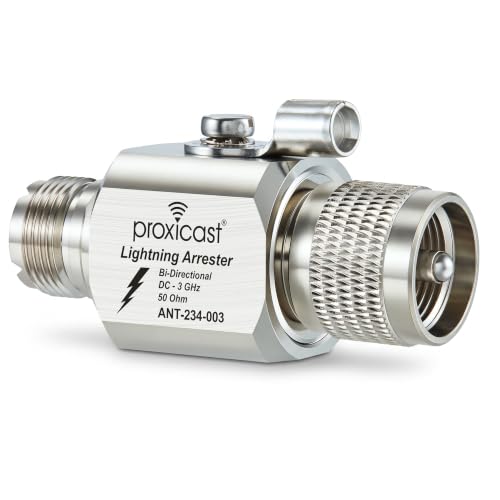
Proxicast ProGrade coaxial lightning arrester, PL-259 / SO-239
A sensible gas discharge arrester for a 100 W HF or VHF feedline. One per coax run.
Check priceUnder $25
PolyPhaser
PolyPhaser IS-50NX coaxial protector
The reference-grade arrester, specified at commercial sites. Worth it when the station behind it is worth four figures.
Sold by PolyPhaser, through dealers, not Amazon. The link searches the category.

Maxwel
Self-amalgamating rubber splicing tape
Self-fusing tape for the outdoor connectors. Water in a connector defeats every other part of the system.
Check priceUnder $25
The full HF base station build prices this whole system as part of the build rather than as an afterthought, which is the right way to think about it: grounding is roughly five percent of a station budget and it protects the other ninety-five.
Common questions
Questions people ask about this
Can I just drive a ground rod at my antenna and connect the coax shield to it?
Not on its own. An electrode at the antenna that is not bonded back to the building electrical service ground creates a difference in potential during a strike, and the only path between the two grounds runs through your coax and your radio. The bonding conductor between the two electrodes is the part that makes the rod useful, and the National Electrical Code requires it for exactly this reason.
Will a lightning arrester save my radio from a direct strike?
No. An arrester clamps the surge to a few hundred volts and diverts the bulk of the energy to the entry panel ground, which protects the structure and the people inside. Several hundred volts is still far more than a receiver front end tolerates. Arresters are a building protection system that also improves equipment odds. Physically disconnecting feedlines is what actually saves radios.
Does grounding improve my signal or lower my SWR?
Almost never, and if it appears to, something else is wrong. A change in SWR when you add or touch a ground wire is a symptom of common-mode current on the outside of the coax braid, and the fix is a choke at the feedpoint. Safety grounding and RF grounding are separate systems that happen to share a bus bar in the shack.
How thick does the bonding conductor need to be?
The code minimum for bonding an antenna discharge unit is 6 AWG copper, and heavier is better. More important than gauge is the path: as short and as straight as possible, with gentle sweeping bends rather than right angles. A surge has a very fast rise time, so the inductance of the run dominates over its resistance, and flat braid outperforms round wire of the same cross section.
What about a station in an apartment with no access to ground?
You cannot build a code-compliant entry panel without access to the outside of the building, so the strategy changes to reducing what is exposed. Run low power, use an indoor or balcony antenna that comes down easily, bond all equipment chassis together so nothing floats relative to anything else, and disconnect everything at the first sign of weather. Practical options are covered in the [apartment and HOA antennas guide](/guides/apartment-and-hoa-antennas/).
Keep going
Related on this site
- Common mode current and RF in the shack The problem people mistake for a grounding problem.
- Balun and choke selection Pick the core and turn count for your band range.
- Full HF base station build Grounding priced as part of the build, not an extra.
- Antenna and mast safety The hazards that come before the antenna is even up.
Disclaimer Researched guidance for planning purposes, not professional engineering, electrical or legal advice. Antenna work, RF exposure, mast and tower work, grounding and battery handling all carry real risk that depends on your specific site and installation. Verify anything safety-critical against current FCC rules, the National Electrical Code and the manufacturer's own documentation, and hire a professional where the job calls for one. We research equipment from published specifications, regulatory documents and verified owner reviews rather than claiming hands-on testing we have not done.