Best Mobile Ham Radios: 4 Picks From Under $250 to Under $500
A mobile radio is the biggest jump in capability a Technician can buy, and it costs less than a premium handheld. Here is which one, and what the install actually involves.
The short answer
The Yaesu FTM-150R ASP at under $500 is the best mobile ham radio for most operators, giving 55 W on 2 m and 50 W on 70 cm with C4FM digital, built-in APRS and a detachable head. On a tight budget the AnyTone AT-778UV at under $250 delivers 25 W dual band with a front panel that needs no menu diving.
- Budget range
- Under $250 to under $500
- Power
- 25 to 85 W
- TX current at 50 W
- ~11 A
- License needed
- Technician
Ask an experienced operator what a newly licensed Technician should buy after the handheld, and the answer is almost always a mobile radio and a real antenna. Fifty watts into a roof-mounted whip is around 10 dB over a handheld with a rubber duck, and it costs less than a premium handheld does. Our pick is the Yaesu FTM-150R ASP(under $500), because it is the version of this purchase that does not need a second purchase later.
What a mobile radio buys you over a handheld
Three things, and only the first is about the radio itself.
Power. Five watts to 50 W is 10 dB, a full two S units on the receiving end. On a marginal repeater that is the difference between being asked to repeat and being copied first time.
An antenna with a ground plane. A quarter-wave or gain whip mounted on a steel roof has a metal ground plane under it, which is what makes the pattern work. A handheld antenna has your hand and your body, which is why the same radio performs differently depending on how you hold it. This is worth more than the power difference in many situations.
A real receiver and a real speaker. Mobile radios are built to be heard over road noise and to work near a running engine. Almost every one fires its speaker at the floor of the car, which is why an AIRITON external communications speaker(under $25) is the cheapest worthwhile addition to any mobile install.
The field, compared
| Radio | Power | Bands | Head | Digital / APRS | Budget |
|---|---|---|---|---|---|
| AnyTone AT-778UV | 25 W | 2 m / 70 cm | Fixed | Neither | Under $250 |
| BTECH UV-25X4 bundle | 25 W | 2 m / 1.25 m / 70 cm | Fixed | Neither | Under $250 |
| Yaesu FT-3185R ASP | 85 W | 2 m only | Fixed | Neither | Under $500 |
| Yaesu FTM-150R ASP | 55 W / 50 W | 2 m / 70 cm | Detachable | C4FM and APRS | Under $500 |
The BTECH UV-25X4 tri-band mobile bundle is worth a second look for a first install specifically because it arrives with a mount, an antenna and a programming cable in one box. Buying those separately costs more than the price difference, and having the right cable on day one is worth something on its own.
Three tiers
Pick by band coverage and where the radio has to fit
Power is the least interesting difference between these radios. The real questions are which bands your local activity uses, whether the body can be hidden, and how much current your install can carry.
A first mobile install on a tight budget
AnyTone
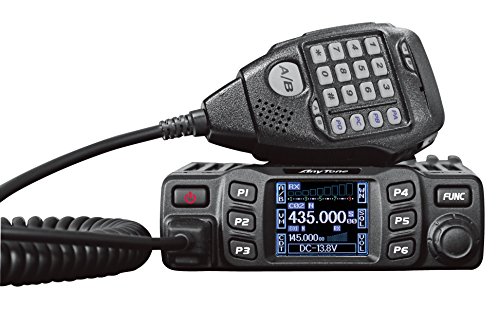
AnyTone AT-778UV
Twenty-five watts dual band with a plain front panel and almost no menu diving, which is rarer than it sounds in this category. It is the cheapest mobile that is genuinely pleasant to operate, and 25 W into a roof antenna is already 7 dB over a handheld.
- Power 25 W
- Bands 2
Tradeoff
No digital, no APRS, no detachable head, and a fixed body that has to live somewhere you can reach. Twenty-five watts against 55 W is 3 dB, which is real but small.
Most operators, and anyone in a Fusion area

Yaesu
Yaesu FTM-150R ASP
Fifty-five watts on 2 m, a detachable head so the body can hide under a seat, C4FM digital that falls back to analog automatically, and APRS built in. It covers every likely use of a mobile radio without a second purchase, which is the definition of the right middle tier.
- Power 55 W
- Head Detachable
Tradeoff
Roughly four times the price of the AnyTone for 3 dB more power and features you may never use. If your area is analog only and your dash has room, that money buys a lot of antenna instead.
Operators who want maximum reach on 2 m and nothing else

Yaesu
Yaesu FT-3185R ASP
Eighty-five watts on a single band, with an oversized front-panel speaker built to be heard in a noisy truck. Single band buys raw power and a simpler installation: one antenna cut for one band, no duplexing compromise, and 2 dB more than a 55 W dual-bander.
- Power 85 W
- Bands 1
Tradeoff
Do not buy this if your local repeaters or your club net live on 70 cm, if you want digital or APRS, or if you need a detachable head. It is a deliberately narrow radio, it draws about 16 A on transmit which rules out any accessory-socket install, and 85 W against 55 W is under 2 dB. A better antenna is a cheaper way to find that.
The install is most of the job
A mobile radio bought without planning the install is a radio in a box. Four decisions, in the order they matter.
Power. Run fused wire directly to the battery terminals, with a fuse in both the positive and the negative conductor near the battery. Do not use an accessory socket for anything above about 25 W: the socket circuit is usually fused at 10 to 15 A and wired with conductors sized for a phone charger, and voltage sag on transmit is what makes a radio reset mid-sentence. Standardizing the DC end on 30 A quick-disconnect power connectors, 40-piece(under $25) housings means every radio, supply and battery in your life connects to every other one.
| Equipment | Receive | Transmit | Accessory socket safe? |
|---|---|---|---|
| Handheld in a charging cradle | 0.1 A | 0.5 A | Yes |
| 25 W dual-band mobile | 0.8 A | 6 A | Marginal, direct wiring is better |
| 50 W dual-band mobile | 1.0 A | 11 A | No |
| 85 W single-band mobile | 1.0 A | 16 A | No |
| 100 W HF mobile | 1.0 A | 22 A | No |
Antenna and mount. Roof centre is best, trunk lip is a good compromise, and a mirror or hood mount is a last resort. A Comet SBB-5NMO dual-band mobile antenna(under $100) is a 3 dBi dual-band NMO whip rated 200 W PEP; a Laird 450-470 MHz unity-gain NMO whip(under $25) is a plain quarter-wave that is nearly indestructible and unity gain, which is the better choice on a truck that visits car washes. If drilling is out of the question, a Tram 1241 NMO magnet mount with coax(under $50) is a solid brass magnet mount with 17 ft of coax already attached.
Noise. Vehicle electrical noise is the most common complaint after an install and the least discussed before one. Ignition noise, fuel pump whine and alternator hash all get in through the DC line and through the antenna. Routing DC away from the engine harness fixes most of it, and ferrite on the DC leads fixes much of the rest.
Programming. Mobile radios take different cables from handhelds. A USB programming cable for Kenwood TM-V71 and TM-D710(under $25) covers the Kenwood mini-DIN family; the BTECH bundle includes its own.
Using a mobile radio as a home base station
This is the cheapest capable VHF and UHF base station there is, and it is what many operators quietly run. You need three things beyond the radio: a 30 A power supply such as a Powerwerx SS-30DV desktop power supply(under $250), an outdoor antenna such as a Diamond X50A dual-band base antenna(under $250) on a Skywalker J-pipe antenna mount, 38 in(under $50), and enough low-loss coax to reach it.
Feedline choice matters far more at 146 MHz than on HF. Fifty feet of RG-58 throws away about 3.2 dB at 146 MHz, which is half your power, while the same length of 240-series loses about 1.6 dB and LMR-400 about 0.8 dB. Run the numbers for your own installation on the coax loss calculator, and see the coax comparison for the sizing argument.
How we chose these radios
We research equipment from published manufacturer specifications, FCC regulatory documents, and verified owner reviews read at volume. We did not install or test these radios in person and we make no hands-on claims. Current draw figures are nominal manufacturer figures at 13.8 V and rise as supply voltage falls, which is exactly why undersized wiring causes resets.
We weighted, in order: whether the radio can be installed cleanly in a normal vehicle, which is what a detachable head is really about. Then band coverage against typical local repeater activity. Then front-panel usability, because a mobile radio is operated without looking at it. Then digital and APRS features. Raw power was weighted last, since the entire spread from 25 W to 85 W is about 5 dB and the antenna decision is worth more.
We excluded radios with no current programming software support, sealed bundles with non-replaceable antennas, and any radio marketed primarily for unlicensed services. Prices were researched at time of writing and are set by the retailer at checkout.
Buying tips
- Budget the antenna, mount and coax as part of the radio. An under-$250 radio with an under-$50 mag mount performs better than an under-$500 radio with the antenna still in the box.
- Check your local repeater directory for band coverage before choosing single band. An 85 W 2 m radio is excellent value and useless for a 70 cm net.
- Measure the dash before you buy a fixed-body radio. A detachable head solves a problem that has no other solution in a modern vehicle interior.
- Fuse both conductors at the battery. Fusing only the positive lead is the most common install error and it is the one that starts fires.
- Add an external speaker. Twelve dollars, and it fixes the single most common complaint about every mobile radio ever made.
- Verify the installation with a meter. A Surecom SW-102 digital VHF/UHF SWR meter(under $100) is small enough to leave permanently in line, and it catches a crushed coax run or a failing mount before you lose a contact over it.
Common questions
Questions people ask about this
Is there a mobile HF radio on this list?
No. These four are VHF and UHF mobiles for repeaters and simplex, which is what most people installing a radio in a vehicle use. For a mobile HF radio, the Yaesu FT-891 is the usual pick: 100 W, a detachable head and a mobile-sized body, reviewed separately. The IC-7100 and FT-991A also cover HF but are larger installs.
What is the best mobile ham radio antenna?
For dual-band VHF and UHF, a quarter-wave or 5/8-wave whip on an NMO mount in the roof centre outperforms any magnet mount on the trunk, because the roof is the ground plane. A mag mount is the right answer for a leased or shared car. The mobile antennas and mounts roundup compares the options, and the installation guide covers routing and grounding.
Is a mobile radio worth it if I already have a handheld?
It is the largest single upgrade available to a Technician, and it usually costs less than a premium handheld. Moving from 5 W into a rubber duck to 50 W into a roof-mounted antenna is roughly 10 to 13 dB once gain and ground plane are counted, which is the difference between a scratchy repeater and a clean one. The radio is only part of it: the antenna, the mount and the coax are what deliver the gain.
Can I use a mobile radio as a base station at home?
Yes, and many operators do. A mobile radio plus a 30 A power supply and an outdoor vertical is a complete and capable VHF and UHF base station for a fraction of the cost of a dedicated base radio. The compromises are a small front-panel speaker, a display designed to be read in daylight through a windshield, and no built-in mains supply. None of those stop it working.
How many amps does a mobile radio draw, and can I run it from the cigarette lighter?
A 25 W dual-band mobile draws about 6 A on transmit, a 50 W radio about 11 A, and an 85 W single-band radio about 16 A. Only the smallest of those is safe on an accessory socket, which is typically fused at 10 to 15 A and wired with thin conductors. The correct installation runs fused wire directly to the battery terminals, which is also what stops the radio resetting on transmit peaks.
Do I need a dual-band radio or is single band enough?
Dual band covering 2 m and 70 cm is the default because most repeater systems use both and the cost difference is small. Single band buys you raw power for the same money: an 85 W 2 m radio costs less than a 50 W dual-bander and reaches further on the band where most nets and emergency traffic live. Choose single band only if you have checked that your local activity is on 2 m.
Magnet mount or drilled NMO mount?
A drilled NMO mount on the roof centre is measurably better, because the roof provides a full ground plane and the connection is a proper one. A magnet mount is capacitively coupled to the roof and typically gives up a fraction of an S unit, plus it can scratch paint and it comes off in a car wash. That said, a magnet mount on the roof beats any handheld antenna used inside the car by a wide margin, because the body is a shield.
What is APRS and do I need a radio that supports it?
APRS is a packet data network on 144.390 MHz in the United States that carries position reports, short messages and weather data through a nationwide network of digipeaters and internet gateways. A radio with built-in APRS, like the Yaesu FTM-150R, beacons your position with no extra hardware. It is genuinely useful for public service events and travel, and completely optional otherwise.
Keep going
Related on this site
- Yaesu FT-891 review The mobile HF radio, if HF from the car is the goal.
- Yaesu FTM-150R review The plain analogue mobile, and the install costs the price does not include.
- Mobile radio installation Power, grounding, antenna placement and noise, in order.
- Best mobile antennas and mounts Where most of the performance actually comes from.
- Handheld versus mobile versus base The honest three-way comparison.
- Best power supplies What a mobile radio needs to work on a desk.
- How to use a repeater Offsets, tones and etiquette.
- VHF range calculator What antenna height buys you in miles.
Disclaimer Researched guidance for planning purposes, not professional engineering, electrical or legal advice. Antenna work, RF exposure, mast and tower work, grounding and battery handling all carry real risk that depends on your specific site and installation. Verify anything safety-critical against current FCC rules, the National Electrical Code and the manufacturer's own documentation, and hire a professional where the job calls for one. We research equipment from published specifications, regulatory documents and verified owner reviews rather than claiming hands-on testing we have not done.