Mobile radio installation: power, mounting and antennas
Power straight from the battery, antenna in the middle of the roof, and nothing in front of an airbag.
The short answer
Run the power lead directly to the battery with fuses in both conductors within a few inches of the terminals, never to the cigarette lighter socket. Mount the antenna as close to the centre of the roof as possible, since a roof-centre NMO mount outperforms every other position, and keep all equipment out of airbag deployment paths.
- Power source
- Battery direct
- Fuse position
- Both leads, at battery
- 50 W radio draw
- About 11 A
- Best antenna position
- Roof centre
- Mount standard
- NMO
- Never mount near
- Airbag paths
A mobile installation is the most used station many operators own, because it gets switched on every day rather than on a free evening. It is also the installation with the most ways to create a problem: alternator noise, a radio that resets on transmit, an antenna that will not tune, and in the worst case a piece of equipment in the path of an airbag.
None of it is difficult. The rules are short and the consequences of ignoring them are specific.
Power, and why the cigarette socket is wrong
An accessory socket is typically fused at 10 to 15 A through thin wiring with a poor contact. A 50 W VHF radio draws around 11 A on transmit and a 100 W HF radio over 20 A. The socket either blows, or it drops enough voltage that the radio misbehaves in ways that look like a radio fault.
- Run the supplied power lead directly to the battery terminals, positive to positive and negative to negative.
- Fit fuses in both conductors within a few inches of the battery. Radios ship with fuse holders in both leads for exactly this reason, and moving them to the battery end is the correct practice.
- Pass the cable through an existing grommet in the bulkhead. Never through a hole you cut without fitting a grommet, because the edge will chafe through the insulation eventually.
- Keep the run away from moving parts, hot components and the steering column.
- Do not connect the negative to the chassis instead of the battery. Modern vehicles have battery monitoring on the negative lead and bypassing it confuses the charging system.
- Use a Powerwerx PD-5F fused distribution block style distribution point if you are powering more than one device, so each gets its own fuse.
Where to put the antenna
The vehicle body is the ground plane, and the antenna wants as much metal around it in every direction as possible. The centre of the roof is the best position by a large margin, and every other position is a compromise for the sake of a car park height barrier or a lease agreement.
Mount positions
Antenna position and what it costs you
| Position | Pattern | Practicality | Verdict |
|---|---|---|---|
| Roof centre, NMO | Even in all directions | Requires drilling | Best, by a clear margin |
| Roof edge or rail | Slightly skewed | Often no drilling | Very good |
| Boot or trunk lip mount | Skewed forward, blocked rearward | No drilling, needs bonding | Good and common |
| Bonnet or fender lip | Skewed rearward | No drilling | Fair |
| Glass mount | Poor, lossy coupling | No drilling at all | Last resort |
| Magnetic mount | Depends on placement | Instant, marks paint | Fine temporarily |
| Hitch or bumper mount | Blocked by the vehicle | Easy, low | Poor for VHF, usable for HF |
For HF the compromises matter less because the antenna is electrically short anyway and the vehicle is a small ground plane at any position. For VHF and UHF the difference between a roof centre mount and a bumper mount is several decibels in most directions.
- An NMO mount is the professional standard, takes a huge range of antennas and seals properly. A Tram 1241 NMO magnet mount with coax or Laird 450-470 MHz unity-gain NMO whip style NMO antenna screws straight onto it.
- A Comet SBB-5NMO dual-band mobile antenna dual-band whip is the usual amateur choice, and a Tram 1465 NMO to UHF ground plane kit or Quad-band mobile antenna, 10 m / 6 m / 2 m / 70 cm covers more bands from the same mount.
- Lip mounts must be bonded properly. Paint is an insulator, and a lip mount clamped over paint has a poor RF connection to the body, which is the most common reason a mobile antenna will not tune.
- For HF mobile, a Gabil GRA-1899T portable HF antenna tapped whip or a screwdriver antenna is the practical answer, and both live or die by the quality of the body bond.
Bonding the vehicle
A modern vehicle is not one piece of metal. Panels are bonded to each other through spot welds, adhesives and hinges, and at RF those joints can be poor. The result is a body that behaves as several separate ground planes, which produces high SWR, a pattern that changes when the boot is opened, and alternator noise.
- Bond the exhaust system to the chassis at both ends with braid. This is the single most effective noise reduction on many vehicles.
- Bond the bonnet and the boot lid to the body with short braid straps across the hinges.
- Bond the engine to the chassis if it is only connected through the main earth strap.
- Use flat Tinned copper ground strap braid, 15 ft rather than round wire, because inductance dominates at RF and flat braid has less of it.
- Scrape to bare metal at every bond point and protect the joint afterwards.
- Bond the antenna mount to the body if it is a lip mount, with a short strap to a bolt that reaches bare metal.
Noise in a vehicle
- Alternator whine
- A tone that rises and falls with engine speed. Usually a bonding problem or a power lead routed alongside vehicle wiring. Bond first, then reroute, then filter.
- Ignition noise
- A rasp in time with engine speed, worse on HF. Modern vehicles are generally good, and where it appears it is often a failing plug lead or coil pack.
- Fuel pump and injector noise
- A steady buzz present with ignition on. Ferrites on the radio power lead help, and the real fix is a clean power run from the battery.
- Electric power steering and hybrid systems
- Increasingly the dominant noise source, and often very difficult to address. Antenna position away from the affected area helps more than filtering.
- Display and charging noise
- A phone charger in a socket is a common culprit and easily tested by unplugging it.
- What to do about all of it
- Bond the vehicle, run the power from the battery, keep the coax and power leads on opposite sides of the vehicle, and fit Palomar Engineers feedline common-mode chokenot on amazon ferrites on the power lead close to the radio.
Safety in a vehicle
- Mount the head unit where it can be operated without taking your eyes off the road, or do not operate it while moving.
- Secure everything. A radio body under a seat needs a bracket, not gravity.
- Route cables so they cannot foul the pedals.
- Use a speaker microphone or a hands-free arrangement, and check the law in your jurisdiction. Amateur radio is often treated differently from a mobile phone, and often is not.
- An external AIRITON external communications speaker improves intelligibility enormously over a radio speaker facing the floor, which is a safety improvement as much as a comfort one.
What to buy
A mobile installation
Radio, mount, antenna, and the bonding and speaker that make it usable.

Yaesu
Yaesu FTM-150R ASP
A 50 W dual-band mobile with a detachable head and a clear display. The default modern mobile radio.
Check priceUnder $500
AnyTone
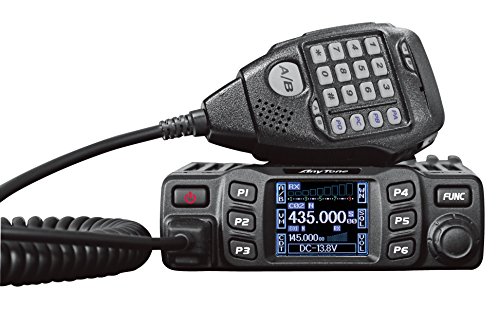
AnyTone AT-778UV
A compact 25 W dual-band mobile that fits where a full size radio will not.
Check priceUnder $250
Comet
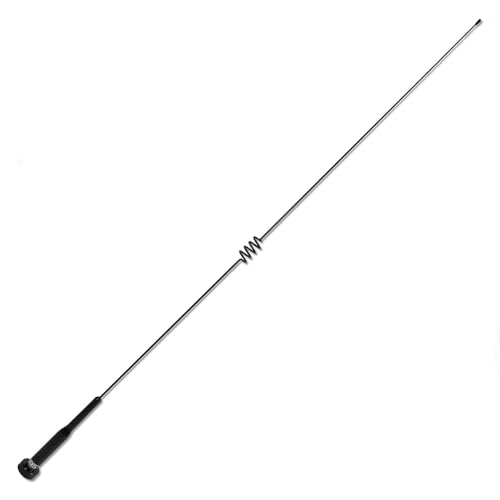
Comet SBB-5NMO dual-band mobile antenna
A dual-band NMO whip with real gain on 70 cm. The standard amateur mobile antenna.
Check priceUnder $100

Tram
Tram 1241 NMO magnet mount with coax
An NMO mount and antenna combination built to the commercial standard, which is what NMO is for.
Check priceUnder $50
Gabil
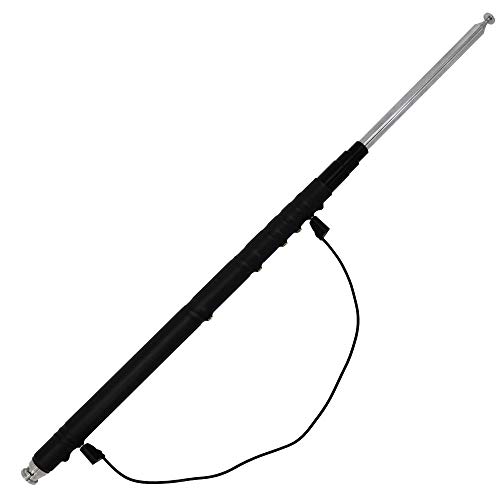
Gabil GRA-1899T portable HF antenna
A tapped HF whip for mobile operation, where band changes are a clip rather than a tool.
Check priceUnder $100

BuyUneed
Tinned copper ground strap braid, 15 ft
Bonding braid for the exhaust, bonnet and boot. The most effective noise fix in most vehicles.
Check priceUnder $25

AIRITON
AIRITON external communications speaker
An external speaker aimed at your ear rather than at the floor. A genuine safety improvement in a noisy cabin.
Check priceUnder $25
Palomar Engineers
Palomar Engineers feedline common-mode choke
Clip-on ferrites for the power lead, which handles most of what bonding does not.
Sold by Palomar Engineers, not Amazon. The link searches the category.
Common questions
Questions people ask about this
Can I power a mobile radio from the cigarette lighter?
Not for anything above about 25 W. An accessory socket is typically fused at 10 to 15 A through thin wiring with a poor contact, and a 50 W radio drawing 11 A on transmit either blows the fuse or drops enough voltage to make the radio misbehave. Run the power lead directly to the battery with fuses in both conductors near the terminals.
Where is the best place to mount a mobile antenna?
The centre of the roof, by a clear margin, because the vehicle body is the ground plane and a centre mount has metal in every direction. A roof edge or rail is nearly as good. Lip mounts on the boot are common and workable provided the mount is properly bonded to bare metal rather than clamped over paint, which is the usual reason one will not tune.
Why does my mobile antenna have high SWR?
Almost always the ground connection rather than the antenna. A lip mount clamped over paint makes a poor RF connection to the body, and the vehicle body itself may be several separate ground planes if the panels are not bonded. Scrape to bare metal at the mount, bond the boot lid and bonnet across their hinges with braid, then retune.
Do I need to bond my vehicle for a mobile installation?
For VHF and UHF at modest power you often get away without it. For HF mobile it is essential, and for noise reduction it is the single most effective step on most vehicles. Bond the exhaust to the chassis at both ends, bond the bonnet and boot lid across their hinges, and use flat braid rather than round wire because inductance dominates at RF.
Is it safe to mount a radio on the dashboard?
Only outside the deployment path of any airbag, and that path is considerably larger than the visible panel. Anything in that space becomes a projectile during deployment. Check the vehicle manual for the deployment zones rather than estimating, secure every component with a bracket rather than relying on friction, and route cables where they cannot foul the pedals.
Keep going
Related on this site
- Yaesu FT-991A review The all-band radio people try to fit in a vehicle, and why the FT-891 is easier.
- Best mobile ham radios What to put in the vehicle.
- Best mobile antennas and mounts NMO, lip and mag mounts compared.
- Handheld versus mobile versus base What each format is actually for.
- RF exposure evaluation A mobile antenna is close to people by definition.
Disclaimer Researched guidance for planning purposes, not professional engineering, electrical or legal advice. Antenna work, RF exposure, mast and tower work, grounding and battery handling all carry real risk that depends on your specific site and installation. Verify anything safety-critical against current FCC rules, the National Electrical Code and the manufacturer's own documentation, and hire a professional where the job calls for one. We research equipment from published specifications, regulatory documents and verified owner reviews rather than claiming hands-on testing we have not done.