Best mobile antennas and mounts
On a car the mount is the antenna. The whip is the easy part.
The short answer
Centre of the roof is the best position on any vehicle, because the roof is the ground plane and the middle gives the most symmetrical one. A permanent NMO mount there outperforms a magnetic mount on the boot lid by a wide margin, and the difference is the ground plane rather than the whip.
- Best position
- Centre of roof
- Best mount
- Permanent NMO
- Ground plane
- The vehicle body
- Mag mount cost
- Real but usable
- Avoid
- Glass mount on HF
- Check
- Height clearance
A mobile antenna is half an antenna. The other half is the vehicle, and that is not a figure of speech: a quarter wave whip needs a ground plane to work against, and on a car the body panel it is mounted to is that ground plane. Which is why where you mount it changes performance more than which whip you buy.
This is the opposite of the usual advice pattern, where the product matters and the installation is detail. Here the installation is most of it. A cheap whip in the centre of the roof will beat an expensive one on a boot-lip mount, consistently, on both transmit and receive.
Everything here is researched from published specifications and verified owner reports rather than from testing we have not done.
Mount positions, ranked honestly
Mount position against performance
| Position | Ground plane | Verdict |
|---|---|---|
| Centre of roof | Excellent, symmetrical | The best there is. Drilling required. |
| Roof, off centre | Good | Slightly skewed pattern, still very good |
| Boot or trunk lid | Poor, hinged panel | Common and compromised. Pattern is skewed and the hinge is a poor ground. |
| Boot lip clip mount | Poor | Convenient, no drilling, noticeably worse |
| Magnetic on roof | Good, capacitive | Surprisingly decent. The mag couples to the roof well. |
| Glass mount | None at all | Avoid for HF. Marginal even on VHF. |
| Bumper or hitch | Very poor for VHF | Only sensible for large HF antennas |
Notice that a magnetic mount on the roof beats a permanent mount on the boot lid. Position matters more than permanence.
What the mount actually has to do
- Provide a low-impedance RF ground connection to the vehicle body. A painted surface, a hinge, or a rusty panel all compromise this.
- Keep water out, permanently, on a surface that flexes and gets pressure-washed.
- Hold the antenna at highway speed, including the wind loading of a long HF whip, which is considerable.
- Not become a hazard. Check your total height against garages, drive-through canopies and car park barriers before you drive off. People take antennas off on garage doors regularly.
Three tiers
Three, by band and by whether you will drill
The mount decision comes first; the whip follows from it.
A dual-band mobile with a permanent roof mount
Comet
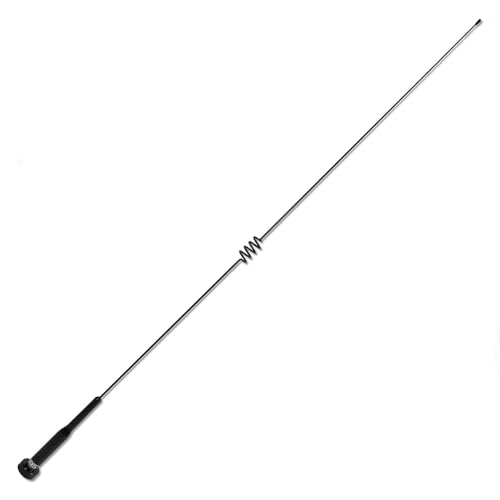
Comet SBB-5NMO dual-band mobile antenna
The straightforward right answer for a dual-band mobile installation, on the mount standard that commercial installers use. Good gain for its length and it survives highway speeds.
- Bands VHF / UHF
- Mount NMO
Tradeoff
NMO means drilling a hole in your roof, which is the correct decision and still the one people avoid.
HF from a vehicle or a small lot without a radial field
Comet
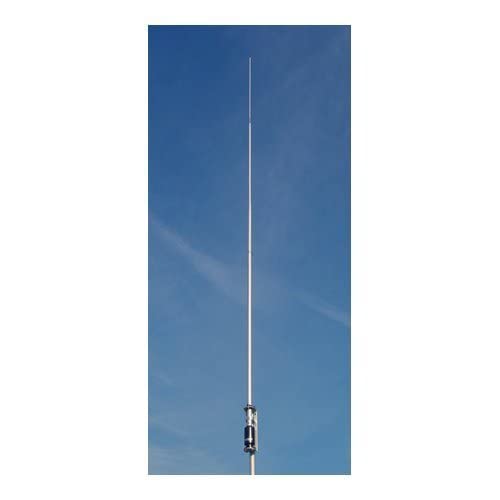
Comet CHA-250B broadband vertical
A broadband vertical that covers a wide HF range without a tuner or radials, which is what makes HF practical where a conventional vertical is not. Compromise antennas earn their place when the alternative is no antenna.
- Bands Wide HF
- Radials Not required
Tradeoff
Broadband efficiency is lower than a resonant antenna. You are trading decibels for the ability to install it at all.
Anyone mounting to a mast, a rail or a structure rather than a body panel
Skywalker
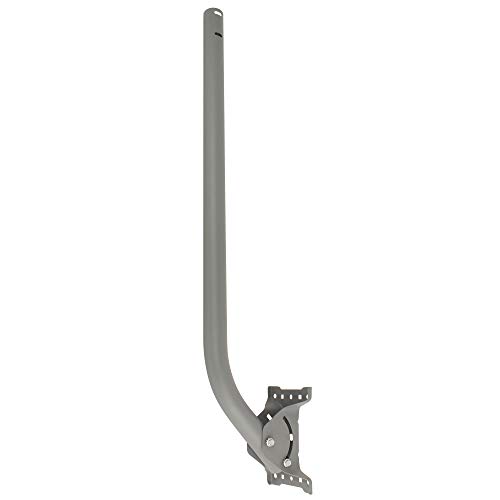
Skywalker J-pipe antenna mount, 38 in
The bracket is the part people forget to budget for, and a bad one is how antennas end up on the ground. Cheap relative to the antenna it holds.
- Type J-mount bracket
Tradeoff
It is hardware, not an antenna. Ground plane still has to come from somewhere.
HF from a vehicle, honestly
Mobile HF works and it is a genuine compromise. A quarter wave on 20 metres is over 16 ft, which no vehicle carries, so every mobile HF antenna is electrically shortened and loses efficiency doing it. The lower the band, the worse the compromise: 40 metres mobile is hard and 80 metres mobile is very hard.
What makes it work anyway is that you are usually parked or moving slowly through varied terrain, and a mobile station that is on the air beats a base station that is not. Bond the vehicle body properly, because on HF a poor ground connection costs more than the antenna choice does.
Common questions
Questions people ask about this
Where is the best place to mount a mobile antenna?
Centre of the roof, without much argument. The roof is your ground plane and the centre gives the most symmetrical one, which produces the most even pattern in every direction. Every other position is a compromise you are accepting for convenience or to avoid drilling.
Are magnetic mounts any good?
Better than their reputation suggests, if you put them on the roof. The magnet couples capacitively to the body and gives a usable ground plane. A mag mount on the centre of the roof beats a permanent mount on the boot lid. The real drawbacks are paint damage over time and the risk of it letting go at speed.
Do I really need to drill a hole in my car?
Not strictly, but NMO through-hole is the best-performing and most durable option and it is what commercial installers fit. If you will not drill, a magnetic mount on the roof is the next best thing and it is genuinely acceptable. A boot-lip clip mount is the convenient option and the weakest of the three.
Can I work HF from my car?
Yes, with a compromise antenna and reduced expectations, especially on the lower bands. Every mobile HF antenna is electrically shortened and loses efficiency because of it. Bonding the vehicle body well matters more than which antenna you choose, and mobile HF is a real and popular activity despite all of that.
Will a mobile antenna damage my car?
A properly installed NMO mount will not, and it is weatherproof by design. Magnetic mounts can mark paint, particularly if grit gets underneath and the antenna is left on permanently. The genuine risk to your vehicle is forgetting the antenna is there and driving into a garage.
Keep going
Related on this site
Disclaimer Researched guidance for planning purposes, not professional engineering, electrical or legal advice. Antenna work, RF exposure, mast and tower work, grounding and battery handling all carry real risk that depends on your specific site and installation. Verify anything safety-critical against current FCC rules, the National Electrical Code and the manufacturer's own documentation, and hire a professional where the job calls for one. We research equipment from published specifications, regulatory documents and verified owner reviews rather than claiming hands-on testing we have not done.