RG-8X versus RG-213 versus LMR-400
On HF, almost anything works. On VHF, the cable choice is worth more than the radio choice.
The short answer
RG-8X is thin, flexible and fine for HF runs under 100 ft. RG-213 is the general purpose choice for HF and short VHF runs. LMR-400 has roughly half the loss of RG-213 at VHF and is the correct choice for any run above about 50 ft at 144 MHz or higher. On HF below 30 MHz the differences between all three are small.
- RG-8X at 7 MHz
- 0.9 dB per 100 ft
- RG-213 at 7 MHz
- 0.6 dB per 100 ft
- LMR-400 at 7 MHz
- 0.4 dB per 100 ft
- RG-8X at 144 MHz
- 4.5 dB per 100 ft
- RG-213 at 144 MHz
- 2.8 dB per 100 ft
- LMR-400 at 144 MHz
- 1.5 dB per 100 ft
Coax is the least interesting purchase in a station and one of the most consequential. On HF the choice barely matters and people agonise over it. On VHF and UHF it matters enormously and people buy whatever is on the shelf. The pattern is worth inverting.
The reason is that cable loss rises with frequency. A cable that throws away half a decibel on 40 metres throws away four and a half at 144 MHz, and at that point you are losing most of your transmitted power and, more importantly, most of what you could have heard.
The numbers
Loss comparison
Matched loss in dB per 100 ft by frequency
| Cable | 3.5 MHz | 14 MHz | 50 MHz | 144 MHz | 440 MHz |
|---|---|---|---|---|---|
| RG-58 | 0.9 | 1.9 | 3.8 | 6.6 | 12.8 |
| RG-8X | 0.6 | 1.3 | 2.5 | 4.5 | 8.6 |
| RG-213 | 0.4 | 0.8 | 1.6 | 2.8 | 5.2 |
| LMR-240 | 0.5 | 1.0 | 2.0 | 3.5 | 6.3 |
| LMR-400 | 0.3 | 0.5 | 1.0 | 1.5 | 2.7 |
| Hardline, 1/2 in | 0.15 | 0.3 | 0.6 | 1.0 | 1.8 |
Figures are typical for good quality cable at 20 degrees Celsius. Cheap cable with a partial braid or a copper-clad steel centre performs worse than the specification. The coax loss calculator computes loss for any length and frequency, including the additional loss from a mismatch.
The three cables in practice
- RG-8X, about 0.24 in diameter
- Thin, light, genuinely flexible, and easy to route around a house or coil into a field bag. Loss is acceptable on HF for runs under about 100 ft, and it handles 100 W comfortably. It is the right cable for a portable kit, for a short jumper, and for an HF wire antenna in a small garden. It is the wrong cable for a long VHF run. A JEFA Tech 240-series flex coax, 50 ft with PL-259 class cable is the field version of this idea.
- RG-213, about 0.40 in diameter
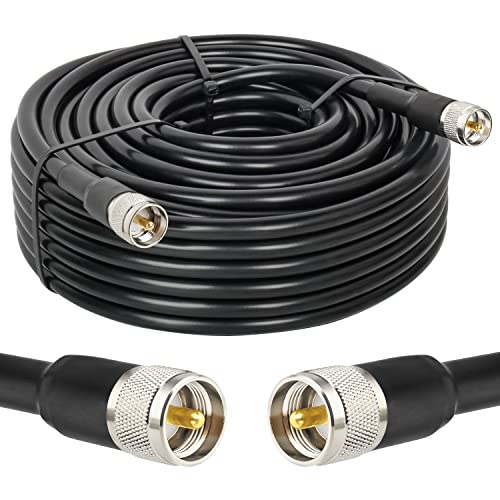
- The general purpose standard. Roughly half the loss of RG-8X, handles high power, and takes a standard PL-259 with no reducer. Stiff enough to be awkward in tight spaces and heavy enough that a long run needs support. A MOOKEERF RG-213 coax, 100 ft with UHF male run is the default answer for an HF base station.
- LMR-400 and equivalents, about 0.40 in diameter
- Same physical size as RG-213 with roughly half the loss again, achieved with a foam dielectric and a foil plus braid shield. The correct choice for VHF and UHF, and for any long HF run where you want to stop thinking about it. Less flexible than RG-213 and unhappy with tight bends, and the foam dielectric is intolerant of a hot soldering iron.
Choosing by application
Selection
What to buy for each job
| Job | Cable | Reason |
|---|---|---|
| HF wire antenna, 50 ft run | RG-8X or RG-213 | Loss under 0.5 dB either way |
| HF wire antenna, 150 ft run | RG-213 or LMR-400 | Length starts to matter |
| HF with an amplifier | RG-213 or LMR-400 | Power handling and voltage rating |
| VHF or UHF vertical, 50 ft | LMR-400 | Loss dominates the whole installation |
| VHF or UHF vertical, 100 ft plus | LMR-400 or hardline | Anything less throws away the antenna |
| Portable field kit, 25 ft | RG-8X or LMR-240 | Weight and flexibility win |
| Short jumper inside the shack | RG-8X | Flexibility, loss is negligible |
| Buried or duct run | Flooded or direct burial rated | Ordinary jacket fails underground |
A useful rule: on HF spend the money on the antenna, on VHF spend it on the cable. The crossover is around 50 MHz.
Things that ruin any cable
- Water ingress at a connector. Water wicks along the braid and raises loss along the whole run. This is the single most common cause of a cable that used to be fine. Weatherproof properly with Self-amalgamating rubber splicing tape.
- Tight bends. Every cable has a minimum bend radius, usually around ten times its diameter for repeated bends. A kink permanently deforms the dielectric and changes the impedance at that point.
- UV degradation. A non-UV-rated jacket cracks in a few years of sunlight and lets water in. Use UV-rated cable outdoors and support it with UV-resistant heavy duty zip ties, 100-pack rather than ordinary ones.
- Cheap cable with a partial braid. Coverage below about 95 percent leaks signal and lets noise in. A copper-clad steel centre conductor is fine at VHF and poor at HF.
- Crushing. A cable run under a door or through a window frame gets flattened, and flattened cable is not 50 ohms any more.
- A badly soldered connector. See how to install PL-259 connectors.
What to buy
Cable and connectors
Buy the run in one piece where you can. Every joint is a place for water to get in.

Bolton Technical
Bolton400 low-loss coax, 100 ft with PL-259
LMR-400 equivalent with connectors fitted. The correct cable for any VHF or UHF run and for a long HF one.
Check priceUnder $250
MOOKEERF
MOOKEERF RG-213 coax, 100 ft with UHF male
RG-213 in a 100 ft length, the general purpose HF standard with high power handling.
Check priceUnder $250

JEFA Tech
JEFA Tech 240-series flex coax, 50 ft with PL-259
A lighter, more flexible cable for portable kits and short runs where weight matters more than the last tenth of a decibel.
Check priceUnder $50

Rydocyee
Rydocyee RG-58 coax jumper, 25 ft
Short RG-58 jumpers for inside the shack, where flexibility matters and length does not.
Check priceUnder $25

Fanbalunke
PL-259 solder connectors with reducers, 6-pack
Connectors with reducers, because the connector is what usually fails rather than the cable.
Check priceUnder $25

exgoofit
SO-239 barrel couplers, 6-pack
Barrels for joining runs and for splitting a cable in half during fault finding.
Check priceUnder $25

Maxwel
Self-amalgamating rubber splicing tape
Self-fusing tape. Water at a connector destroys the whole run, not just the joint.
Check priceUnder $25

Bonison
UV-resistant heavy duty zip ties, 100-pack
UV-rated ties for dressing an outdoor run. Ordinary ties fail in a year and drop the cable.
Check priceUnder $25
Common questions
Questions people ask about this
Does coax type matter much on HF?
Less than people think. At 14 MHz, 100 ft of RG-8X loses 1.3 dB and the same length of LMR-400 loses 0.5 dB, a difference of under one S unit. For a typical wire antenna run under 100 ft, any decent 50 ohm cable is fine. The money is better spent on getting the antenna higher, which is worth several times as much.
Which coax should I use for a 2 metre antenna?
LMR-400 or equivalent for anything above about 50 ft, without hesitation. At 144 MHz, RG-58 loses 6.6 dB per 100 ft and LMR-400 loses 1.5 dB, so the cable choice is worth five decibels each way. That is more than any realistic antenna or radio upgrade, and it costs both your transmitted signal and everything you could have received.
Is expensive coax worth it?
It depends entirely on frequency and length. Below 30 MHz on a short run, no. Above 50 MHz on a long run, it is the most cost effective improvement available. What is always worth paying for is genuine specification: a full copper braid with at least 95 percent coverage, a solid copper centre conductor, and a UV-rated jacket for outdoor use.
Can I join two lengths of coax together?
Yes, with a barrel connector, and the loss of a good joint is negligible. The real risk is water. Every joint outdoors is a potential ingress point, and water inside coax wicks along the braid and ruins the whole run. Where a joint is unavoidable outdoors, weatherproof it thoroughly and site it so water drains away rather than pooling.
How do I know if my coax has gone bad?
Measure it. Put a known good dummy load on the far end and check the loss against the specification with an analyser, or compare the SWR reading at both ends. Cable that has taken water shows higher loss than it should, and a run whose loss is unusually high while the SWR looks suspiciously good is the classic signature of a cable that is quietly absorbing your signal.
Keep going
Related on this site
Disclaimer Researched guidance for planning purposes, not professional engineering, electrical or legal advice. Antenna work, RF exposure, mast and tower work, grounding and battery handling all carry real risk that depends on your specific site and installation. Verify anything safety-critical against current FCC rules, the National Electrical Code and the manufacturer's own documentation, and hire a professional where the job calls for one. We research equipment from published specifications, regulatory documents and verified owner reviews rather than claiming hands-on testing we have not done.