Best power supplies for ham radio
Size it for the transmit peak, not the average, and buy quiet.
The short answer
A 100 W HF transceiver draws roughly 20 to 22 A on transmit peaks, so buy a 30 A supply at 13.8 V. Sizing to the average draw is the classic mistake: the radio browns out on voice peaks, which shows up as distorted audio reports rather than as an obvious power problem.
- 100 W HF radio
- 30 A supply
- 50 W VHF mobile
- 15 to 20 A
- Handheld charging
- 5 A is plenty
- Voltage
- 13.8 V nominal
- Headroom
- 25 to 30 percent
- Watch for
- Switching noise
A power supply is the least interesting purchase in a station and one of the easiest to get wrong, because the specification that matters is not the one on the front of the box. A radio does not draw its rated current steadily. It draws almost nothing on receive and a great deal in short peaks on transmit, and those peaks are what the supply has to survive without sagging.
The symptom of an undersized supply is not a dead radio. It is distorted audio, low output, and other operators telling you that you sound bad on peaks, which sends people looking at their microphone and their antenna for weeks.
Everything here is researched from published specifications and verified owner reports rather than from testing we have not done. Run your own numbers with the power supply sizing calculator.
Why the transmit peak is the only number that matters
Manufacturers quote a supply two ways: continuous current and peak or intermittent current. A radio on SSB voice is an intermittent load with a high crest factor, so it repeatedly asks for its full draw for a fraction of a second. If the supply can only deliver that as a brief peak rather than continuously, voltage sags on every syllable.
Current draw by radio type, researched from published specifications
| Radio | Receive | Transmit peak | Supply to buy |
|---|---|---|---|
| Handheld charger | under 1 A | 1 to 2 A | 5 A |
| 25 W VHF mobile | 0.5 to 1 A | 7 to 9 A | 12 A |
| 50 W VHF/UHF mobile | 0.8 to 1.5 A | 11 to 13 A | 20 A |
| 100 W HF transceiver | 1.5 to 2.5 A | 20 to 22 A | 30 A |
| 100 W HF plus accessories | 3 to 4 A | 23 to 26 A | 30 to 40 A |
| 500 W amplifier at 12 V | n/a | 60 A and up | Dedicated supply |
Buy the supply in the right hand column. The margin between the transmit peak and the supply rating is what stops the voltage sagging on speech peaks.
Linear or switching
This used to be a real argument and is now mostly settled, with one caveat that matters for HF.
- Switching supplies are light, efficient, cheap and cool. They are the default and almost everyone should buy one.
- The caveat: a switching supply generates RF hash, and a poor one will raise your receive noise floor across HF. A well designed one is quiet. This is where brand reputation genuinely earns its premium.
- Linear supplies are heavy, warm and inherently quiet. If you already own one and it is big enough, keep it.
- If a switching supply is audibly noisy on receive, that is a fault in your station rather than something to live with. Ferrite on the DC leads helps; a better supply helps more.
- Never run a radio from a computer ATX supply. The voltage is wrong and the regulation under an intermittent load is not designed for this.
Three tiers
Three supplies
By what the station actually draws.
A first HF station on a tight budget
TekPower
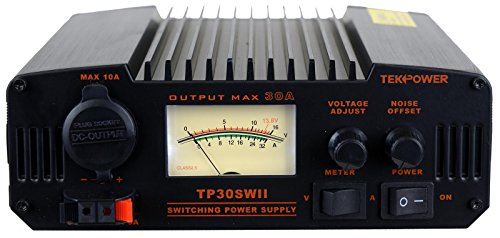
TekPower TP30SWII 30 A switching power supply
A 30 A switching supply with an analogue meter and adjustable voltage at a noticeably lower price than the premium brands. It has the current a 100 W radio needs, which is the specification that matters most.
- Current 30 A
- Outputs Terminals
Tradeoff
Screw terminals rather than Powerpoles, so budget an hour and some connectors. Switching noise is more variable at this price point than with a premium supply.
Almost any 100 W HF station

Powerwerx
Powerwerx SS-30DV desktop power supply
Enough current for a 100 W radio with real headroom, a quiet reputation on HF receive, and Powerpole outputs so the whole station can standardise on one connector.
- Current 30 A
- Outputs Powerpole
Tradeoff
Costs meaningfully more than the budget option for the same headline current figure. What you are buying is the noise performance and the connectors.
Charging handhelds, powering a small QRP rig or a shack accessory bus
Powerwerx
Powerwerx PD-5F fused distribution block
A compact 5 A supply that does not take a desk over. The right answer when what you actually need is to charge radios and run low-draw accessories rather than transmit at 100 W.
- Current 5 A
- Size Compact
Tradeoff
Nowhere near enough for a 100 W radio. Do not try; it will sag badly.
An amplifier changes the sizing entirely. A QRP radio behind the Xiegu GPA100 100 W amplifier draws current like a 100 W transceiver, so the supply that ran the radio alone will not run the pair.
The wiring between supply and radio
A correctly sized supply feeding a radio through undersized DC wire behaves exactly like an undersized supply. The voltage drop happens in the cable instead of the supply, and the symptom is identical.
- Use the gauge the wire gauge and current chart specifies for your current and run length, and treat the total loop length as twice the distance.
- Keep the DC run short. A radio on the desk two feet from its supply has no excuse for a voltage drop.
- Fuse both conductors close to the supply. Most radios fuse the positive lead only, which is not enough in a vehicle installation.
- Powerpole connectors are the de facto amateur standard for a reason: they are polarity safe, genuinely rated for the current, and every other operator uses them.
Common questions
Questions people ask about this
What size power supply do I need for a 100 watt radio?
A 30 A supply at 13.8 V. A typical 100 W HF transceiver draws 20 to 22 A on transmit peaks, and you want meaningful headroom above that so the voltage does not sag on speech peaks. Buying a 20 A supply because the average draw is lower is the most common sizing mistake in this hobby.
Is a switching power supply too noisy for HF?
A good one is not. A poor one genuinely will raise your noise floor across the HF bands, which is why supplies with a reputation for quiet operation cost more than their current rating alone would justify. If yours is noisy, ferrite chokes on the DC leads help, but replacing it helps more, and living with a raised noise floor is not something you should accept.
Can I run my radio from a car battery instead?
Yes, and for portable operating it is the normal approach. A LiFePO4 battery holds its voltage far flatter than lead acid under load, which suits a transmitting radio well. For a home station a mains supply is more convenient, and many operators keep a battery as backup so the station survives an outage.
Does the voltage need to be exactly 13.8 volts?
Close to it. Amateur radios are specified at 13.8 V because that is roughly what a vehicle charging system produces, and most tolerate a range around it. What actually matters is that the voltage stays up under load. A supply sitting at 13.8 V on receive and dropping to 11 V on transmit is the problem, regardless of what the front panel says at idle.
Do I need a bigger supply for an amplifier?
Almost certainly a dedicated one. A 500 W amplifier at 12 V draws upward of 60 A, which is beyond any normal station supply, and many HF amplifiers run from mains voltage directly rather than from 13.8 V for exactly this reason. Check what the specific amplifier requires before buying anything.
Keep going
Related on this site
- Astron RS-35M-AP review The linear option, weighed against a switcher.
- Power supply sizing calculator Total your station current and get a supply size
- Wire gauge and current chart DC wire size by current and run length
- Battery runtime calculator For portable and backup operation
- Full HF base station build Where a 30 A supply fits in a complete station
Disclaimer Researched guidance for planning purposes, not professional engineering, electrical or legal advice. Antenna work, RF exposure, mast and tower work, grounding and battery handling all carry real risk that depends on your specific site and installation. Verify anything safety-critical against current FCC rules, the National Electrical Code and the manufacturer's own documentation, and hire a professional where the job calls for one. We research equipment from published specifications, regulatory documents and verified owner reviews rather than claiming hands-on testing we have not done.