Best Handheld Antennas: The Cheapest Real Upgrade to Any HT
Sixteen dollars buys 2 to 3 dB on transmit and receive, every time you key up. Nothing else you can bolt to a handheld comes close to that return.
The short answer
The Nagoya NA-771C 15-inch whip at under $25 is the best handheld ham radio antenna for most operators, giving roughly 2 to 3 dB over a stock rubber duck on both transmit and receive with an SMA-female fitting that matches Baofeng and BTECH radios. For reaching a distant repeater from high ground, a three-element Arrow II 2 m Yagi delivers around 6 to 7 dBd in one direction.
- Typical gain
- 2 to 3 dB
- Budget range
- Under $25 to under $250
- Common fitting
- SMA-female on radio
- Best length
- 15 to 17 in
The stock antenna supplied with a handheld is the weakest part of the package, on every radio at every price. It is short because the box is small, and short antennas on 2 m are electrically compromised in a way no amount of radio quality compensates for. The fix costs about the same as lunch. Our pick is the Nagoya NA-771C 15-inch whip(under $25).
Why the stock antenna is so bad
A rubber duck is a helically wound antenna, meaning the radiating element is a coil of wire compressed into a few inches of rubber instead of a straight quarter wave. On 2 m a quarter wave is about 19 inches, so a 4 inch stock antenna is roughly a fifth of the length it wants to be. The coil restores resonance electrically, but it does so with a narrow bandwidth and real losses in the winding.
The result is an antenna that typically measures somewhere between minus 3 and minus 6 dBi, against roughly 0 dBi for a proper quarter wave with a ground plane. That deficit applies twice: your transmitted signal is weaker and everything you hear is weaker. Since antenna gain works in both directions, a whip upgrade improves the contacts you can hear as well as the ones you can make, which is the part people forget when they compare it to buying a higher-power radio.
The other half of the problem is the ground plane, or the absence of one. A handheld antenna works against your hand, your arm and your body, which is an unpredictable and lossy counterpoise. This is why the same radio gives different reports depending on how you hold it, and why a mag mount on a car roof beats any handheld antenna used inside the car by a wide margin.
Get the connector right before anything else
This is the mistake that generates the most returns in this category. The fitting on the radio decides what you can buy.
| Connector | Impedance | Usable to | Weatherproof | Where you meet it |
|---|---|---|---|---|
| SMA | 50 ohm, constant | 18 GHz | No | Handheld radios and small SDRs. The threads are fragile; do not over-torque. |
| Reverse-polarity SMA | 50 ohm | 18 GHz | No | Confusingly common on handhelds. The centre pin sits in the opposite half, so a normal SMA antenna will not mate. |
| BNC | 50 ohm, constant | 4 GHz | No | Bench and test equipment, some handheld antennas, low-power VHF. Quarter-turn bayonet. |
| NMO | 50 ohm | 6 GHz | Yes, installed correctly | The mobile mount standard. One hole in the roof, any NMO whip afterwards. |
| UHF (PL-259 / SO-239) | Not constant impedance | About 300 MHz | No, needs wrapping | The amateur standard on HF and 2 m. Turns up on handheld Yagis and adapters. |
In practice: Baofeng, BTECH, TIDRADIO, Quansheng and most budget handhelds use SMA-female on the radio body, so you want an antenna described as SMA-female, meaning it carries the male pin that goes into the radio. Yaesu handhelds generally use the opposite convention. When in doubt, look at the radio: if there is a pin sticking up out of the radio, you need an antenna with a socket. The full picture is in the coax connector chart.
The field, compared
| Antenna | Length | Fitting | Bands | Best for | Budget |
|---|---|---|---|---|---|
| Nagoya NA-771C | 15 in | SMA-female | 2 m / 70 cm | The default upgrade for a budget handheld | Under $25 |
| Diamond SRJ77CA | Compact | SMA | 144 / 430 MHz | Everyday carry, better build, less snagging | Under $50 |
| Gabil GRA-SMA24 | Flexible | BNC | 2 m / 70 cm | Rough handling, wound element, survives abuse | Under $50 |
| Arrow II 3-element Yagi | Beam | Removable elements | 146 MHz | Satellites and reaching a distant repeater | Under $250 |
Three tiers
Pick by whether the antenna stays on the radio
The first two are everyday antennas and the difference between them is durability against length. The third is not an everyday antenna at all, and buying it as one is the most common mistake in this category.
Anybody who just bought a budget handheld

Nagoya
Nagoya NA-771C 15-inch whip
Fifteen inches of flexible whip on an SMA-female fitting, which is what Baofeng and BTECH radios take. This is the upgrade that turns an under-$25 radio into something that actually works the local repeater from indoors, and it costs the same as the radio did.
- Length 15 in
- Gain 2 to 3 dB typical
Tradeoff
It is long enough to catch on doorframes and car seats, and the leverage it puts on the SMA connector is real. Treat the connector gently and support the antenna when you are getting in and out of vehicles.
Operators who carry the radio daily and want it to survive
Diamond Antenna
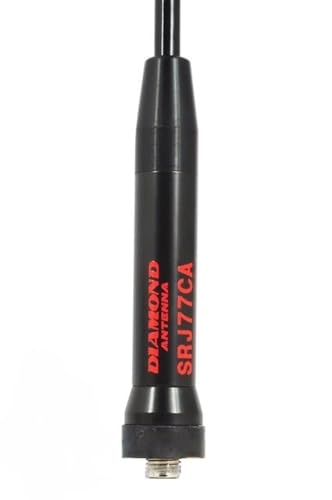
Diamond SRJ77CA
A compact dual-band whip for 144 and 430 MHz from a manufacturer whose build quality is a genuine step up. It is shorter than a 771-style antenna, which means less snagging and far less strain on the radio connector, at the cost of a little gain.
- Bands 144 / 430 MHz
- Build Premium
Tradeoff
You give up perhaps 1 dB against the longer whip, and you pay a little more. If the radio lives on a desk rather than on a belt, that trade is the wrong way round.
Satellite operators and anyone working a repeater from a summit
Arrow Antenna
Arrow II 3-element 2 m handheld Yagi
A three-element 146 MHz beam that breaks down into a bag, giving roughly 6 to 7 dBd of forward gain. That is four to five times the effective radiated power of a whip, in the direction you point it, which turns 5 W into something that reaches well past the normal radio horizon.
- Elements 3
- Gain ~6 to 7 dBd
Tradeoff
Do not buy this as an everyday antenna. It is directional, so it must be aimed, and it is useless while walking or driving. If your problem is a weak repeater from your living room, an outdoor vertical on a mast solves it better and permanently. This is a tool for hilltops, satellite passes and directional work, and nothing else.
What gain and height are actually worth
Antenna gain is only half the story on VHF, and usually the smaller half. Height decides the radio horizon, which is the hard limit on how far a signal travels when propagation is close to line of sight.
| Configuration | Antenna gain | Height | Net against stock indoors |
|---|---|---|---|
| Stock rubber duck, indoors | -3 dBi | 5 ft | baseline |
| 15 in whip, indoors | 0 dBi | 5 ft | +3 dB |
| 15 in whip, outdoors on foot | 0 dBi | 6 ft | +3 to +12 dB |
| Whip plus counterpoise, outdoors | +1 dBi | 6 ft | +4 to +13 dB |
| Three-element Yagi, hilltop, aimed | +8 dBi | 6 ft plus terrain | +11 dB, plus the hill |
| Roof vertical, 50 ft of 240-series coax | +4.5 dBi | 25 ft | +6 dB, plus 20 ft of height |
The lesson in that table is the third row. Walking outside is worth more than any antenna you can buy, because a building is an attenuator and a hill is not something a whip can argue with. The second lesson is the last row: if the problem is reaching a repeater from home, the answer is not a handheld antenna at all. It is an outdoor vertical, and that is covered in best VHF and UHF base antennas. Run the geometry for your own location on the VHF range calculator.
The accessories that go with a whip upgrade
- A speaker mic. A Baofeng BF-850 speaker mic(under $25) on the two-pin Kenwood connector lets you keep the radio and its now longer antenna away from your face. It is also the cheapest RF exposure improvement available.
- A chest pouch. A abcGoodefg radio chest harness(under $25) holds the radio with the antenna clear of your head, which matters over a six hour public service shift.
- A boom headset. A Heletul over-ear boom headset(under $25) with inline PTT is the right answer for a noisy event where a speaker mic cannot be heard.
- A way to verify the match. A Surecom SW-102 digital VHF/UHF SWR meter(under $100) covers 125 to 525 MHz, is powered from the coax and small enough to leave in line. A NanoVNA H4 vector network analyzer(under $100) tells you far more, including exactly where the antenna is resonant.
- A magnet mount, for the car. A Tram 1241 NMO magnet mount with coax(under $50) with 17 ft of coax attached beats any handheld antenna used inside a vehicle, because the body of the car is a shield.
How we chose these antennas
We research equipment from published manufacturer specifications, regulatory documents including the FCC maximum permissible exposure limits in 47 CFR 1.1310, and verified owner reviews read at volume. We did not test these antennas in person and we make no hands-on claims. Published gain figures for handheld antennas are the least trustworthy numbers in amateur radio, quoted in inconsistent references and rarely measured against a ground plane resembling a human hand, so the figures on this page are stated as typical ranges rather than as specifications.
We weighted, in order: whether the antenna is actually carried, which rules out anything long enough to be annoying. Then connector durability and mechanical strain on the radio, because that is what fails. Then real-world gain, then price. Directional antennas were assessed separately, since they answer a different question entirely.
We excluded antennas making implausible gain claims, anything requiring an adapter stack to fit a common radio, and multi-band whips whose coverage does not align with amateur allocations. Prices were researched at time of writing and are set by the retailer at checkout.
Buying tips
- Check the connector on your radio before ordering. SMA-female on the radio is the common case on budget handhelds, and reverse-polarity SMA is the trap.
- Do not exceed about 17 inches. Past that the gain flattens and the inconvenience does not.
- Buy two. Whips are the part that gets sat on, shut in doors and left in a pocket. At under $25 a spare is cheaper than an evening without one.
- Be suspicious of any handheld whip claiming more than about 3 dBi. Physics limits what a body-loaded quarter wave can do, and the numbers on the packaging are frequently quoted against a reference nobody names.
- Support the antenna when you get in a car. Nearly every broken SMA connector was broken by leverage, not by radio failure.
- If the goal is coverage from home, buy an outdoor antenna instead. Twenty feet of height beats any whip, and the Technician starter station prices out exactly what that costs.
Common questions
Questions people ask about this
How much difference does a better handheld antenna really make?
Typically 2 to 3 dB against a stock rubber duck, applied to both transmit and receive. That is roughly half an S unit, which sounds modest until you remember it costs under $25 and applies every time you key up. On a marginal repeater it is often the difference between full quieting and a signal that breaks up. No accessory on a handheld gives a better return per dollar.
Is a longer antenna always better?
Up to about 17 inches, longer generally means more gain on 2 m because you are approaching a proper half wave for the band. Past that the returns flatten and the practical penalties grow: the antenna catches on doorframes, it levers on the SMA connector, and the radio stops being something you carry. A radio you leave at home has a gain of zero no matter what is screwed to it.
What is the difference between SMA-female and SMA-male on a handheld?
It describes the connector on the radio. Baofeng, BTECH and most budget handhelds use SMA-female on the radio body, so the antenna carries the male pin. Yaesu and several others do the opposite. Buy the wrong one and it will not mate at all. Reverse-polarity SMA is a third variant that looks correct and is not, because the centre pin sits in the opposite half of the pair.
Do I need a counterpoise or tiger tail on a handheld?
A quarter-wave counterpoise wire, about 19.5 inches for 2 m, clipped to the antenna ground gives the antenna something to work against other than your hand and body. Reported improvements range from negligible to a full S unit depending on how you hold the radio. It costs almost nothing to make from wire, and it is the cheapest experiment in the hobby. It also gets in the way, which is why few people leave one fitted.
Will a handheld Yagi help me reach a distant repeater?
Substantially, if you can point it. A three-element 2 m beam gives roughly 6 to 7 dBd of gain in one direction, which is four to five times the effective radiated power of a whip. That turns a 5 W handheld on a hilltop into something that reaches well past the normal radio horizon. It is directional, bulky and useless while walking, which is why it lives in a bag rather than on the radio.
Can I damage my radio with the wrong antenna?
You can. Transmitting into a badly mismatched antenna, or into no antenna at all, reflects power back into the final transistors. Most modern handhelds fold back power to protect themselves, but budget radios are less reliable about it. The other common damage is mechanical: hanging a long whip off an SMA connector and catching it in a car door twists the connector out of the case.
Keep going
Related on this site
- Best handheld ham radios The radios these antennas go on.
- Technician starter station The antenna in context, with a running total.
- Tuning an antenna with an SWR meter How to check a whip is actually matched.
- Coax connector chart SMA, BNC, NMO and UHF, and where each belongs.
- VHF range calculator What gain and height are worth in miles.
- RF exposure evaluation The case that matters most on a body-worn radio.
Disclaimer Researched guidance for planning purposes, not professional engineering, electrical or legal advice. Antenna work, RF exposure, mast and tower work, grounding and battery handling all carry real risk that depends on your specific site and installation. Verify anything safety-critical against current FCC rules, the National Electrical Code and the manufacturer's own documentation, and hire a professional where the job calls for one. We research equipment from published specifications, regulatory documents and verified owner reviews rather than claiming hands-on testing we have not done.