Best VHF and UHF base antennas
Height first, gain second, radio last. This is the purchase that changes a VHF station.
The short answer
For most home stations the answer is a dual-band collinear vertical such as the Diamond X50A, mounted as high as the property allows and fed with low-loss coax. It gives roughly 6 dBi on 2 metres and 8 dBi on 70 centimetres from a 5 ft 6 in whip, which turns marginal repeaters into daily ones.
- Best all round
- Dual-band collinear
- Typical gain
- 6 to 8 dBi
- Height target
- 25 ft and up
- Feedline
- LMR-400 class
- Mounting
- Gable end or mast
- Cost of a full install
- $250 to $450
A base antenna is the single largest improvement available to a VHF or UHF station, and it is larger than most people expect because it improves three things at once: gain, height and feedline quality. A handheld indoors and a gain vertical at 30 ft on good coax are not the same station with a different antenna. They are different stations.
What follows is researched from published specifications, manufacturer pattern data and verified owner reports rather than from hands-on testing we have not done. Prices were researched at time of writing and change without notice.
What gain actually means here
A vertical antenna produces gain by squashing its radiation pattern flatter, concentrating energy toward the horizon instead of upward. For terrestrial VHF work that is exactly what you want, since every repeater and every simplex station is near the horizon from your point of view.
- Gain in dBi is referenced to an isotropic radiator; gain in dBd is referenced to a dipole. dBi is 2.15 higher for the same antenna, and manufacturers quote whichever flatters the number.
- A collinear with 6 dBi on 2 metres is about 3.85 dBd, which is a genuine and useful improvement over a plain quarter wave.
- More gain means a flatter pattern, which is a disadvantage if you are in a valley talking to a repeater on a mountain directly above you. That case is rare and worth knowing about.
- Gain and height compound. A 6 dBi antenna at 30 ft beats a 9 dBi antenna at 10 ft in almost every real situation.
- Work out what height buys you on the VHF range calculator.
Three tiers
Three base antennas
Chosen by what your mounting situation actually allows, not by the gain number.
A first outdoor antenna on a small budget
Tram
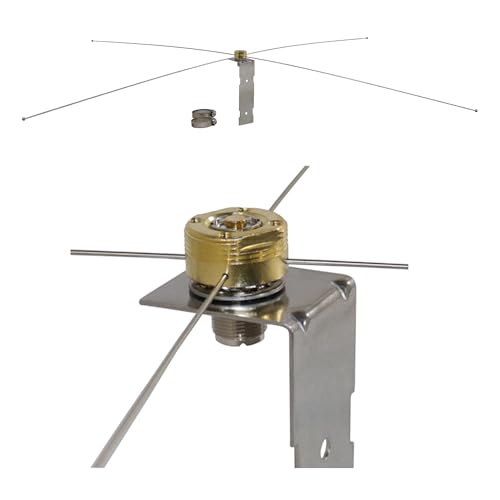
Tram 1465 NMO to UHF ground plane kit
A ground plane kit that mounts on a short mast and gets a real antenna outside the building, which is the step that matters far more than the gain figure. Simple, cheap and effective.
- Type Ground plane
- Mount NMO
Tradeoff
A quarter wave ground plane has no gain over a dipole, so this is about getting outside rather than about performance.
Almost every home station

Diamond Antenna
Diamond X50A dual-band base antenna
The standard answer. Dual-band collinear gain in a 5 ft 6 in package that mounts on a gable end, with a proven weatherproofing record and a mast clamp in the box.
- Gain 6.0 / 8.0 dBi
- Length 5 ft 6 in
Tradeoff
Its longer sibling offers more gain if you have the mounting height and the wind loading tolerance.
Weak signal work, satellites and reaching one distant repeater

Diamond Antenna
Diamond A144S5 5-element 2 m Yagi
A five element 2 metre beam concentrates energy in one direction, which both increases your signal that way and rejects noise and interference from every other direction. For satellite work and SSB weak signal operation this is the correct tool.
- Elements 5
- Band 2 m
Tradeoff
Directional, so it needs a rotator to be generally useful, and it works on one band only.
The comparison
Comparison
Base antennas compared on the numbers that matter
| Antenna | Type | Gain | Length | Best for |
|---|---|---|---|---|
| Diamond X50A dual-band base antenna | Dual-band collinear | 6.0 / 8.0 dBi | 5 ft 6 in | The default home station |
| Tram 1465 NMO to UHF ground plane kit | Ground plane kit | Unity | Compact | A first outdoor antenna |
| Laird 450-470 MHz unity-gain NMO whip | Quarter wave UHF | Unity | Short | A dedicated 70 cm mount |
| Diamond A144S5 5-element 2 m Yagi | 5 element Yagi | About 9.5 dBi | 5 ft boom | Satellites and weak signal |
| Arrow II 3-element 2 m handheld Yagi | 3 element portable Yagi | About 7 dBi | Handheld | Satellite work and direction finding |
| Sirio SY27-3 3-element 10 m Yagi | 3 element 10 m Yagi | About 8 dBi | Large | 10 metre DX at solar maximum |
| Comet CHA-250B broadband vertical | HF and 6 m vertical | Unity | 23 ft | HF from the same mast |
Gain figures are manufacturer published and measured under different conditions by different makers, so treat small differences between brands as noise. The difference between unity gain and 6 dBi is real; the difference between 8.0 and 8.5 dBi from two catalogues is not.
Mounting and feeding
- Mount as high as the property allows. Height beats gain, and it beats power comprehensively.
- A Skywalker J-pipe antenna mount, 38 in on a gable end is reached from a ladder and avoids walking on the roof entirely.
- A Easy Up 20 ft telescoping push-up mast with a Threlaco 3-way galvanized guy wire kit, 50 ft raises the antenna clear of the roof line where the roof itself is in the way.
- Use Bolton400 low-loss coax, 100 ft with PL-259 class coax. At 144 MHz thin cable throws away more than any antenna upgrade gains.
- Weatherproof the connector with Self-amalgamating rubber splicing tape and dress the cable with UV-resistant heavy duty zip ties, 100-pack.
- Ground the feedline at a single entry point with a Proxicast ProGrade coaxial lightning arrester, PL-259 / SO-239, and bond that point to the electrical service ground.
Everything else worth naming
The rest of the installation
The antenna is one line on the invoice. These are the others.
Skywalker
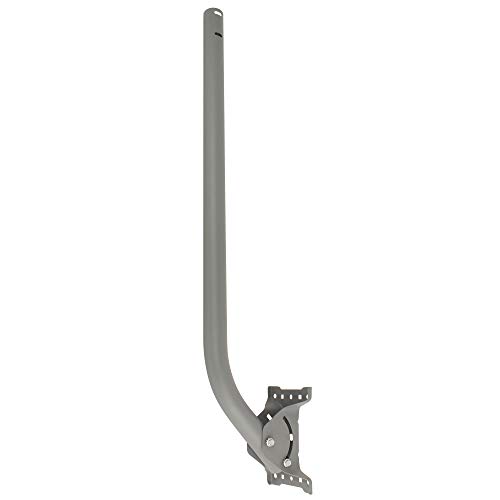
Skywalker J-pipe antenna mount, 38 in
A gable end mount reached from a ladder, which keeps you off the roof surface.
Check priceUnder $50

Easy Up
Easy Up 20 ft telescoping push-up mast
Telescoping mast for the height the roof line does not provide, and it lowers alone.
Check priceUnder $250

Threlaco
Threlaco 3-way galvanized guy wire kit, 50 ft
Anchors and tensioners. A mast without guys is a lever waiting for wind.
Check priceUnder $50

Bolton Technical
Bolton400 low-loss coax, 100 ft with PL-259
Low-loss coax with connectors fitted. Worth more at 144 MHz than any radio upgrade.
Check priceUnder $250
Proxicast
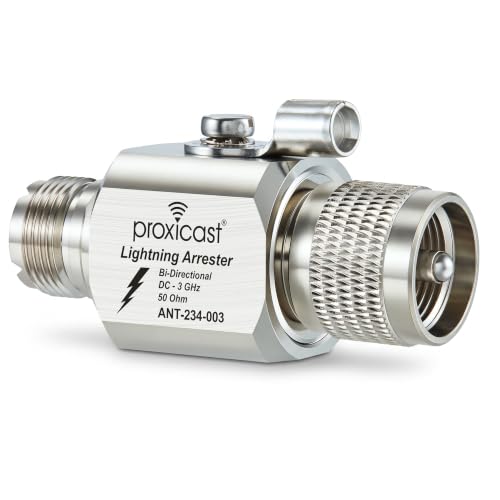
Proxicast ProGrade coaxial lightning arrester, PL-259 / SO-239
An arrester at the entry point, because a mast antenna is the highest thing on the property.
Check priceUnder $25

Maxwel
Self-amalgamating rubber splicing tape
Self-fusing tape for the outdoor connector. Water there ruins the whole run.
Check priceUnder $25

AURSINC
NanoVNA H4 vector network analyzer
Confirms the antenna is resonant where you operate and that the feedline is intact.
Check priceUnder $100

Yaesu
Yaesu FTM-150R ASP
A 50 W radio to feed it, which doubles as a mobile if you want it to.
Check priceUnder $500
The whole station, priced with a running total, is the Technician starter station build.
Common questions
Questions people ask about this
How much difference does a base antenna make over a handheld?
A large one. Adding up the gain, the height and the removal of body absorption, a gain vertical at 30 ft delivers roughly thirty times the effective radiated power of a handheld with a rubber duck at waist height, and improves receive by a similar margin. It routinely turns repeaters that were unreachable into repeaters that are full quieting.
Is more gain always better on a vertical?
Almost always, with one exception. Gain on a vertical comes from flattening the radiation pattern toward the horizon, which is what you want for terrestrial work. If you are in a valley talking to a repeater on a mountain directly above you, a very high gain antenna can point its null at the repeater. That situation is rare and easy to recognise.
What is the difference between dBi and dBd?
The reference. dBi compares the antenna to a theoretical isotropic radiator; dBd compares it to a half wave dipole. A dipole has 2.15 dBi of gain, so any figure in dBi is 2.15 higher than the same antenna quoted in dBd. Manufacturers quote whichever number looks better, so always check which one you are reading before comparing two antennas.
Do I need special coax for a VHF base antenna?
For any run above about 50 ft, yes. At 144 MHz, 100 ft of RG-58 loses 6.6 dB and the same length of LMR-400 loses 1.5 dB, which is five decibels each way. That is more than the difference between a plain ground plane and a high gain collinear, so spending on cable before spending on antenna gain is often the better order.
Can I mount a base antenna in the attic?
You can, and it will work considerably less well, typically one to two S units down, and far worse under a metal roof or foil-backed insulation. The bigger issue is RF exposure, since an attic antenna sits a couple of metres from occupied rooms. Evaluate it at your actual power before transmitting and expect to reduce power.
Keep going
Related on this site
Disclaimer Researched guidance for planning purposes, not professional engineering, electrical or legal advice. Antenna work, RF exposure, mast and tower work, grounding and battery handling all carry real risk that depends on your specific site and installation. Verify anything safety-critical against current FCC rules, the National Electrical Code and the manufacturer's own documentation, and hire a professional where the job calls for one. We research equipment from published specifications, regulatory documents and verified owner reviews rather than claiming hands-on testing we have not done.