Dipole versus end fed half wave
Same wire, different feed point. That one difference changes everything about the installation.
The short answer
A centre fed dipole is slightly more efficient and far better behaved electrically, but needs two supports and a feedline reaching the middle. An end fed half wave needs one support and puts the feedline at your end, covers several harmonic bands from one wire, and needs a proper choke to keep RF off the coax. For most gardens the end fed is the one that gets installed.
- Dipole feedpoint
- About 50 to 70 ohms
- End fed feedpoint
- About 2,400 ohms
- Dipole supports
- Two, plus centre
- End fed supports
- One
- Dipole bands
- One, plus odd harmonics
- End fed bands
- Four or more
Both antennas are a half wavelength of wire. The only difference is where you attach the feedline, and that single choice cascades into everything else: how many trees you need, how the transformer works, whether you get RF in the shack, and how many bands you can use.
Neither is objectively better. What is true is that one of them is much easier to actually install in a normal garden, which is why it has become the default recommendation for a first HF antenna.
The electrical difference
Current and voltage are distributed differently along a half wave of wire. Current is highest at the centre and lowest at the ends; voltage is the opposite. Since impedance is voltage divided by current, the feedpoint impedance depends entirely on where you tap in.
- At the centre, current is high and voltage low, so the impedance is around 50 to 70 ohms in free space. That is a near perfect match for coax, which is why the dipole is the reference antenna.
- At the end, current is low and voltage high, so the impedance is in the thousands of ohms. Feeding that with 50 ohm coax needs a transformer, conventionally 49 to 1.
- A 49 to 1 transformer transforms 2,450 ohms down to 50. Real installations land somewhere near that, close enough that most radios run into it without a tuner.
- The transformer has loss, typically a few tenths of a decibel, and it can heat at power if it is undersized for the duty cycle.
- Because the end fed is a half wave on its fundamental, it is also close to a full wave on twice the frequency and so on, which is where the multiband behaviour comes from.
The installation difference
Head to head
What each one demands and delivers
| Factor | Dipole | End fed half wave |
|---|---|---|
| Support points | Two, at both ends | One, at the far end |
| Feedline route | To the centre, in mid air | To one end, near the house |
| Bands from one wire | One, plus odd harmonics | Four to eight |
| Transformer needed | A 1:1 choke balun | A 49:1 transformer plus a choke |
| Efficiency | Highest | Slightly lower, transformer loss |
| Common mode risk | Low with a choke | High without a choke and counterpoise |
| Typical cost | $40 to $90 built | $70 to $180 ready made |
| Pattern | Broadside, predictable | Similar, skewed by the feed |
The row that decides most installations is the first one. A garden with two suitable supports 70 ft apart is much rarer than a garden with one tall tree.
The common mode problem
This is the end fed genuine drawback and it is worth being clear about. A half wave fed at the end has no obvious return path for current at the feedpoint, so it uses whatever conductor is there. In a coax fed installation that is the outside of the braid.
- Fit a counterpoise wire at the transformer, roughly 0.05 wavelengths on the lowest band. This gives the antenna something better to work against than your feedline.
- Fit a common mode choke behind the transformer. A FT-240-31 ferrite toroid core core with the coax wound through it, or a commercial Balun Designs 1171 1:1 current balunnot on amazon.
- Symptoms of skipping this are RF burns from the microphone, an SWR reading that changes when you touch the radio, and a high receive noise floor.
- A dipole is not immune. Coax feeding a balanced antenna is itself an imbalance, which is exactly what a 1 to 1 current balun exists to correct.
- The full diagnosis and cure is in common mode current and RF in the shack.
Which to build
Three tiers
Three ways to hang a half wave
The same length of wire, fed three different ways, at three levels of installation effort.
One tree, a spool of wire and an afternoon
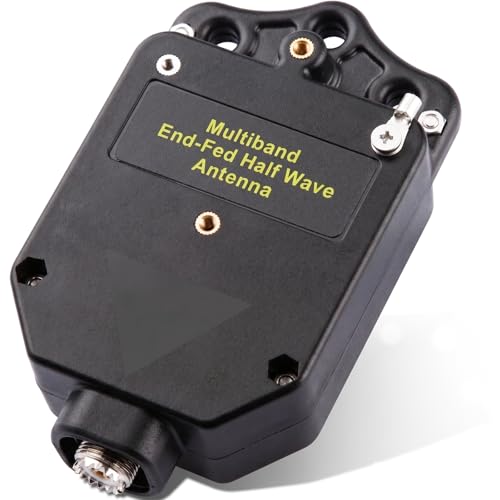
GOOZEEZOO
GOOZEEZOO 150 W end fed antenna transformer
A 49 to 1 transformer plus your own wire is the cheapest route to a multiband HF antenna, and you can cut the wire to whatever your garden actually allows rather than to a product specification.
- Ratio 49:1
- Wire Yours
Tradeoff
You do the trimming and the weatherproofing, and you must add a choke and counterpoise yourself.
One support point and no desire to build anything

JYR
JYR8010 8-band end fed half wave, 150 W
Wire, transformer and hardware in one package, covering eight bands. Hang it, connect the coax and operate. The fastest path from delivery to a first contact.
- Bands 8
- Supports 1
Tradeoff
Fixed length, so it is what it is if your garden is shorter than the wire.
Two supports but not enough span for a full size 40 m dipole

Alpha Delta
Alpha Delta DX-EE parallel dipole, 40 to 10 m
A shortened multiband dipole with the electrical behaviour of a centre fed antenna and a physical length a normal lot can take. Fed in the middle, so common mode current is far less of an issue.
- Feed Centre
- Bands Multi
Tradeoff
Shortening costs bandwidth and a little efficiency, and it needs two supports plus a feedline to the centre.
Either antenna is built from the same wire: 14 AWG stranded for a permanent install and 18 to 22 AWG for portable, as the antenna wire gauge chart sets out. If neither fits your lot, the best HF vertical antennas need only a single support and a radial field.
Parts either way
What both installations need
Wire, rope, insulators and a choke. The choke is not optional on either.
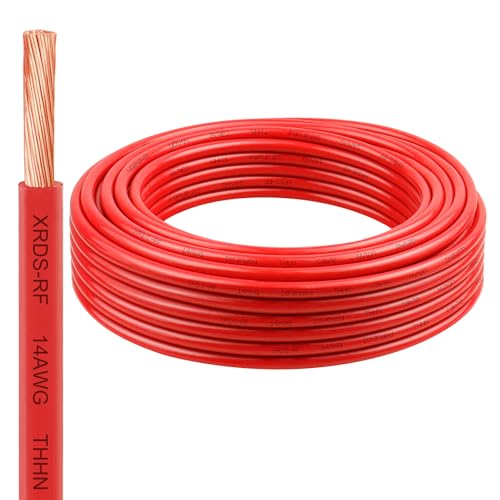
XRDS-RF
XRDS-RF 14 AWG stranded copper wire, 25 ft
Stranded insulated antenna wire that survives being hauled into a tree and left there for years.
Check priceUnder $25

Quality Nylon Rope
QNR 3/16 in polyester antenna rope, 500 ft
UV-stable support rope. The component that decides whether the antenna is still up next season.
Check priceUnder $50

Redman
Nylon dog bone antenna insulators, 10-pack
End insulators, so the high-voltage wire tip terminates into rope rather than into a branch.
Check priceUnder $50

Fair-Rite type 31
FT-240-31 ferrite toroid core
A type 31 core for a common mode choke covering the whole of HF. A few dollars and it fixes RF in the shack.
Check priceUnder $25
Balun Designs
Balun Designs 1171 1:1 current balun
The commercial 1 to 1 current balun, potted and weatherproof, rated for real power.
Sold by Balun Designs, not Amazon. The link searches the category.

Fumei
Fumei 1:4 HF balun, 200 W
A 4 to 1 balun for a feedpoint that needs impedance transformation rather than choking, such as a folded or off-centre fed design.
Check priceUnder $50

Forester
Forester arborist throw line kit
Getting the support line into the tree, which is the actual hard part of either installation.
Check priceUnder $25

AURSINC
NanoVNA H4 vector network analyzer
Shows where the antenna is resonant so trimming takes one trip outside instead of four.
Check priceUnder $100
Common questions
Questions people ask about this
Which is better, a dipole or an end fed half wave?
Electrically the dipole, by a small margin, because it has no transformer loss and its feedpoint impedance is naturally close to coax. Practically the end fed, by a large margin, because it needs one support instead of two, puts the feedline at your end, and covers several bands from one wire. An end fed at 35 ft outperforms a dipole at 15 ft, and the end fed is the one that goes up.
Why does an end fed antenna need a 49 to 1 transformer?
Because the impedance at the end of a half wave is very high, in the region of 2,400 ohms, while coax is 50 ohms. A 49 to 1 impedance transformer, which is a 7 to 1 turns ratio, brings 2,450 ohms down to 50. Feeding an end fed directly with coax without one presents an enormous mismatch that no radio will run into.
Do I need a counterpoise on an end fed half wave?
Yes, and skipping it is the most common installation error. A half wave fed at the end needs something to work against, and without a deliberate counterpoise it uses the outside of your coax braid. That puts RF in the shack, raises the noise floor and makes the SWR reading depend on where you stand. A wire roughly 0.05 wavelengths long at the transformer plus a choke solves it.
Can a dipole cover more than one band?
A plain dipole is resonant on its design band and on odd harmonics, so a 40 metre dipole also works on 15 metres. For more coverage you can add traps, run parallel wires for several bands from one feedpoint, or feed a doublet with open wire line and a balanced tuner. Each adds complexity, which is precisely the gap the multiband end fed filled.
Does the end fed transformer get hot?
It can, on high duty cycle modes at full power, and that is a sign the core is undersized for the job. A transformer rated at 100 W on SSB may be marginal on FT8 at the same power setting, because digital modes transmit continuously. If a transformer runs warm, reduce power on digital modes or fit one rated for higher continuous duty.
Keep going
Related on this site
Disclaimer Researched guidance for planning purposes, not professional engineering, electrical or legal advice. Antenna work, RF exposure, mast and tower work, grounding and battery handling all carry real risk that depends on your specific site and installation. Verify anything safety-critical against current FCC rules, the National Electrical Code and the manufacturer's own documentation, and hire a professional where the job calls for one. We research equipment from published specifications, regulatory documents and verified owner reviews rather than claiming hands-on testing we have not done.