Best HF Vertical Antennas for 2026
The short answer · Updated 2026
The best HF vertical antenna for most yards is the Hustler 4BTV (40 to 10 m, 21 ft) over 16 or more radials, which keeps ground loss to 1 to 2 dB. With no room for radials, the Comet CHA-250B covers 80 to 6 m from a 23 ft whip at a cost of roughly 3 to 6 dB. For portable work, a coil-loaded whip on a spike goes up in five minutes.
A vertical trades a radial field for a small footprint and a low takeoff angle.
Picks at a glance
HF verticals compared
| Antenna | Bands | Height | Radials |
|---|---|---|---|
| Hustler 4-BTV trap verticalnot on amazon | 40 to 10 m | 21 ft | 16+ on the ground |
| Comet CHA-250B broadband vertical | 80 to 6 m | 23 ft | None |
| DX Commander Classic multiband verticalnot on amazon | Multi, by build | About 30 ft | Required |
| Wolf River Coils Take It Along verticalnot on amazon | Any, by tap | About 10 ft | Kit included |
The Comet is on Amazon; the others sell through dealers or direct, so their buttons run a category search. Ground loss figures are for the radial counts shown.
- Takeoff angle
- 15 to 25 degrees
- Ground radials
- 16 to 32
- Elevated radials
- 4 tuned
- Four radials costs
- Several dB
- Footprint
- Small
- Noise
- Higher than horizontal
A vertical is half a dipole standing on end, with the missing half supplied by a ground system. That single fact explains everything about them: the low takeoff angle that favours distance, the small footprint, the sensitivity to what is underneath, and the reputation for both excellence and disappointment depending on whether the installer did the radials.
Everything here is researched from published specifications and verified owner reports rather than from hands-on testing we have not done. Prices were researched at time of writing.
The radial question, first
Before choosing a vertical, decide what ground system you can build, because the antenna choice follows from it rather than the other way round.
Ground systems
What each radial arrangement costs you
| Ground system | Approximate loss | Effort | Verdict |
|---|---|---|---|
| 4 radials on the ground | 3 to 6 dB | Low | Poor, most of your signal in the soil |
| 8 radials on the ground | 2 to 3 dB | Moderate | Noticeably better |
| 16 radials on the ground | 1 to 2 dB | A weekend | Good, the practical target |
| 32 radials on the ground | Under 1 dB | A long weekend | Close to the ceiling |
| 4 elevated tuned radials | Under 1 dB | Moderate | As good as 30 on the ground |
| No radials, matched design | 3 to 6 dB | None | Honest compromise where nothing else fits |
Ground radials do not need to be resonant, so number matters far more than length. Elevated radials must be cut accurately to a quarter wave. Plan yours on the radial planning calculator.
Three tiers
Three verticals
Chosen by what your ground and your footprint allow.
A suburban garden with no room for radials
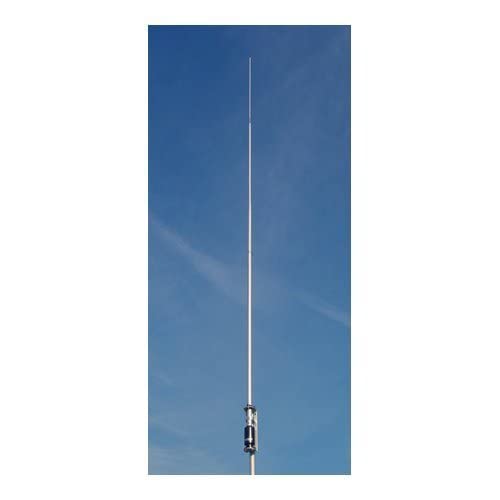
Comet
Comet CHA-250B broadband vertical
Covers 80 through 6 metres continuously from a 23 ft whip with no radial field required, using an internal matching network. It goes up in an afternoon, needs no lawn full of wire and works.
- Bands 80 to 6 m
- Radials None
Tradeoff
The matching network costs efficiency, and the manufacturer is honest about that. It is a compromise antenna that makes contacts rather than a performance antenna.
A garden with lawn and a weekend to spend
Hustler
Hustler 4-BTV trap vertical
A trapped vertical that is genuinely resonant on each of its bands, so nothing is lost in a matching network. Given a real radial field it is a serious antenna at a modest price, and it has survived decades of weather in thousands of gardens.
- Bands 4
- Height 21 ft
Tradeoff
Requires the radial field to perform. Installed with four radials it will disappoint, and that is not the antenna fault.
Sold through amateur dealers, roughly $290
Sold by Hustler, through amateur radio dealers, not Amazon. The button searches the category.
Someone who wants maximum performance per dollar and will do the work
DX Commander
DX Commander Classic multiband vertical
A fibreglass mast carrying parallel resonant wires for each band, so there are no traps and no lossy matching. Widely regarded as one of the best value performers available when the radial field is done properly.
- Design Parallel wires
- Traps None
Tradeoff
Sold direct rather than through Amazon, and it is a kit that rewards care in assembly.
Sold by DX Commander, roughly $400 plus shipping
Sold by DX Commander, not Amazon. The button searches the category.
Trapped, no-radial or multi-wire
- Trapped verticals
- Parallel resonant traps isolate the upper sections on higher bands, so one element is electrically the right length on several bands. Efficient, proven, and the traps are the maintenance item, since water ingress detunes them. A Hustler 4-BTV trap verticalnot on amazon is the classic example.
- No-radial verticals
- An internal matching network and often a substantial counterpoise inside the base let the antenna work without a radial field. Honest manufacturers state the efficiency cost. A Comet CHA-250B broadband vertical or the heavier Comet CHA-250HD broadband vertical covers a very wide band range this way and earns its place where a radial field is impossible.
- Multi-wire verticals
- Several resonant wires in parallel up a non-conductive mast, one per band. No traps, no matching network, so nothing is lost. A DX Commander Classic multiband verticalnot on amazon is the well known example and needs a real radial field to shine.
- Coil-loaded portable verticals
- A short whip with a large loading coil, tapped or slid to change bands. A Wolf River Coils Take It Along verticalnot on amazon or Super Antenna MC80 80 m SuperCoil goes up in five minutes on a spike, which is what makes portable activations practical. Efficiency is modest and it does not matter, because the alternative is no antenna.
Comparison
Comparison
HF verticals compared
| Antenna | Bands | Height | Radials | Best for |
|---|---|---|---|---|
| Hustler 4-BTV trap verticalnot on amazon | 40 to 10 m | 21 ft | Required | The performance answer with lawn |
| Comet CHA-250B broadband vertical | 80 to 6 m | 23 ft | None | A small garden, wide coverage |
| Comet CHA-250HD broadband vertical | 80 to 6 m | 23 ft | None | The same idea with more power handling |
| DX Commander Classic multiband verticalnot on amazon | Multi, by build | About 30 ft | Required | Best value performance, sold direct |
| Wolf River Coils Take It Along verticalnot on amazon | Any, by tap | About 10 ft | Included kit | Portable, five minute setup |
| Gabil GRA-7350T telescopic HF whip | Multi, by tap | Compact | Kit | Balcony and portable |
| Super Antenna MC80 80 m SuperCoil | Multi, by tap | Compact | Super Antenna MR4010 radial set | Restricted lots and travel |
Verticals sold direct by small manufacturers are named here because leaving them out would misrepresent the field. Their buy buttons run an Amazon category search for comparable gear rather than landing on that exact item.
Installing one well
- Site it away from the house. Distance from the building lowers the noise floor more than any other single decision, and verticals are noise sensitive.
- Lay the radials before you trim the element, because adding radials changes resonance.
- Use cheap wire in quantity for ground radials. Paladin 14 AWG stranded copper wire, 500 ft on a spool is the right approach.
- Elevate the whole thing if you can. Four tuned radials at 8 ft outperform thirty on the ground and take an afternoon rather than a weekend.
- Fit a common mode choke at the feedpoint. A vertical with an inadequate ground system will use your coax braid as the missing half.
- Sweep it with a NanoVNA H4 vector network analyzer before and after adding radials, so you can see the feedpoint impedance settle.
Supporting parts
What the installation needs
Radial wire, a choke, a feedline and a way to measure the result.

Paladin
Paladin 14 AWG stranded copper wire, 500 ft
Bulk wire for the radial field, which is where the performance actually comes from.
Check priceUnder $100
Balun Designs
Balun Designs 1171 1:1 current balun
A common mode choke at the feedpoint, so the coax braid does not become the missing half of the antenna.
Sold by Balun Designs, not Amazon. The link searches the category.
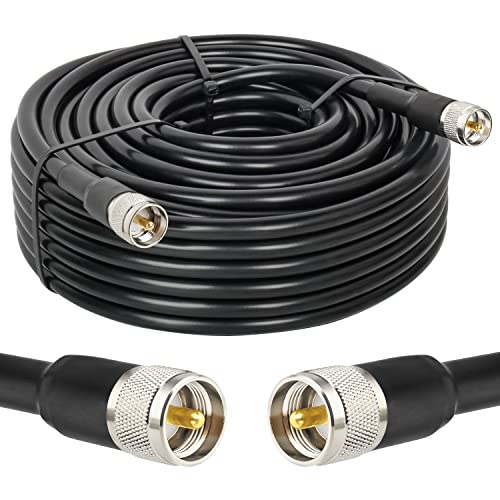
MOOKEERF
MOOKEERF RG-213 coax, 100 ft with UHF male
A robust feedline run for a ground mounted antenna at the far end of the garden.
Check priceUnder $250

AURSINC
NanoVNA H4 vector network analyzer
Shows the feedpoint impedance changing as radials go down, which is how you know when to stop.
Check priceUnder $100

HEVIDUBANA
8 ft copper-bonded ground rod kit with clamp
A ground electrode at the antenna, bonded back to the service ground as the code requires.
Check priceUnder $100

Maxwel
Self-amalgamating rubber splicing tape
Weatherproofing for the feedpoint connector, which sits at ground level in the wet.
Check priceUnder $25

VQP
ATU-130 200 W automatic antenna tuner
A small tuner for the band edges and for the bands a trapped vertical does not natively cover.
Check priceUnder $100

Super Antenna
Super Antenna MR4010 radial set
A ready-made radial set for a portable vertical, which removes the usual portable excuse.
Check priceUnder $50
Common questions
Questions people ask about this
What is the best HF vertical antenna for a small yard?
If you can lay even 8 to 16 short radials along the edges of the lawn, a trapped vertical such as the Hustler 4BTV still wins, because ground radials do not need to be a quarter wave long. If you truly cannot run any wire, a no-radial design such as the Comet CHA-250B is the honest answer: it covers 80 to 6 m on a 23 ft whip and gives up roughly 3 to 6 dB to do it.
How many radials does an HF vertical need?
Sixteen laid on the ground is a good practical target and thirty two is close to the ceiling of usefulness. Four is genuinely poor and costs several decibels, most of which ends up as heat in the soil. The important exception is elevated radials: four resonant quarter wave radials at height perform about as well as thirty on the ground for far less effort.
Are no-radial verticals any good?
They work, and they are less efficient than a proper vertical with a radial field, typically by three to six decibels. Honest manufacturers say so. They earn their place where a radial field is genuinely impossible, such as a small garden, a roof or a rental property, and they beat having no HF antenna at all by an enormous margin.
Is a vertical better than a wire antenna?
For distance, at equal installation quality, yes, because a vertical has a low takeoff angle at any height while a horizontal wire needs to be half a wavelength up to achieve one. For regional contacts and for a lower receive noise floor, a horizontal wire wins. Most active stations end up with both and switch between them by band and time of day.
Why is my vertical noisy on receive?
Because it is omnidirectional and most sensitive at low angles, which is exactly where man-made noise arrives from. A horizontal antenna rejects a good deal of vertically polarised local noise by orientation alone. Siting the vertical further from the house helps substantially, and on the low bands many operators transmit on the vertical and listen on a separate wire.
Do traps need maintenance?
Yes, eventually. A trap is a parallel resonant circuit sealed against weather, and water ingress detunes it, which shows as a band that no longer matches while the others are fine. Inspect the seals every few years, and treat a single band going out of tune as a trap problem rather than an element length problem.
Keep going
Related on this site
- Hustler 6-BTV review The trap vertical, and the radial field it needs.
- Comet CHA-250B review Why low SWR everywhere is not efficiency.
- Vertical versus dipole The head to head, with takeoff angles.
- Radial planning calculator How many, how long, what each one buys.
- Quarter wave vertical calculator Element length for any band.
- Best HF wire antennas The alternative, if you have a tree.
Sources
- Band coverage, height and radial requirements: manufacturer specifications from Hustler (New-Tronics), Comet, DX Commander and Wolf River Coils.
- Ground radial loss by radial count and elevated radial performance: The ARRL Antenna Book, vertical antennas and ground systems chapters, and the Brown, Lewis and Epstein ground system study (Proceedings of the IRE, 1937).
- RF exposure evaluation at the antenna base: FCC OET Bulletin 65 and 47 CFR 1.1310.
Disclaimer Researched guidance for planning purposes, not professional engineering, electrical or legal advice. Antenna work, RF exposure, mast and tower work, grounding and battery handling all carry real risk that depends on your specific site and installation. Verify anything safety-critical against current FCC rules, the National Electrical Code and the manufacturer's own documentation, and hire a professional where the job calls for one. We research equipment from published specifications, regulatory documents and verified owner reviews rather than claiming hands-on testing we have not done.