You Passed. Here Is Exactly What to Do Next
A call sign, an empty log and no idea what to say. This is the first week, in order, including the exact words of a first transmission and the equipment decisions that avoid buying anything twice.
The short answer
Wait until your call sign appears in the FCC database before transmitting, then buy a dual-band handheld, a better whip, a genuine programming cable and an outdoor antenna, under $400 complete. For a first transmission on a repeater, say your call sign in phonetics followed by the word listening. The easiest first contact is checking into a local weekly net, because the control operator's job is to invite you.
- May transmit
- When granted
- First station
- Under $400
- First contact
- A weekly net
- Identify
- Every 10 minutes
Passing is the part everyone plans for. The week afterwards is the part nobody does, and it is the week most new licensees describe as the hardest, because a call sign is a permission rather than an instruction. Here is what to do with it, in order, from the moment the FCC database updates.
Day one: do not transmit yet
The certificate you were handed at the exam is a Certificate of Successful Completion of Examination, and it is not a license. The license exists when the FCC grants it, which happens after you pay the application fee from the email link and typically shows up in the database one to two business days later. Until your call sign is visible there, you are an unlicensed operator holding a piece of paper.
What you can do meanwhile: listen. Receiving has never required a license. Programme your radio, find your local repeaters, learn which ones are busy and at what time of day, and listen to a net without checking in. A week of listening before your first transmission is the best possible preparation, and the people you will eventually talk to did exactly the same thing. The paperwork detail is on getting your call sign.
Week one: buy the right four things
The most common first-purchase mistake in amateur radio is spending the entire budget on the radio and then transmitting into the antenna that came in the box. The stock rubber duck on every budget handheld is the worst antenna you will ever own, and replacing it costs sixteen dollars and is worth more than doubling your transmit power.
Three tiers
Pick the first radio by how sure you are
The honest framing is not budget, it is certainty. Buy the cheap one if you are testing the hobby and the expensive one if you already know.
Newly licensed and not yet sure the hobby will stick
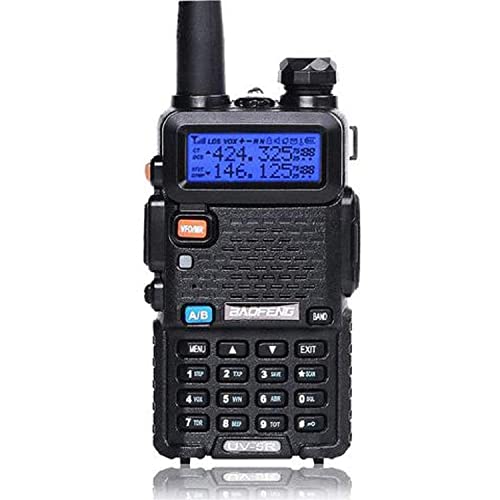
Baofeng
Baofeng UV-5R
The complete entry: 4 watts, dual band, 128 memories, CHIRP support and a price low enough that a second one for a family member is not a decision. Buying two cheap radios rather than one better one solves the real first-week problem, which is having nobody to talk to.
- Power 4 W
- Memories 128
Tradeoff
The receiver struggles near strong commercial transmitters and the stock antenna has to be replaced immediately. Budget under $50 more for a whip, an extended battery and a genuine programming cable.
Anyone certain they will stay, who wants no programming cable at all

BTECH
BTECH UV-PRO
IP67 sealed, USB-C charged and programmed from a phone over Bluetooth, with APRS and GPS built in rather than bolted on. Removing the programming cable removes the single step that stalls the most new operators in their first fortnight.
- Sealing IP67
- APRS Built in
Tradeoff
App-dependent configuration means trusting a manufacturer app to keep working, and the receiver is good rather than exceptional. If front-end quality matters more than convenience, the FT-60R is the other answer at similar money.
Someone who already knows they want one radio that lasts a decade

Yaesu
Yaesu FT-60R
A die-cast chassis, 1000 memories and a receiver front end that stays usable next to commercial paging and broadcast transmitters, which is exactly where budget radios fall apart. It has been discontinued more than once and keeps selling because nothing near the price matches it.
- Power 5 W
- Chassis Die-cast
Tradeoff
Programming needs a cable and software, there is no APRS, no Bluetooth and no USB-C charging, and it costs twelve times the Baofeng. None of that matters if what you want is a radio that works in a bad RF environment for ten years.
Whichever radio, the other three purchases are the same and none of them is optional:
- A Nagoya NA-771C 15-inch whip(under $25) in place of the stock antenna. Fifteen inches of flexible whip, worth roughly 2 to 3 dB on both transmit and receive. Cheapest meaningful upgrade in the hobby.
- A BTECH PC03 FTDI programming cable(under $25) with a genuine FTDI chip. Counterfeit serial chips are the most common reason the free CHIRP software will not connect, and hand-entering fifty repeaters through a menu system is how people give up.
- A Baofeng UV-5R 3800 mAh USB-C battery, 2-pack(under $25) with USB-C charging in the pack, which roughly triples talk time and removes the drop-in cradle from your bag.
Then, when the budget allows, the thing that actually changes what you can reach: an outdoor antenna. A Diamond X50A dual-band base antenna(under $250) on a mast with proper coax turns a handheld into a station that works repeaters you could not hear indoors. The complete build with every item priced and in buying order is the under-$400 Technician starter station.
Week one: programme the radio
A handheld out of the box has no local repeaters in it, and entering one by keypad means setting a receive frequency, an offset direction, an offset size, a transmit tone and a memory name through an unlabelled menu system. The free CHIRP software plus a genuine cable loads fifty in two minutes.
- Find your local repeaters in an online directory. Note frequency, offset and tone.
- Install CHIRP, connect the cable, download the image from the radio first.
- Edit the memory channels in the spreadsheet view, then upload back to the radio.
- Put the busiest repeater in memory channel one, because that is the one you will use.
- Add the NOAA weather channels and a couple of simplex calling frequencies.
Step by step with the specific settings on programming a Baofeng with CHIRP. What the offsets and tones mean is on how to use a repeater and the standard values are on the offsets and tones reference.
Your first transmission, word for word
On a repeater, the correct opening is short and it is not a question:
That is a complete, correct transmission. It identifies you, it announces that you are monitoring, and it invites a reply without demanding one. If someone comes back, say your call sign again, their call sign, and something ordinary. There is no script beyond that and the conventions are gentler than newcomers expect.
Two things not to do on a repeater. Do not ask whether the frequency is in use, which is an HF convention and meaningless on a repeater that will announce itself. Do not call CQ, which is also an HF convention; on a repeater the equivalent is exactly the transmission above. Neither is a rules problem and neither will be corrected unkindly, but knowing saves the small awkwardness.
Your first real contact: check into a net
Calling into silence and getting nothing is the most demoralising thing that happens to a new licensee, and it is usually not the radio. It is that the repeater is quiet at that hour. The fix is to find a net.
A net is a scheduled on-air meeting with a control operator whose explicit job is to invite check-ins, including from new and visiting stations. Almost every area has at least one weekly. You listen until the control operator asks for check-ins, you say your call sign in phonetics, they acknowledge you, and you have made your first contact with no ambiguity about whether anyone is listening. Ask the club that ran your exam session when their net meets; it is usually the same evening every week on the same repeater.
Log it
Write down the date, time in UTC, frequency, mode, the other station's call sign and the signal report. There is no longer any federal requirement to keep a log, and you should keep one anyway, because it is the only record of what your station could actually do under given conditions. Six months of logs tell you whether the new antenna helped in a way that memory cannot.
Paper is fine to start. Free logging software is better because it will look up call signs, calculate distances and export to the online confirmation services later. Covered properly on logging and confirming contacts.
The first month: the mistakes worth avoiding
- Transmitting before the grant appears. The single rule violation new licensees commit, entirely out of enthusiasm.
- Buying an HF radio on a Technician license. Four narrow segments, three of them Morse code only. If HF is what you want, sit General first.
- Buying a cheap amplifier for a handheld. Frequently dirty on the output and a handheld cannot key them cleanly. A mobile radio is cheaper, cleaner and legal.
- Keying up on a repeater with the wrong tone and concluding the radio is broken. The most common false fault report in the hobby. Check the tone, the offset direction and the offset size before anything else.
- Putting an antenna up near a power line. This is the one that kills people, and it happens during the raising rather than during operation.
- Never checking into a net because it feels intrusive. It is the opposite. The net exists to be checked into and the control operator will thank you.
Month two and beyond
Two forks. If you want to talk to the world rather than the county, the answer is HF and the route is the General license followed by the first HF station. If you want to get more out of what you already hold, the answer is an outdoor antenna, then a mobile radio, then possibly digital modes or satellite work, all of which a Technician license covers in full.
There is a third fork worth naming: emergency communications. Every area has a group that trains for it, they are chronically short of licensed volunteers, and they will train you properly rather than expecting you to arrive competent. If the reason you got licensed was preparedness, start there rather than with equipment.
Common questions
Questions people ask about this
What is the first thing to say on the air?
On a repeater, say your call sign in phonetics and the word listening: "Kilo Alpha One Alpha Bravo Charlie, listening." That is a complete and correct transmission that invites a reply without demanding one. Do not say "is this frequency in use" on a repeater and do not say "CQ" on one either; both are HF conventions that mark you as new in a way that is harmless but avoidable.
What should I buy first after passing the Technician exam?
A dual-band handheld, a better whip than the one in the box, a genuine programming cable and an outdoor antenna with coax. The complete build comes to under $400 with more money in the antenna system than the radio, which is deliberate: the antenna is the cheapest major component and the single largest influence on how well the station works.
How do I find someone to talk to?
Find your local weekly net. A net has a control operator whose job is to invite check-ins, including from new stations, which removes every awkward part of a first contact. Look up your area repeaters in a directory, listen for a few evenings to learn which ones are busy, and check into the net on the one that is. This is far easier than calling into silence.
Do I have to identify with my call sign every time I transmit?
You must identify at least every ten minutes during a communication and at the end of it. You do not need to identify at the start of every transmission, though it is normal practice to give your call when you first key up. Identification must be in English by voice, or in Morse code, and the station call sign is what identifies you.
How long before I should upgrade to General?
If you did not sit it on the same day, the most efficient time is within the next month while the Technician material is still current, because roughly a third of the General pool builds directly on it. The counterargument is spending a few months learning to operate on the repeaters first, which builds skill that transfers. What is not sensible is buying HF equipment before holding the license for it.
What paperwork do I still need to do?
Pay the FCC application fee from the emailed link within ten days if you have not, keep your mailing address current in the FCC system, and set a calendar reminder for nine years and nine months from your grant date so the ten year renewal does not surprise you. That is the entire ongoing administrative burden of holding an amateur license.
Keep going
Related on this site
- How to use a repeater Offsets, tones, and what to say when nobody answers.
- Programming with CHIRP Cable to first repeater contact, step by step.
- The under-$400 starter station Every item priced and linked, in buying order.
- The General upgrade What it opens and how long it takes.
- Logging and confirming contacts What to write down and why it matters later.
- Q signals and RST The shorthand you are about to hear constantly.
Disclaimer Researched guidance for planning purposes, not professional engineering, electrical or legal advice. Antenna work, RF exposure, mast and tower work, grounding and battery handling all carry real risk that depends on your specific site and installation. Verify anything safety-critical against current FCC rules, the National Electrical Code and the manufacturer's own documentation, and hire a professional where the job calls for one. We research equipment from published specifications, regulatory documents and verified owner reviews rather than claiming hands-on testing we have not done.