Sizing a power supply for a ham station
Size for the transmit peak with margin, not for the average, and buy for continuous duty if you run digital.
The short answer
A 100 W HF transceiver draws about 20 to 23 A on transmit peaks, so it needs a supply rated 25 to 30 A continuous. A 50 W VHF mobile draws about 11 A and wants a 20 A supply. Size at 125 percent of the radio maximum draw, and treat any supply rated only at an intermittent duty cycle as being worth about two thirds of its label.
- 100 W HF radio
- 20 to 23 A peak
- 50 W VHF mobile
- 10 to 12 A
- 5 W handheld
- Under 2 A
- Sizing margin
- 125 percent
- Nominal voltage
- 13.8 V DC
- Undervoltage symptom
- Distorted audio
The power supply is bought last, chosen on price, and then blamed for problems it is causing. A supply that sags on transmit peaks produces audio that sounds fine to you and distorted at the far end. A supply that is electrically noisy raises your own receive noise floor across the bands you are trying to hear. Both are common and both are avoidable for the price of one size up.
Sizing a supply is arithmetic on one number: the maximum current your radio draws on transmit. Everything else follows from it.
What radios actually draw
Current draw
Typical DC current at 13.8 V by radio type
| Radio | Receive | Transmit peak | Supply to buy |
|---|---|---|---|
| 5 W handheld | 0.1 A | 1.6 A | Charger only |
| 10 to 20 W QRP HF | 0.5 A | 4 to 6 A | 10 A |
| 50 W VHF or UHF mobile | 0.8 A | 11 A | 20 A |
| 100 W HF transceiver | 1.5 to 2.5 A | 20 to 23 A | 30 A |
| 100 W HF plus tuner and accessories | 3 A | 25 A | 30 to 40 A |
| Two radios sharing a supply | Sum both | Sum both peaks | 40 A and up |
| 600 W amplifier | Own supply | Separate mains supply | Not from the 13.8 V rail |
Peak draw is what matters, not average. A supply that meets the average and folds back on peaks produces flat-topped audio at the far end while everything looks normal at your end. Work out your own figure on the power supply sizing calculator.
Continuous versus intermittent ratings
Supplies are advertised with two numbers, and the larger one is usually the one on the box. A supply labelled "30 A peak, 25 A continuous" is a 25 A supply. A supply labelled "30 A" with no qualification, from a brand with no reputation, is often a 20 A supply that survives a brief 30 A demand.
- Buy on the continuous figure. It is the one that means something.
- FT8, RTTY and FM are essentially 100 percent duty on transmit, so a digital station lives at the continuous rating rather than visiting it. See getting started with FT8.
- SSB voice peaks hard and averages low, which is why a marginal supply can pass a casual test and fail on a long over.
- Add 25 percent margin over your calculated peak. It costs a small amount and removes an entire category of problem.
- Heat is the limiting factor in almost every supply. One running at 90 percent of its rating in a warm room will not last.
Linear versus switching
- Linear supply
- A mains transformer, a rectifier and a regulator. Heavy, physically large, and electrically silent. An Astron RS-35M-AP linear power supply weighs a great deal and produces no switching noise at all, which is why they remain the choice for stations chasing weak signals. Efficiency is poor, so they run warm and waste power as heat.
- Switching supply
- A high frequency converter. Light, compact, efficient and cheap, and it switches at a frequency whose harmonics can land in the amateur bands. Good ones such as a Powerwerx SS-30DV desktop power supply are filtered properly and quiet in practice. Poor ones raise your noise floor by several S units across HF.
- Which to buy
- A well made switching supply for almost everybody, because the weight and price difference is large and the noise difference on a good unit is small. A linear supply if you chase weak signals, if your station is already noisy, or if you have had a bad experience with a cheap switcher and do not want to repeat the experiment.
- The variable-frequency feature
- Some switching supplies let you shift the switching frequency slightly. That is there so you can move a birdie off the frequency you care about. It is a genuinely useful feature and worth having.
Wiring, which people get wrong more often than the supply
- Use heavy enough cable. At 23 A, voltage drop over even a short thin run is enough to make a radio misbehave. Size the wire for the current and the length, not for what fits the connector.
- Fuse both conductors, at the supply end. Most radio power leads come with fuses in both the positive and the negative lead for a reason.
- Standardise on one connector. 30 A quick-disconnect power connectors, 40-piece sets are the hobby default, they are genuinely good, and every field site you visit will accept them.
- Distribute rather than daisy chain. A Powerwerx PD-5F fused distribution block distribution panel with individual fuses beats a nest of splices, and it makes a fault obvious.
- Keep the DC run away from coax and audio cable. A switching supply lead running beside a microphone cable is a noise injection path.
- Measure at the radio, not at the supply. Voltage under load at the radio end is the number that matters.
Symptoms of an undersized supply
- Reports of distorted or muffled audio that you cannot hear on your own monitor.
- The radio display dimming or the radio resetting on transmit peaks.
- Output power that reads correctly on a short test and falls away on a long transmission.
- A supply that gets hot enough to be uncomfortable to touch during normal operation.
- An audible buzz or click from the supply in time with your speech.
- A noise floor that rises when the supply is switched on, which is a different fault and points at filtering rather than capacity.
What to buy
Supplies and distribution
Size for the peak, buy on the continuous rating, and wire it properly.

Powerwerx
Powerwerx SS-30DV desktop power supply
A 30 A switching supply with proper filtering and Powerpole outputs. The default choice for a 100 W station.
Check priceUnder $250

Astron
Astron RS-35M-AP linear power supply
A 35 A linear supply that produces no switching noise whatsoever. Heavy, expensive and permanently quiet.
Check priceUnder $1,000
TekPower
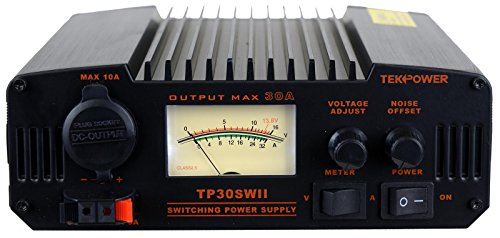
TekPower TP30SWII 30 A switching power supply
A variable voltage 30 A switching supply with a shiftable switching frequency for moving a birdie off a band you use.
Check priceUnder $250
Powerwerx
Powerwerx PD-5F fused distribution block
A fused distribution panel so every device has its own protection and a fault is obvious rather than mysterious.
Check priceUnder $100

smseace
30 A quick-disconnect power connectors, 40-piece
Connectors. Standardising on one system is worth more than it sounds, particularly at a field site.
Check priceUnder $25

GOLDENMATE
GOLDENMATE 12 V 20 Ah LiFePO4 battery
A LiFePO4 pack as a backup or portable supply, which also removes mains noise from the equation entirely.
Check priceUnder $100
Common questions
Questions people ask about this
What size power supply do I need for a 100 watt HF radio?
Thirty amps continuous. A 100 W transceiver draws around 20 to 23 A on transmit peaks depending on the model and the band, and sizing at 125 percent of that lands on 25 to 30 A. Buying a 20 A supply for a 100 W radio is the classic mistake: it works on short overs, sags on long ones, and produces distorted audio that sounds perfect at your end.
Are switching power supplies too noisy for ham radio?
A well made one is not. Modern switching supplies designed for amateur use are properly filtered and add little or nothing to the noise floor, and several offer a shiftable switching frequency so any residual birdie can be moved off a frequency you care about. Cheap unbranded switchers are a different matter and can raise the HF noise floor by several S units.
Can I run my radio from a car battery instead?
Yes, and it is genuinely quiet because there is no mains involved at all. A 12 V lead-acid or LiFePO4 pack sized for your transmit current works well, and many operators use one as both a backup and a noise-free supply. Fuse at the battery, size the fuse to the wire, and never charge a lithium pack with a lead-acid charger set to an equalisation mode.
Why does my radio reset when I transmit?
Voltage at the radio is dropping below the point where it holds up, on transmit peaks. That is either an undersized supply, undersized DC cable, a poor connection, or all three. Measure the voltage at the radio power connector while transmitting rather than at the supply terminals, because the drop happens along the cable and the supply meter never shows it.
Does the power supply matter for digital modes?
More than for voice. FT8, RTTY and other digital modes transmit at essentially full duty, so the supply sits at its continuous rating for the whole transmission rather than visiting a peak briefly. A supply that handles SSB comfortably can overheat on a digital run. Size on the continuous figure and give the supply airflow.
Keep going
Related on this site
Disclaimer Researched guidance for planning purposes, not professional engineering, electrical or legal advice. Antenna work, RF exposure, mast and tower work, grounding and battery handling all carry real risk that depends on your specific site and installation. Verify anything safety-critical against current FCC rules, the National Electrical Code and the manufacturer's own documentation, and hire a professional where the job calls for one. We research equipment from published specifications, regulatory documents and verified owner reviews rather than claiming hands-on testing we have not done.