Portable power and batteries for field operation
Capacity is the easy part. Fusing at the battery and charging with the right profile are the parts that go wrong.
The short answer
A 12 V 20 Ah lithium iron phosphate pack runs a 20 W HF radio for a full day of typical operating, because receive current dominates the average. Fuse at the battery terminal and size the fuse to the wire, never to the load, and charge only with a LiFePO4 profile charger rather than a lead-acid charger with a desulphation mode.
- Best chemistry
- LiFePO4
- Usable capacity
- 90 to 95 percent
- Lead-acid usable
- 50 percent
- Weight for 20 Ah
- About 5 lb
- Fuse location
- At the battery
- Charge below freezing
- Never
Battery power changed portable operating twice. First when lithium iron phosphate made a usable capacity practical to carry, and again when the price fell far enough that a 20 Ah pack costs less than a decent antenna. A field station that used to mean a car battery in a milk crate now fits in a shoulder bag.
What has not changed is the physics. A 12 V pack can deliver hundreds of amps into a short circuit, lithium chemistries are unforgiving about charge profiles and temperature, and the fuse people fit is usually in the wrong place.
This page covers sizing, fusing, charging and solar, in that order.
Why LiFePO4 rather than anything else
Chemistry comparison
What each battery type gives you for a portable station
| Chemistry | Usable capacity | Weight for 20 Ah usable | Cycles |
|---|---|---|---|
| Sealed lead-acid | 50 percent | About 28 lb | 200 to 500 |
| AGM deep cycle | 50 to 60 percent | About 25 lb | 400 to 700 |
| LiFePO4 | 90 to 95 percent | About 5 lb | 2,000 to 5,000 |
| Lithium ion, NMC | 90 percent | About 4 lb | 500 to 1,000 |
A lead-acid battery discharged past half its capacity loses life rapidly, which is why the usable figure is half the label. LiFePO4 gives you nearly all of the label, five times the cycles and a fifth of the weight, which is why the field has moved to it almost completely. NMC lithium is lighter still and much less tolerant of abuse.
The other advantage is the discharge curve. A LiFePO4 pack holds close to 13 V for most of its discharge and then falls quickly, so a radio sees a stable supply almost to the end. A lead-acid battery sags continuously, and a radio at 11.5 V produces distorted audio long before the battery is empty.
Sizing the pack
The mistake is to size on transmit current. In real operating, receive dominates because you spend most of the time listening.
- Find your radio receive current and transmit current at the power you actually use. Both are in the manual, and both are lower than you expect at reduced power.
- Estimate your transmit fraction. Casual operating is around 20 percent, a busy park activation with a queue is closer to 40, and a digital run is close to 50.
- Average current equals receive current times the listening fraction plus transmit current times the transmitting fraction.
- Divide the usable capacity by the average current for hours of operation. A 20 Ah LiFePO4 pack has about 19 Ah usable.
- Work an example: a QRP radio drawing 0.5 A on receive and 5 A on transmit at 20 percent duty averages 1.4 A, which is roughly 13 hours from a 20 Ah pack.
- Check the arithmetic for your own case on the battery runtime calculator.
Fusing, which is the part that matters
A LiFePO4 pack can deliver a very large current into a short circuit, limited by its internal resistance and its management system rather than by anything sensible. A shorted cable at the battery end, with the fuse at the radio end, is an unfused conductor carrying hundreds of amps.
- Fuse at the battery terminal, as close to the post as physically possible. That fuse protects the cable, which is what actually catches fire.
- Size the fuse to the wire, not to the load. The purpose is to open before the cable overheats. A 30 A fuse on 10 AWG cable is correct even if the radio only draws 5 A.
- Fuse both conductors on a radio power lead, which is why radios ship with fuses in both the positive and negative leads.
- Use a proper distribution point rather than splices. A Powerwerx PD-5F fused distribution block panel gives every device its own fuse.
- Never bypass a blown fuse. It opened for a reason and the reason is still there.
- Carry spares. A blown fuse ends an activation otherwise.
Charging correctly
- Use a LiFePO4 charger
- The charge profile is different from lead-acid: a constant current phase then a constant voltage phase at around 14.4 V, with no float and no equalisation stage. A lead-acid charger with a desulphation or equalisation mode applies pulses well above that and damages the cells.
- Never charge below freezing
- Charging any lithium chemistry below zero degrees Celsius plates metallic lithium onto the anode, which permanently reduces capacity and creates an internal short risk. Discharging in the cold is fine. Charging is not. Many packs include low-temperature charge cutoff, and you should not rely on it.
- The battery management system is a safety net, not a controller
- It disconnects on over-current, over-voltage, under-voltage and often temperature. Every one of those events is something you should have prevented. A pack that regularly hits its protection thresholds is a pack being misused.
- Storage
- LiFePO4 is happiest stored around half charge in a cool place, and it self-discharges very slowly. Unlike lead-acid it does not need to be kept topped up, and leaving it on a charger for months is worse than leaving it alone.
Adding solar
A folding panel turns a one-day battery into an indefinite one, which matters for multi-day events and for emergency preparedness. It is also a source of noise if you are careless.
- You need a charge controller between panel and battery, matched to LiFePO4. Connecting a panel directly to a battery is a way to destroy the battery.
- A FlexSolar 100 W foldable solar panel folding panel produces enough in reasonable sun to keep a QRP station running indefinitely while operating.
- Cheap MPPT controllers are switching converters and some of them are extremely noisy across HF. Test yours before you rely on it, and site the controller and its cabling away from the antenna.
- Panel output falls off dramatically with angle and shade. A panel flat on the ground produces a fraction of what the same panel produces aimed at the sun.
- Size the panel to the average draw, not the peak. A 100 W panel comfortably covers a station averaging 1.5 A.
What to buy
Field power
A pack sized to the day, a way to distribute it, and a panel if the day turns into a weekend.

GOLDENMATE
GOLDENMATE 12 V 20 Ah LiFePO4 battery
A 20 Ah LiFePO4 pack with a built-in management system. The standard size for a full day of QRP operating.
Check priceUnder $100
ERYY
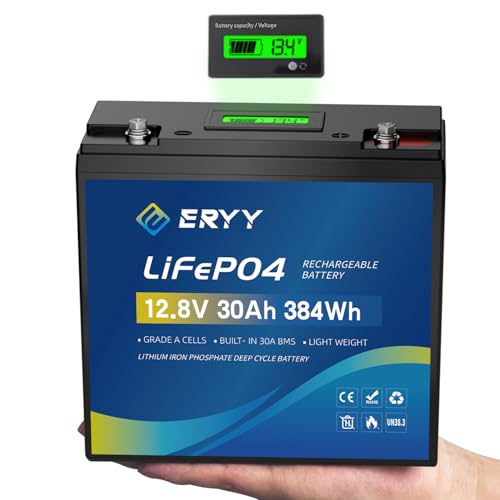
ERYY 12 V 30 Ah LiFePO4 battery
Thirty amp hours for a station running higher power or a multi-day event, still at a weight you can carry.
Check priceUnder $100

DCDG
DCDG 12 V 6 Ah lithium battery pack
A small pack for a handheld, a QRP radio or a summit activation where every ounce is argued over.
Check priceUnder $50

FlexSolar
FlexSolar 100 W foldable solar panel
A folding panel that keeps a low-power station running indefinitely in reasonable sun.
Check priceUnder $100
Powerwerx
Powerwerx PD-5F fused distribution block
A fused distribution panel so each device has its own protection rather than sharing one fuse and one splice.
Check priceUnder $100

smseace
30 A quick-disconnect power connectors, 40-piece
Standard connectors. At a field site, everything plugging into everything else is worth more than it sounds.
Check priceUnder $25
The whole field station, priced with weights and a running total, is the portable field kit build.
Common questions
Questions people ask about this
What size battery do I need for a day of portable operating?
A 20 Ah LiFePO4 pack covers a full day for a radio running 10 to 20 W, because receive current dominates the average and receive current is small. The same pack runs a 100 W radio for under four hours. Work out your own figure from receive current, transmit current and your realistic transmit fraction rather than from capacity alone.
Where should the fuse go?
At the battery terminal, as close to the post as you can get it. The fuse exists to protect the cable, and a fuse at the radio end leaves the whole length of cable unprotected against a short at the battery end. Size it to the wire rather than to the load, so it opens before the cable can overheat, and fit fuses in both conductors.
Can I charge a LiFePO4 battery with a car charger?
Only with a charger that has a genuine LiFePO4 mode. Lead-acid chargers apply a float voltage and often a desulphation or equalisation pulse well above what lithium iron phosphate tolerates, which damages the cells over time. The correct profile is constant current then constant voltage around 14.4 V, with no float stage at all.
Is it safe to leave a lithium battery in the car?
Not in extreme heat or cold. High temperatures accelerate degradation, and charging any lithium chemistry below freezing plates lithium onto the anode and permanently reduces capacity. Discharging in the cold is fine. If a pack has been in a freezing vehicle, let it warm before charging, and do not rely on the management system to catch it for you.
How much solar do I need to run a station all weekend?
Match the panel to your average current rather than your peak. A station averaging 1.5 A needs about 20 W of average solar production, and because a panel produces its rating only in ideal conditions, a 100 W folding panel is a sensible size for that. You also need a charge controller with a LiFePO4 profile, and it is worth checking that the controller is not noisy across the bands you use.
Keep going
Related on this site
Disclaimer Researched guidance for planning purposes, not professional engineering, electrical or legal advice. Antenna work, RF exposure, mast and tower work, grounding and battery handling all carry real risk that depends on your specific site and installation. Verify anything safety-critical against current FCC rules, the National Electrical Code and the manufacturer's own documentation, and hire a professional where the job calls for one. We research equipment from published specifications, regulatory documents and verified owner reviews rather than claiming hands-on testing we have not done.