LiFePO4 versus lead-acid for portable operating
Half the label is usable on lead-acid. Nearly all of it is usable on lithium, at a fifth of the weight.
The short answer
A lead-acid battery should not be discharged past half its rated capacity, so a 40 Ah lead-acid pack gives you the same usable energy as a 20 Ah LiFePO4 pack at five times the weight. LiFePO4 also holds voltage nearly flat through the discharge, delivers four to ten times the cycle life, and works out cheaper per usable amp hour over its life.
- Lead-acid usable
- 50 percent
- LiFePO4 usable
- 90 to 95 percent
- 20 Ah usable, lead-acid
- About 28 lb
- 20 Ah usable, LiFePO4
- About 5 lb
- Lead-acid cycles
- 200 to 500
- LiFePO4 cycles
- 2,000 to 5,000
For decades a portable station meant a sealed lead-acid battery in a crate, and everybody accepted the weight because there was no alternative. Lithium iron phosphate changed that completely, and unlike some technology shifts the arithmetic is not close.
The comparison people make is capacity for capacity, which understates the difference badly, because half a lead-acid battery capacity is unavailable if you want it to survive. Compare on usable energy and the gap becomes fivefold on weight and severalfold on cost over a decade.
The usable capacity problem
A lead-acid battery discharged below about half its rated capacity suffers permanent sulphation and loses life rapidly. Manufacturers rate cycle life at a stated depth of discharge for exactly this reason, and the deeper you go the fewer cycles you get. In practice a 100 Ah lead-acid battery is a 50 Ah battery you are allowed to use.
LiFePO4 has no equivalent penalty. Discharging to 90 or 95 percent is normal and the cycle life figures quoted are at that depth. A 20 Ah lithium pack really is about 19 Ah of energy you can take out and put back thousands of times.
The real comparison
Equal usable energy, both chemistries
| Metric | Sealed lead-acid | LiFePO4 |
|---|---|---|
| Rated capacity for 19 Ah usable | 40 Ah | 20 Ah |
| Weight | About 28 lb | About 5 lb |
| Volume | Large | About a third |
| Cycles at that depth | 200 to 500 | 2,000 to 5,000 |
| Voltage at 50 percent discharged | About 12.1 V | About 13.1 V |
| Self discharge per month | 3 to 5 percent | 1 to 3 percent |
| Purchase price | $70 to $110 | $100 to $180 |
| Cost per usable kWh over life | Higher | Substantially lower |
The voltage row matters more than it looks. A radio at 12.1 V produces noticeably less output and worse audio than the same radio at 13.1 V, so a lead-acid pack degrades your signal through the second half of every session.
The discharge curve
Lead-acid voltage falls steadily from the moment you start drawing current. Lithium iron phosphate holds a nearly flat plateau for most of its discharge and then drops off quickly at the end. For a radio, that is a large practical difference.
- A 100 W radio at 13.8 V makes its rated output. The same radio at 12.0 V makes noticeably less and often distorts on peaks.
- The flat lithium curve means the radio sees close to nominal voltage until the pack is nearly empty.
- The downside of the flat curve is that voltage is a poor state of charge indicator on lithium. Use a coulomb counter or simply track hours.
- The end of a lithium discharge is abrupt. The management system disconnects, and the station stops. Carry a second pack or watch the time rather than waiting for a warning.
- Never run a pack down to the management system cutoff routinely. That is a protection event, not a discharge target.
Safety and charging
- Charge only with a LiFePO4 profile: constant current then constant voltage around 14.4 V, with no float and no equalisation stage. A lead-acid charger with a desulphation mode damages lithium cells.
- Never charge below freezing. Charging any lithium chemistry below zero Celsius plates metallic lithium onto the anode and permanently reduces capacity. Discharging in the cold is fine.
- Fuse at the battery terminal and size the fuse to the wire. A lithium pack can deliver a very large current into a short, and the fuse protects the cable rather than the load.
- Store around half charge in a cool place. Unlike lead-acid, lithium does not want to be kept permanently topped up.
- Do not treat the built-in management system as a controller. It is a last line of defence, and a pack that regularly triggers it is a pack being misused.
- Lead-acid has its own hazards: hydrogen gassing during charge, spillable acid in flooded types, and a mass that hurts if it lands on a foot.
Where lead-acid still makes sense
- A vehicle starting battery, where the huge cold cranking current and the automotive charging profile suit the chemistry.
- A fixed backup where weight is irrelevant, the budget is tight and the battery will sit charged for years.
- An installation where the existing charger is lead-acid and replacing it is not practical.
- Everywhere else, and certainly anywhere you carry the battery, lithium iron phosphate wins clearly.
What to buy
Packs and the wiring around them
Size to your average current draw and the hours you want, then fuse it properly.

GOLDENMATE
GOLDENMATE 12 V 20 Ah LiFePO4 battery
Twenty amp hours, about five pounds, and a full day at QRP power. The standard field pack size.
Check priceUnder $100
ERYY
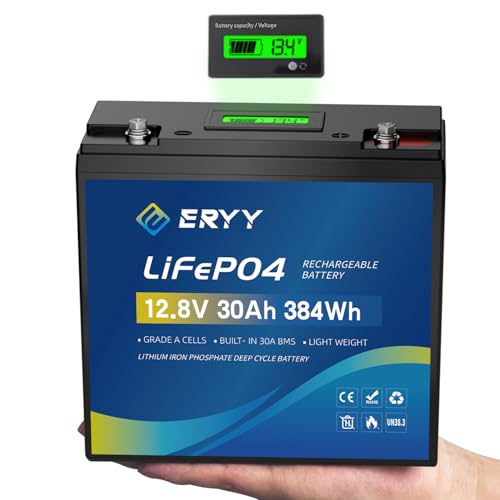
ERYY 12 V 30 Ah LiFePO4 battery
Thirty amp hours for higher power operating or a multi-day event, still carryable.
Check priceUnder $100

DCDG
DCDG 12 V 6 Ah lithium battery pack
A small pack for a handheld or a summit activation where every ounce is argued over.
Check priceUnder $50

FlexSolar
FlexSolar 100 W foldable solar panel
A folding panel with a controller, which turns a day of capacity into an indefinite one.
Check priceUnder $100
Powerwerx
Powerwerx PD-5F fused distribution block
A fused distribution panel so each device has its own protection.
Check priceUnder $100

smseace
30 A quick-disconnect power connectors, 40-piece
Standard connectors, so packs, panels and radios interchange without adapters.
Check priceUnder $25
Common questions
Questions people ask about this
Is LiFePO4 worth the extra cost over lead-acid?
Yes, decisively, once you compare on usable energy rather than rated capacity. A lead-acid battery gives up half its label if you want it to last, so you need twice the rated capacity and five times the weight for the same usable energy. Add four to ten times the cycle life and the cost per usable amp hour over a decade is substantially lower for lithium.
How long will a 20 Ah LiFePO4 battery run my radio?
About a full day for a 10 to 20 W HF radio in typical operating, because receive current dominates the average and receive current is small. The same pack runs a 100 W radio for under four hours. Work it out from receive current, transmit current and your realistic transmit fraction on the [battery runtime calculator](/calculators/battery-runtime/).
Can I charge a LiFePO4 battery with my existing charger?
Only if it has a genuine LiFePO4 mode. Lead-acid chargers apply a float voltage and often a desulphation or equalisation pulse well above what lithium iron phosphate tolerates, which degrades the cells over time. The correct profile is constant current to about 14.4 V then constant voltage, with no float stage at all.
Why does my radio work fine and then suddenly stop?
That is the lithium discharge curve doing what it does. Voltage stays nearly flat for most of the discharge and then falls off quickly at the end, at which point the management system disconnects. It is not a fault. Track operating hours or use a coulomb counter rather than watching the voltage, since voltage tells you very little until it is nearly over.
Is it safe to fly with or ship a lithium battery?
Air transport of lithium batteries is regulated by capacity and by whether they are in checked or carry-on baggage, and the rules change. Check current airline and regulator guidance before travelling, since a pack that is fine in hand luggage may be prohibited in the hold. Shipping is similarly regulated and most carriers require specific labelling.
Keep going
Related on this site
Disclaimer Researched guidance for planning purposes, not professional engineering, electrical or legal advice. Antenna work, RF exposure, mast and tower work, grounding and battery handling all carry real risk that depends on your specific site and installation. Verify anything safety-critical against current FCC rules, the National Electrical Code and the manufacturer's own documentation, and hire a professional where the job calls for one. We research equipment from published specifications, regulatory documents and verified owner reviews rather than claiming hands-on testing we have not done.