Linear versus switching power supply for a ham station
A good switching supply is quiet. A cheap one raises your noise floor across every band you use.
The short answer
A well made switching supply designed for amateur use adds little or nothing to the noise floor, weighs a fraction of a linear supply and costs less. A linear supply is electrically silent by construction and is the right choice for a station chasing weak signals or already fighting noise. Cheap unbranded switchers are the real problem and should be avoided at any price.
- Linear 30 A weight
- About 25 lb
- Switching 30 A weight
- About 4 lb
- Linear efficiency
- 40 to 60 percent
- Switching efficiency
- 80 to 90 percent
- Switching frequency
- 50 to 200 kHz
- Harmonics land on
- HF bands
The power supply argument in amateur radio is really an argument about one thing: whether the supply you are considering is a good example of its type. A well designed switching supply is quiet, light and efficient. A poorly designed one puts carriers every 130 kHz across the whole of HF and there is nothing you can do about it. A linear supply is quiet by construction, which is a real guarantee and comes with a substantial weight penalty.
This page explains how each works, what the noise mechanism actually is, and how to test whether your supply is the problem.
How each one works
- Linear supply
- A mains transformer steps the voltage down, a rectifier converts it to DC, a large capacitor smooths it and a regulator holds it steady by dissipating the excess as heat. There is nothing switching at radio frequencies anywhere in the design, so there is nothing to radiate. The transformer is the weight, and the regulator dissipation is the inefficiency.
- Switching supply
- The mains is rectified straight to high voltage DC, chopped at 50 to 200 kHz by a semiconductor, passed through a small high frequency transformer and rectified again. Because the transformer runs at high frequency it can be tiny, which is where all the weight and cost saving comes from. The chopping is a square wave, and a square wave is rich in harmonics.
- Where the noise comes from
- The harmonics of the switching frequency extend well into HF. A supply switching at 130 kHz produces energy at every multiple of that, which is a carrier every 130 kHz across the whole spectrum. Good designs contain that energy with proper filtering and shielding. Bad ones radiate it from the case and conduct it down the mains and DC leads.
Head to head
Comparison
A 30 amp supply, both ways
| Factor | Linear | Switching |
|---|---|---|
| Weight | About 25 lb | About 4 lb |
| Size | Large, deep | Compact |
| Efficiency | 40 to 60 percent | 80 to 90 percent |
| Heat produced | Substantial | Modest |
| RF noise, good example | None | Negligible |
| RF noise, poor example | None | Severe across HF |
| Price, 30 A | $250 to $400 | $110 to $200 |
| Regulation under load | Excellent | Excellent |
| Behaviour on a short | Current limits | Usually shuts down |
The row that matters is the difference between the two noise rows for switching supplies. That is the entire risk, and it is a purchasing decision rather than a technology decision.
Testing whether your supply is the problem
Five minutes with a battery
- 1
Note the noise floor on several bands
Pick a quiet spot on 80, 40, 20 and 10 metres and write down the S meter reading with the supply running normally.
- 2
Run the radio from a battery instead
A GOLDENMATE 12 V 20 Ah LiFePO4 battery pack or a car battery, with the supply completely unplugged from the mains rather than just switched off.
- 3
Repeat the readings
A drop of one S unit or more, on multiple bands, means the supply is contributing.
- 4
Look for the signature
Switching noise shows as evenly spaced carriers. If you can tune from one to the next and measure a consistent gap, that spacing is the switching frequency and the diagnosis is certain.
- 5
Try ferrites before replacing anything
Several turns of the DC lead through a FT-240-31 ferrite toroid core core, and clip-on Palomar Engineers feedline common-mode chokenot on amazon ferrites on the mains lead. Conducted noise is often most of the problem and this fixes conducted noise.
- 6
If it is radiating from the case, replace it
A supply whose noise persists with the leads choked is radiating directly, and there is no external cure for that.
Which to buy
Three tiers
Three supplies for three situations
Size for the transmit peak with margin, then choose the type by how much noise you can tolerate.
Almost every station

Powerwerx
Powerwerx SS-30DV desktop power supply
Thirty amps of properly filtered switching supply with Powerpole outputs and a meter. Light enough to move, cheap enough not to argue about, and quiet enough that most operators never think about it again.
- Output 30 A
- Weight Light
Tradeoff
A very sensitive station in an already quiet location may still measure a difference against a linear supply.
Anyone who wants to move a birdie off a band
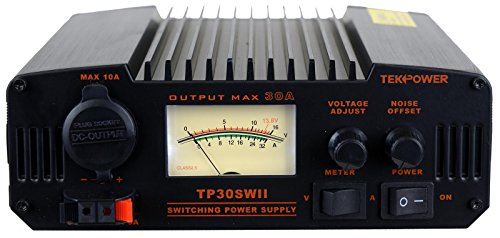
TekPower
TekPower TP30SWII 30 A switching power supply
A variable voltage 30 A switcher with a shiftable switching frequency, so a harmonic that lands on a frequency you care about can be moved somewhere you do not.
- Output 30 A
- Freq shift Yes
Tradeoff
Variable voltage is a bench feature rather than a station one, and it is one more control to set wrong.
Weak signal work, or a station already fighting noise

Astron
Astron RS-35M-AP linear power supply
A linear supply cannot produce switching noise because there is nothing switching in it. Thirty five amps with meters, built to last decades, and the answer when you want the supply removed from the list of suspects permanently.
- Output 35 A
- Type Linear
Tradeoff
Very heavy, runs warm, and costs roughly twice the switching equivalent.
Everything else in the DC chain
Distribution and filtering
The supply is one part. The wiring and the connectors decide whether it performs as specified.
Powerwerx
Powerwerx PD-5F fused distribution block
A fused distribution panel so every device has its own protection and a fault is obvious rather than mysterious.
Check priceUnder $100

smseace
30 A quick-disconnect power connectors, 40-piece
Standard connectors throughout, which is worth more than it sounds when something has to be swapped in a hurry.
Check priceUnder $25

Fair-Rite type 31
FT-240-31 ferrite toroid core
A core for choking the DC leads, which addresses conducted noise from a switching supply.
Check priceUnder $25
Palomar Engineers
Palomar Engineers feedline common-mode choke
Clip-on ferrites for the mains lead and any accessory cable, where rewinding is not an option.
Sold by Palomar Engineers, not Amazon. The link searches the category.

GOLDENMATE
GOLDENMATE 12 V 20 Ah LiFePO4 battery
A battery for the diagnostic test, and a genuinely noise-free supply in its own right.
Check priceUnder $100
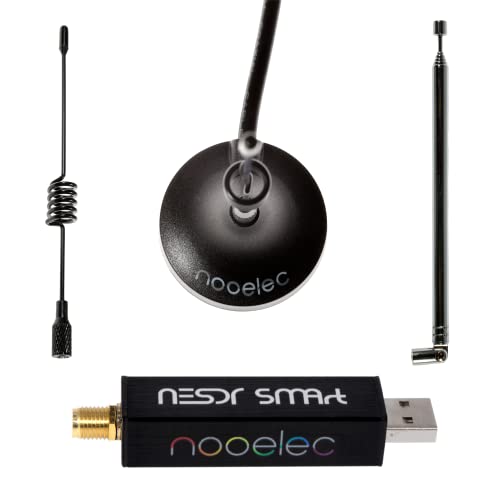
Nooelec
Nooelec NESDR Smart RTL-SDR bundle
Shows the whole spectrum at once, which makes the evenly spaced carrier signature of a switcher unmistakable.
Check priceUnder $100
Common questions
Questions people ask about this
Are switching power supplies bad for ham radio?
Poorly designed ones are, and well designed ones are not. The noise comes from harmonics of the switching frequency extending into HF, which good designs contain with proper filtering and shielding. Supplies sold specifically for amateur service are generally quiet. Cheap unbranded switchers are frequently severe offenders, and no amount of external filtering fixes noise radiating from the case itself.
How do I know if my power supply is causing noise?
Run the radio from a battery with the supply fully unplugged from the mains, and compare noise floor readings on several bands. A drop of one S unit or more identifies the supply. The confirming signature is evenly spaced carriers across the band, where the spacing equals the switching frequency, typically somewhere between 50 and 200 kHz.
Is a linear supply worth the extra weight?
For a station chasing weak signals or already fighting a high noise floor, yes, because it removes the supply from the list of suspects permanently. For most stations a good switching supply is quiet enough that the difference is unmeasurable, and the weight, size and cost savings are substantial. Buy linear when you have a specific reason, not by default.
What size supply do I need?
Twenty five to thirty amps continuous for a 100 W HF transceiver, which draws 20 to 23 A on transmit peaks. Twenty amps for a 50 W VHF mobile. Size at 125 percent of the radio maximum draw and buy on the continuous rating rather than the peak figure, since digital modes sit at the continuous rating for the whole transmission.
Can ferrites fix a noisy switching supply?
Often, because a large share of the noise is conducted out along the mains and DC leads rather than radiated from the case. Several turns of the DC lead through a type 31 core, plus clip-on ferrites on the mains cord, resolves many cases. If the noise persists with every lead choked, the supply is radiating directly and the only cure is a different supply.
Keep going
Related on this site
Disclaimer Researched guidance for planning purposes, not professional engineering, electrical or legal advice. Antenna work, RF exposure, mast and tower work, grounding and battery handling all carry real risk that depends on your specific site and installation. Verify anything safety-critical against current FCC rules, the National Electrical Code and the manufacturer's own documentation, and hire a professional where the job calls for one. We research equipment from published specifications, regulatory documents and verified owner reviews rather than claiming hands-on testing we have not done.