Best Portable HF Radios: 5 Picks for POTA, Summits and Field Day
Portable HF is the fastest growing corner of the hobby, and the radios have changed to suit it: internal tuners, internal batteries, and receive currents measured in hundreds of milliamps.
The short answer
The Xiegu X6100 at under $1,000 is the best portable HF radio for most operators, giving 10 W on all HF bands plus 6 m with an internal battery, an internal automatic tuner and a colour waterfall, so a park activation runs out of one small bag. For maximum capability per ounce the Elecraft KX2 is the reference, and Elecraft sells it themselves rather than through Amazon.
- Typical power
- 5 to 20 W
- RX current
- 0.6 to 0.9 A
- Battery for a day
- 20 Ah LiFePO4
- License needed
- General for most HF
A portable HF station is judged by what you are willing to carry, not by what it can do on a bench. That reframes every specification: receive current matters more than transmit power, an internal tuner is worth more than a better display, and a radio that runs from its own battery removes an entire bag. Our pick is the Xiegu X6100(under $1,000), because it is the only radio here that is genuinely self-contained.
What makes a radio genuinely portable
Not size. Four things, in the order that a day in a park exposes them.
Receive current. A portable station spends most of its time listening, so receive draw sets the battery size. A radio pulling 0.6 A on receive uses 4.8 Ah over an eight hour day of listening alone, before a single transmission. The difference between 0.6 A and 0.9 A is the difference between a 6 Ah pack and a 10 Ah pack in your bag.
An internal tuner. Field antennas are compromised by definition, because you take whatever tree you find. A built-in automatic tuner turns a mediocre antenna into a usable one without adding a box, a cable and a second thing to power. The Xiegu G90 and Xiegu X6100 both have one.
Display readability in sunlight. Underrated until you sit under an open sky with a glossy screen. This is where the character displays on the smallest radios quietly beat the colour ones.
Connector placement and cable count. Every separate box adds a cable, and every cable is a thing to forget. The reason self-contained radios dominate this category is not elegance, it is that fewer parts means fewer failed activations.
The field, compared
| Radio | Power | RX current | TX current | Tuner | Budget |
|---|---|---|---|---|---|
| QRP Labs QMX+ | 5 W | ~0.1 A | ~1 A | No | Kit, maker sold |
| Xiegu X6100 | 10 W | 0.6 A | 3 A | Internal | Under $1,000 |
| Xiegu G90 | 20 W | 0.9 A | 6 A | Internal | Under $500 |
| Elecraft KX2 | 10 W | ~0.15 A | ~2 A | Optional | Maker sold |
| Yaesu FT-891 | 100 W | 1.0 A | 22 A | No | Under $1,000 |
The Yaesu FT-891 is in the table because it is the honest high-power portable answer: it is small, it is rugged, and it costs less than several 10 W radios. What it demands is 22 A of transmit current, which means a 20 Ah or 30 Ah pack rather than a 6 Ah one and several extra pounds in the bag. That is a legitimate trade for a car-based operation and a poor one for a hike.
The Elecraft KX2not on amazon is the reference in this category on receiver performance per ounce, and Elecraft sells it themselves rather than through Amazon, so the button on its card finds comparable portable HF transceivers instead. The QRP Labs QMX+not on amazon is the other maker-sold entry, a multi-band 5 W CW and digital transceiver you build from a kit, and the cheapest route onto HF that exists.
Three tiers
Pick by how far you have to carry it
The tiers here are not about capability so much as about the distance between your car and your operating position. That single fact drives every other decision in a portable station.
Operators driving to the site, who want the extra power

Xiegu
Xiegu G90
Twenty watts with a real internal automatic tuner and a small waterfall, at the lowest price of any capable portable SDR. Twenty watts against 10 W is 3 dB, which is small, but it is free once you accept an external battery and it helps most on the crowded bands where activators get buried.
- Power 20 W
- RX draw 0.9 A
Tradeoff
No internal battery, so a pack and cables are mandatory, and 0.9 A on receive means a bigger pack than the X6100 needs. The head unit and body separate, which is flexible on a desk and one more thing to manage on a picnic table.
Park and field operators who want one bag and no cables
Xiegu
Xiegu X6100
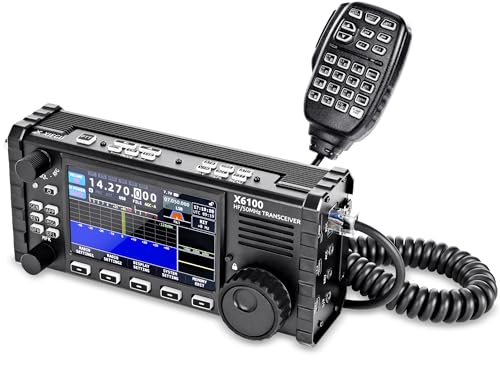
Ten watts, internal battery, internal tuner and a colour waterfall in a body that fits a small sling bag. The internal battery is not enough for a full day alone, and it is enough to keep operating while you swap an external pack, which is the difference between an inconvenience and a finished activation.
- Power 10 W
- RX draw 0.6 A
Tradeoff
The colour screen is harder to read in direct sun than a character display, and the internal battery adds weight you carry even when an external pack is connected anyway.
Summit activators and CW operators who count grams
Elecraft
Elecraft KX2
A 10 W HF transceiver the size of a paperback with a receiver that outperforms radios ten times its size, drawing roughly 150 mA on receive. That receive figure is the specification that matters on a summit: it turns a small battery into a long day. Elecraft sells it themselves rather than through Amazon, so the button below finds comparable portable HF transceivers.
- Power 10 W
- RX draw ~0.15 A
Tradeoff
Do not buy this if you want a waterfall display, if you operate mainly voice from a car, or if the price of a KX2 plus its options is a large fraction of your total station budget. It has no spectrum scope, its display is a character display, and a Xiegu X6100 will make most of the same contacts for less than half the money.
Sold by Elecraft, roughly $1,100 for the base transceiver
Sold by Elecraft, not Amazon. The button searches the category.
How long will a battery actually last?
Runtime is average current against usable capacity, and average current depends on your duty cycle. A realistic activation is roughly one third transmit and two thirds receive for voice, and closer to half and half for CW at speed.
| Radio class | Average current | 6 Ah pack | 20 Ah pack | 30 Ah pack |
|---|---|---|---|---|
| 5 W CW, QMX class | 0.4 A | 13 h | 45 h | 67 h |
| 10 W, X6100 class | 1.4 A | 3.9 h | 13 h | 19 h |
| 20 W, G90 class | 2.6 A | 2.1 h | 6.9 h | 10 h |
| 100 W, FT-891 class | 8.0 A | 0.7 h | 2.2 h | 3.4 h |
Two things fall out of that table. A 10 W radio and a DCDG 12 V 6 Ah lithium battery pack(under $50) is a four hour station that weighs almost nothing, which is the right shape for a hike. A 100 W radio needs an ERYY 12 V 30 Ah LiFePO4 battery(under $100) to get through a morning, which is the right shape for a vehicle. Run your own numbers on the battery runtime calculator.
The antenna is still the whole game
Portable operators discover this faster than home operators, because they change antennas every week and see the difference directly. A resonant wire in a tree beats a loaded whip on a tripod, usually by a wide margin, and it costs a fraction as much.
- End fed half wave. One support, one wire, a ground-level feedpoint and no tuner needed on most bands. A JYR8010 8-band end fed half wave, 150 W(under $100) covers 80 through 10 m at 150 W.
- Loaded vertical. A Gabil GRA-7350T telescopic HF whip(under $250) telescopic whip packs to 16 inches and covers 3.5 to 50 MHz, and it needs a counterpoise or radials to work at all. A Super Antenna MR4010 radial set(under $50) radial set is not optional.
- A way to get a wire up. A Forester arborist throw line kit(under $25) puts a line over a branch fifty feet up from the ground, which is both safer and far more accurate than throwing a rock.
- Support rope. QNR 3/16 in polyester antenna rope, 500 ft(under $50) in polyester, which survives sunlight in a way cheap nylon does not.
How we chose these radios
We research equipment from published manufacturer specifications, regulatory documents including Part 97, published third-party receiver measurements, and verified owner reviews read at volume. We did not test these radios in person and we make no hands-on claims. Current figures are nominal manufacturer figures at 13.8 V unless the maker publishes them at a lower field voltage, and runtime figures above are calculated from those, not measured.
We weighted, in order: total system weight and cable count for a working station, not the radio alone. Then receive current, because it sets the battery. Then whether the radio can match a compromised field antenna without help. Then receiver performance, then display readability outdoors. Transmit power was weighted low, since the whole field spans 5 W to 100 W and the antenna choice moves results more than that range does.
We excluded receive-only radios, single-band radios, and designs with no current firmware or parts support. Prices were researched at time of writing and are set by the retailer at checkout. Two entries are sold by their makers rather than through Amazon, and are included because leaving them out would misrepresent what the best portable gear is.
Buying tips
- Weigh the whole station, not the radio. A lighter radio that needs a separate tuner, a bigger battery and three cables is heavier in the bag.
- Buy the antenna before the second radio. Every operator with two portable radios and one antenna would have been better off the other way around.
- Size the battery from receive current, not transmit. You listen far more than you talk, and that is where the amp hours go.
- Fuse the battery at the battery. A LiFePO4 pack can deliver hundreds of amps into a short, and a field station is full of things that can pinch a wire.
- Take a paper log and a pencil. Cold weather kills phone batteries and tablets fail in bright sun. See logging and confirming contacts.
- Check the site for overhead lines before you throw anything. This is the one mistake in portable operating that has killed people, and it happens during the setup rather than the operating.
Common questions
Questions people ask about this
Can you really work the world with 10 watts?
Routinely, on a good band with a decent antenna. Ten watts against 100 watts is 10 dB, which is under two S units, and it is smaller than the difference between a wire in a tree and a wire on the ground. Park and summit activators work hundreds of contacts a year at 5 to 10 W using end fed half waves and verticals. Where low power genuinely suffers is crowded pileups and marginal night-time conditions on the low bands.
What does QRP mean, and is a 20 watt radio QRP?
QRP conventionally means 5 W output on CW and 10 W peak on SSB, taken from the Q signal meaning reduce power. A 20 W radio is not QRP by that definition, though nobody will object to the word being used loosely. The distinction matters for awards and for some contest categories, which score QRP separately, and it matters for battery sizing, because power draw scales roughly with output.
How big a battery does a portable HF station need?
A 10 W radio drawing about 3 A on transmit and 0.6 A on receive, at a typical activation duty cycle of one third transmit, averages roughly 1.4 A. A 6 Ah LiFePO4 pack therefore supports about four hours, and a 20 Ah pack supports a full day with margin. LiFePO4 holds close to 13 V nearly flat until it is empty, which matters because most radios reduce power below about 11 V.
Do I need an antenna tuner for portable operation?
It depends entirely on the antenna. A resonant end fed half wave cut for the band needs nothing. A random wire, a shortened loaded whip or a linked dipole with the wrong link in place all need a match. Radios with internal tuners like the Xiegu G90 and X6100 remove the extra box and the extra cable, which is worth more in a backpack than it is on a desk.
Is a portable radio a reasonable first HF radio?
Yes, if you already know you want to operate outdoors, and a poor choice if you want a home station. Portable radios trade power and front-panel space for size and battery efficiency. A Yaesu FT-891 gives you 100 W for less than an X6100 and still fits in a bag, at the cost of needing an external battery large enough to feed 22 A. Decide where you will operate before you choose.
What is POTA and why does it matter to this category?
Parks on the Air is an award programme in which operators activate designated parks and other stations chase them. It has become the dominant use of portable HF gear, and it changed what these radios are designed around: fast band changes, internal tuners, low receive current and a display readable in sunlight. If you buy a portable HF radio, this is very likely what you will use it for.
Keep going
Related on this site
- Icom IC-705 review A base station receiver you can carry, at a price that starts arguments.
- Xiegu X6100 review Battery, tuner and waterfall in one box, with the receiver that shows the price.
- Chameleon MPAS 2.0 review The antenna half of a field kit, reviewed on its own.
- The complete portable field kit Radio, antenna, battery and support, with a running total.
- Field Day and POTA How portable operating actually works.
- Best portable power Batteries, solar and how long a pack really lasts.
- Battery runtime calculator Amp hours against duty cycle, for your radio.
- Best HF wire antennas What a portable radio should be feeding.
- Dipole versus end fed half wave One support or two, and what it costs you.
Disclaimer Researched guidance for planning purposes, not professional engineering, electrical or legal advice. Antenna work, RF exposure, mast and tower work, grounding and battery handling all carry real risk that depends on your specific site and installation. Verify anything safety-critical against current FCC rules, the National Electrical Code and the manufacturer's own documentation, and hire a professional where the job calls for one. We research equipment from published specifications, regulatory documents and verified owner reviews rather than claiming hands-on testing we have not done.