Field Day and portable operating events explained
Portable operating is the fastest way to learn a station, because everything that can go wrong does, in daylight, with help nearby.
The short answer
Field Day is an annual emergency-preparedness exercise run over one summer weekend where clubs operate from temporary stations on emergency power. Parks On The Air and Summits On The Air run continuously all year and need only one operator, ten contacts and a park or summit. For a new operator, POTA is the easier entry and Field Day is the better introduction to a club.
- Field Day
- Annual, one weekend
- Winter Field Day
- Annual, cold weather
- POTA
- Year round
- SOTA
- Year round, summits
- Activation minimum
- 10 contacts
- Best first event
- Club Field Day
Operating away from home is where amateur radio stops being an indoor hobby. It is also, unexpectedly, the fastest way to become competent at it. A portable station forces you to understand every part of the chain, because you assemble the whole thing from nothing in an hour and every weakness announces itself immediately.
There are four events worth knowing about, and they suit different people. Two are annual, high-energy, club-centred weekends. Two are continuous programs you can do alone on a Tuesday afternoon.
This page explains what each one is, what you need, and which to try first.
The four events
- Field Day
- The largest annual amateur event in North America, held over a summer weekend. Clubs set up temporary stations in parks and fields, run on generators or batteries, and work as many contacts as possible over 24 hours. It is scored as a contest and framed as an emergency preparedness exercise, and in practice it is a social weekend where a lot of people learn a lot quickly.
- Winter Field Day
- The same idea in cold weather, on purpose. Emergencies do not wait for good conditions, and the event exists to prove a station can be deployed when the ground is frozen. Smaller, friendlier, and a genuinely useful test of gear that works fine in a warm garden.
- Parks On The Air
- A continuous program where operators activate designated parks. An activator needs ten contacts from inside the park to count. Hunters work activators from home. There is no schedule, no entry fee and no season. You can do it on a weekday afternoon with a radio, a battery and a wire.
- Summits On The Air
- The same structure, with summits instead of parks, and points scaled by elevation. Operating gear must be carried to the summit and cannot use vehicle power, which makes it a hiking activity with a radio rather than a radio activity with a walk.
Which one to try first
If you have a local club, go to their Field Day. You will not need to bring anything, somebody will put you in front of a radio, and a whole weekend of watching experienced operators solve problems is worth more than months of reading. New licensees are actively welcomed because there is a scoring category that rewards clubs for getting newcomers on the air.
If you have no club nearby, or you prefer to work alone, start with a park activation. It needs nothing you would not already buy for a portable kit, the bar is ten contacts, and hunters actively search for activators, so getting answered is far easier than calling from home. How to work POTA has the full procedure.
What a portable station needs
The list is short and every item earns its place. This is the same kit whether you are at a park, a summit or a club Field Day site.
Portable kit
The five things a portable HF station cannot do without
| Item | Why it is on the list | Typical cost |
|---|---|---|
| Radio | Something under 20 W and under 3 lb | $300 to $1,300 |
| Antenna and support | A wire and a way to get it into a tree, or a vertical and radials | $50 to $250 |
| Battery | 12 V lithium iron phosphate, sized to the hours you want | $60 to $200 |
| Feedline | Light coax, 25 ft is usually enough | $25 to $60 |
| Something to sit at | A table and chair, because four hours on the ground is four hours you do not do | $40 to $120 |
The full priced version with a running total is the portable field kit build.
The portable core
Light, low current, and assembled from a bag in fifteen minutes.
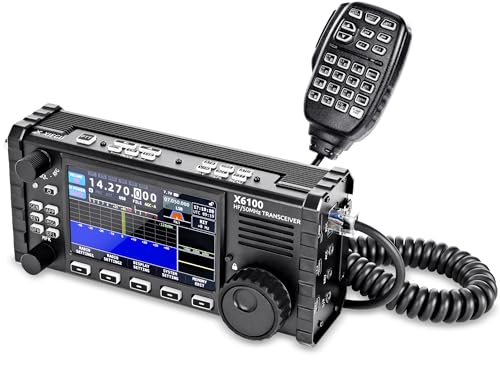
Xiegu
Xiegu X6100
A self-contained portable with an internal battery and tuner. Nothing else to carry, which is the whole argument for it.
Check priceUnder $1,000
Elecraft
Elecraft KX2
The reference portable HF radio: tiny, efficient, and with a receiver that outperforms radios five times its size.
Sold by Elecraft, not Amazon. The link searches the category.
PackTenna
PackTenna Mini 40 m end fed half wave
A packable end fed half wave that fits in a jacket pocket and needs one support point.
Sold by PackTenna, not Amazon. The link searches the category.

GOLDENMATE
GOLDENMATE 12 V 20 Ah LiFePO4 battery
A LiFePO4 pack that runs a 20 W radio for a full day and weighs a fraction of the lead-acid equivalent.
Check priceUnder $100

Forester
Forester arborist throw line kit
Getting the wire over a branch is the actual hard part of a park activation. This is how it is done in one throw.
Check priceUnder $25

FlexSolar
FlexSolar 100 W foldable solar panel
A folding panel extends an activation from one day to as many as you like, which matters for multi-day events.
Check priceUnder $100
Operating on emergency power
Field Day scores extra for running on power that is not the mains, and there is a real lesson buried in the scoring. A station running from a battery behaves differently from one on a bench supply: voltage sags under transmit, a marginal connection shows up as distorted audio, and a radio that draws 22 A on peaks turns a thin cable into a heater.
- Fuse at the battery, not only at the radio, and size the fuse to the wire. See portable power and batteries.
- Use heavier cable than seems necessary. Voltage drop over 10 ft of thin wire at 20 A is enough to make a radio misbehave.
- Standardise on one connector. 30 A quick-disconnect power connectors, 40-piece sets are the hobby default for a reason: everything at a Field Day site plugs into everything else.
- Take a spare fuse, a spare adapter and a spare length of coax. The failure will be one of those three.
- A Surecom SW-102 digital VHF/UHF SWR meter in line tells you instantly whether a strange symptom is the antenna or the radio.
Getting the most out of a club Field Day
- Arrive for the setup, not for the operating. Watching a station go up teaches you more than sitting at one.
- Ask to be shown the logging software before you sit down. Nothing derails a new operator faster than a contact they cannot record.
- Take a turn as a logger for an experienced operator first. You hear the exchange twenty times before you have to produce it.
- Then take the microphone. Somebody will sit beside you, and the exchange on Field Day is short and repetitive by design.
- Stay for the teardown. That is where you learn how the antenna was actually rigged, because it comes apart in reverse.
Common questions
Questions people ask about this
Do I need my own equipment to take part in Field Day?
No. Club Field Day sites are set up so that anybody can walk in and operate, and most clubs actively want new licensees at the microphone because there is a scoring bonus for it. Bring a chair, water and a willingness to log for somebody for an hour first. If you do not have a licence yet, you can still visit, watch and talk to people.
Is Field Day a contest or an emergency exercise?
Both, deliberately. It is scored like a contest, which is what makes people take the setup seriously, and the scoring rewards exactly the things that matter in an emergency deployment: operating away from the mains, setting up in a short window, and getting message traffic through. Treating it purely as either one misses the point of the format.
What is the minimum for a POTA activation?
Ten contacts made from within the boundary of a designated park, logged and uploaded. There is no minimum power, no required mode and no time limit within the calendar day. Many activators reach ten contacts within twenty minutes because hunters actively search for new activations, which makes it far easier to get answered than calling from home.
Can I do SOTA with a heavy radio?
Physically yes, sensibly no. Everything must be carried to the summit and vehicle power is not allowed, so the whole activity pushes toward radios under 3 lb and antennas that fit in a pack. A 100 W radio, a linear supply and a lead-acid battery are a genuinely bad afternoon on a mountain. This is the one activity where a QRP radio is the correct tool rather than a compromise.
How much power do I need for portable operating?
Five to twenty watts is normal and works. Portable operators get answered easily because hunters are actively looking for them, which is worth far more than power. A 5 W radio into a resonant wire at a park regularly produces contacts across a continent. Battery capacity is the real constraint, and lower power buys you hours of operating instead of decibels you do not need.
Keep going
Related on this site
Disclaimer Researched guidance for planning purposes, not professional engineering, electrical or legal advice. Antenna work, RF exposure, mast and tower work, grounding and battery handling all carry real risk that depends on your specific site and installation. Verify anything safety-critical against current FCC rules, the National Electrical Code and the manufacturer's own documentation, and hire a professional where the job calls for one. We research equipment from published specifications, regulatory documents and verified owner reviews rather than claiming hands-on testing we have not done.