How to work POTA: activating a park from scratch
Ten contacts, one afternoon, and the easiest way in the hobby to get answered.
The short answer
To activate a park for Parks On The Air you operate from inside a designated park, make at least ten contacts in a calendar day in UTC, log them with your park reference, and upload the log. A 10 W radio, a wire antenna in a tree and a small lithium battery are enough, and most activations reach ten contacts in under half an hour.
- Contacts to activate
- 10
- Day boundary
- UTC, not local
- Typical power
- 5 to 20 W
- Usual band
- 40 m or 20 m
- Kit weight
- 8 to 15 lb
- Time to ten contacts
- 15 to 45 minutes
Parks On The Air took the structure of a rare-station chase and applied it to a list of thousands of public parks. The result is a program where the operator in the field is the desirable station and everybody at home is trying to work them. For a newer operator that inverts the usual difficulty: instead of calling into a band that ignores you, you call once and a queue forms.
The bar for a successful activation is ten contacts from inside the park boundary in one UTC day. That is it. No minimum power, no required mode, no entry fee.
This page walks through one activation end to end, including the parts that catch people out: the UTC day boundary, the park boundary itself, and getting a wire into a tree without a bad afternoon.
Choosing a park and checking the rules
- Find a designated park near you in the program database. Each has a reference number in the form of a country prefix and a four or five digit number, and that reference goes in every log entry.
- Check the park own rules separately from the program rules. Some parks require a permit for any equipment setup, most prohibit anything attached to a tree in a way that damages bark, and a few prohibit antennas outright.
- Look at the site on a map before you go, and specifically look for overhead power lines to shelters, toilet blocks and car parks. Those service drops are low, and in summer they hide in the canopy.
- Pick a spot with a tree at the edge of a clearing and space to run a wire away from paths. Away from paths matters, because a wire at head height across a footpath is an injury waiting to happen.
- Confirm you are inside the boundary. This catches people constantly: the car park may belong to a different agency, and a contact made from outside the boundary does not count.
What to pack
A park activation kit is small. Everything here fits in a shoulder bag except the mast, if you take one.
A working activation kit
A radio, a wire, a way to hang it, a battery and something to sit at. Prices researched at time of writing.
Xiegu
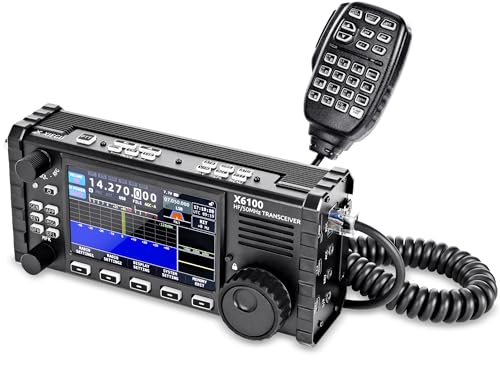
Xiegu X6100
Internal battery and tuner in one box. The lowest-friction way to activate, because there is nothing to connect except the antenna.
Check priceUnder $1,000
Elecraft
Elecraft KX2
The lightest capable HF radio with a genuinely excellent receiver. The one that makes a summit activation pleasant.
Sold by Elecraft, not Amazon. The link searches the category.
QRP Labs
QRP Labs QMX+
A tiny multiband CW and digital transceiver at a price that makes a dedicated field radio easy to justify.
Sold by QRP Labs, not Amazon. The link searches the category.
PackTenna
PackTenna Mini 40 m end fed half wave
A pocketable end fed half wave. One support point, no radials, no tuner needed on the design bands.
Sold by PackTenna, not Amazon. The link searches the category.
Wolf River Coils
Wolf River Coils Take It Along vertical
A coil-loaded vertical with a spike, for parks with no trees. Sets up in five minutes and works on any band with a tap change.
Sold by Wolf River Coils, not Amazon. The link searches the category.

GOLDENMATE
GOLDENMATE 12 V 20 Ah LiFePO4 battery
Enough capacity for a full day at 20 W, at a weight you will actually carry back to the car.
Check priceUnder $100

JEFA Tech
JEFA Tech 240-series flex coax, 50 ft with PL-259
Light, low-loss enough coax at a length that reaches a tree without dragging.
Check priceUnder $50

Camp Field
Camp Field folding aluminum table
A folding table and chair turn a two hour activation from an endurance test into a pleasant afternoon.
Check priceUnder $100
Setting up
From car park to first call
- 1
Walk the site and look up
Find every overhead conductor before anything leaves the bag. Shelters and lighting in parks are fed by low service drops that are easy to miss.
- 2
Get the support line up first
A Forester arborist throw line kit with a throw weight over a branch about 25 to 30 ft up. Do this before you unpack the radio, because it is the step most likely to need three attempts.
- 3
Hang the wire and keep the ends out of reach
The far end of an end fed antenna sits at high RF voltage. Terminate it above head height with a Nylon dog bone antenna insulators, 10-pack insulator and rope, well away from any path.
- 4
Run the coax back and check SWR before you transmit properly
A quick check with a Surecom SW-102 digital VHF/UHF SWR meter or the radio own meter confirms the antenna is up and connected. Two minutes here saves twenty of confusion.
- 5
Set power sensibly
Five to ten watts is normal and works. The battery is the constraint, not the propagation, and hunters are actively looking for you.
- 6
Spot yourself
Post your frequency, mode and park reference to the program spotting page from your phone. This is the single biggest difference between a slow activation and a queue. Hunters watch the spots.
Calling and running the pileup
The exchange is short by design, because both sides want to move on to the next contact.
- Call: "CQ POTA, CQ Parks On The Air, this is KX0ABC, Kilo X-ray Zero Alpha Bravo Charlie, park Kilo dash four four four four, over."
- When several answer at once, pick out any fragment you heard: "the station with Alpha Bravo, go ahead."
- The exchange is callsign and signal report both ways. Name and location are optional politeness, not required.
- Repeat your callsign every few contacts. New hunters arrive constantly and need it.
- Log immediately, every contact, before the next one. Reconstructing a log afterwards is how activations fail.
- If it goes quiet, change bands rather than waiting. Forty metres in the late afternoon and twenty in the middle of the day is the usual pattern.
After the activation
- Pack out everything, including the throw line and any tape. A park that bans amateur setups usually got there because somebody left something behind.
- Convert your log to ADIF with your callsign, the park reference and the date, following the program naming convention.
- Upload it. Hunters cannot get credit until you do, and the queue that formed for you is waiting on it.
- Upload to Logbook of The World as well, since park activations count toward other awards too. See logging and confirming contacts.
- Note what failed. Every activation reveals one weak part of the kit, and fixing it before the next trip is how a field kit becomes reliable.
What usually goes wrong the first time
- The throw line goes nowhere
- Practise in a garden before the first activation. A weight that will not clear a branch at 30 ft in a park cleared it fine at 15 ft at home, and the difference is technique rather than equipment.
- The battery goes flat sooner than expected
- Transmit current at 20 W is not a fifth of transmit current at 100 W, and receive current runs the whole time. Work it out on the battery runtime calculator rather than estimating.
- SWR is fine at home and terrible at the park
- Ground conditions and nearby objects change an antenna. This is normal, and it is why a small tuner such as an ATU-100 EXT automatic antenna tuner earns its place in the bag.
- Nobody answers
- You are almost certainly not spotted. Spotting is the mechanism the whole program runs on. Post the spot and the situation changes within a minute.
- The log is a mess
- Log during, not after. A paper log with pre-drawn columns and a pencil beats a phone app in cold weather and never runs out of battery.
Common questions
Questions people ask about this
How many contacts do I need for a successful activation?
Ten, made from inside the park boundary within a single UTC day. There is no minimum power, no required mode and no time restriction beyond the UTC day boundary. Contacts with other activators in other parks count for both sides and are worth chasing, since park to park contacts are popular and easy to find on the spotting page.
Do I need a permit to operate in a park?
It depends entirely on the park. Most public parks require nothing for a person sitting at a picnic table with a radio and a wire in a tree. Some state and national parks require a permit for any organised activity or for anything attached to a structure. Check the managing agency rules for the specific park before you go, and never attach anything to a tree in a way that damages it.
What power do I need for a park activation?
Five to twenty watts is normal and produces a queue. Hunters actively search the spotting page for new activations, so getting answered is far easier than calling from home at any power. Battery capacity is the real limit, and running 10 W instead of 100 W turns a two hour activation into a full day on the same pack.
Can I activate a park without a General license?
A Technician can activate using the VHF and UHF bands and the Technician portion of 10 metres, which works well in populated areas and during high solar activity but is unreliable in a remote park. The program is far easier with a General license and access to 40 and 20 metres. Many people use a first activation as their reason to sit the General exam.
What if I only make seven contacts?
The contacts still count for the hunters who worked you, and they still count toward other awards in your own log. The activation simply does not qualify, and you can return another day. Uploading a short log is still the right thing to do, because the people who worked you get their credit either way.
Keep going
Related on this site
Disclaimer Researched guidance for planning purposes, not professional engineering, electrical or legal advice. Antenna work, RF exposure, mast and tower work, grounding and battery handling all carry real risk that depends on your specific site and installation. Verify anything safety-critical against current FCC rules, the National Electrical Code and the manufacturer's own documentation, and hire a professional where the job calls for one. We research equipment from published specifications, regulatory documents and verified owner reviews rather than claiming hands-on testing we have not done.