Putting up a wire antenna: rope, trees and tension
The wire is the easy part. The rope, the branch and the tension are what decide whether it is still up next year.
The short answer
Use an arborist throw weight and line to get a support rope over a branch 25 to 40 ft up, then haul UV-stable Dacron rope through and tension it with a counterweight or a spring so the tree can move without breaking the wire. Terminate both ends with insulators, keep the high-voltage ends above head height, and never work near an overhead conductor.
- Useful branch height
- 25 to 40 ft
- Throw weight
- 8 to 12 oz
- Rope type
- UV-stable Dacron
- Tension allowance
- Counterweight or spring
- Wire gauge
- 14 to 18 AWG stranded
- Crew
- Two people
Every wire antenna guide spends its pages on lengths and impedances and then says "hang it in a tree" as though that were a single step. It is the whole job. The wire costs twenty dollars and takes ten minutes to cut. Getting a line over the right branch, at the right height, with the right rope, tensioned in a way that survives a tree moving in the wind, is the part that takes an afternoon and the part that decides whether the antenna is still there in a year.
None of it is difficult. It is a set of small techniques that nobody tells you, and once you know them a wire antenna goes up in an hour.
Getting a line into a tree
There are three methods and one of them is clearly best.
- Arborist throw weight and line
- A lead-shot bag on thin, slick line, thrown underhand with a pendulum swing. This is what tree workers use, it is controlled, it reaches 40 ft reliably with practice, and a Forester arborist throw line kit set costs less than a takeaway meal. The line is deliberately slippery so it pulls through branches without snagging.
- Slingshot or catapult
- Reaches higher and is far less controllable. A missed shot sends a weight somewhere you did not intend, at speed. Usable, but not near houses, cars, people or anything overhead, which describes most gardens.
- Throwing the rope itself
- Does not work above about 15 ft. Rope has too much air resistance and too much friction over bark. Everyone tries it first and everyone stops.
The throw, step by step
- 1
Pick the branch before you pick up the weight
You want a branch that is high, roughly horizontal, thick enough to take the load, and clear of the branches below it. A line that lands over three branches on the way down will not pull through.
- 2
Flake the line out on the ground
Lay it in loose figure-of-eight coils, or use the cube the set comes with. A tangled line stops the weight mid flight, which is both frustrating and the most common failure.
- 3
Throw underhand with a pendulum swing
Hold about 3 ft of line above the weight, swing it, release at the bottom of the arc so it goes up rather than out. Overhand throws go flat and short.
- 4
Let it fall all the way back to the ground
If the weight hangs up in the canopy, shake the line rather than pulling hard. A stuck weight pulled hard becomes a permanently stuck weight.
- 5
Tie the support rope to the throw line and haul it over
Use a knot with a smooth profile so it does not catch on bark. Pull steadily.
- 6
Leave the rope over the branch, not tied to it
A rope that runs freely over the branch lets you lower the whole antenna for maintenance from the ground. A rope tied to the branch means a ladder every time.
Rope choice, which is not a small decision
The rope is the component that fails. It sits in ultraviolet light all year, it takes cyclic loading every time the wind blows, and it saws gently against bark. Hardware store polypropylene lasts one season and then drops your antenna.
- Dacron or polyester is the standard choice. UV stable, low stretch, and it does not lose strength when wet. QNR 3/16 in polyester antenna rope, 500 ft in 1/8 in or 3/16 in is the usual size for a wire antenna.
- Avoid nylon for the support run. It stretches significantly and then keeps stretching, so the antenna sags progressively over months.
- Avoid polypropylene entirely. It is the cheap yellow or orange rope, it degrades fast in sunlight, and it is the most common cause of a wire antenna appearing in the garden after a storm.
- Oversize it. The load is small, so rope size is chosen for abrasion and UV life rather than strength. Thicker rope also runs over a branch with less sawing.
- Use a dark colour if you would rather the installation was not obvious from the road.
Letting the tree move
A tree sways several feet in wind. A wire strung tight between two trees, or between a tree and a fixed point, has nowhere to give, so the wind load goes into the wire, the insulators and the feedpoint. Something eventually breaks, usually at the connection to the transformer, and usually in the worst weather of the year.
- Counterweight
- Run the support rope over the branch and down to a weight hanging clear of the ground, rather than tying it off. When the tree moves, the weight lifts. A gallon of water or a few bricks in a bag is enough. This is the best solution and it costs nothing.
- Spring or bungee
- A heavy spring in the run, sized so it extends under wind load but not under static load. Simpler than a counterweight where there is no room for one, and it needs replacing every few years as it fatigues.
- Deliberate sag
- Leave the wire visibly slack. A catenary curve absorbs a surprising amount of movement. It costs almost nothing in performance and it is what most long-lived installations actually look like.
- Never do this
- Do not tension a wire antenna like a guitar string between two trees. It looks tidy for a week and then it fails, and the failure is usually the feedpoint rather than the rope.
The ends
The tips of a dipole and the far end of an end fed carry high RF voltage on transmit. Contact causes a deep RF burn, and at 100 W the voltage at the end of a half wave is in the kilovolts.
- Terminate every end into an insulator such as a Nylon dog bone antenna insulators, 10-pack, with rope taking the strain beyond it. The conductor should never be the thing tied to something.
- Keep the ends above head height and out of reach of anyone in the garden, including anyone standing on something.
- Keep the ends away from gutters, downpipes and metal fences. Capacitive coupling to nearby metal detunes the antenna and can arc.
- Add a wrap of Self-amalgamating rubber splicing tape over the feedpoint connections. Water in a connector is the second most common failure after rope.
- Support the coax so its weight does not hang on the feedpoint. A short loop of rope taking the strain saves the connector.
Wire, and whether gauge matters
Electrically, almost not at all at HF. Mechanically, a great deal. Thin wire breaks at stress points, stretches, and is invisible enough to be a hazard.
Wire selection
Antenna wire by application
| Wire | Best for | Notes |
|---|---|---|
| 14 AWG stranded THHN | Permanent home installs | Tough, insulated, cheap, easy to handle |
| 16 to 18 AWG stranded | Portable and field antennas | Lighter to carry, less strong, fine for temporary spans |
| Copperweld or copper clad steel | Long spans, 80 m and 160 m | Much higher tensile strength, harder to work with |
| Silky or Kevlar cored wire | Backpack antennas | Very light, very strong, expensive per foot |
| Bare solid copper | Short elements and radials | Work hardens and snaps at flex points, avoid for spans |
Insulated wire is very slightly shorter for the same resonance than bare wire, usually by two to four percent. Cut long and trim rather than relying on a table. The antenna wire gauge chart has the full comparison.
Once it is up, sweep it at final height before you trim anything. The best antenna analyzers page explains why an inexpensive NanoVNA shows too long or too short in one sweep, where an SWR meter needs a dozen transmissions.
The installation kit
Everything the job needs
Line, rope, insulators, wire and the tape that keeps water out of the connections.

Forester
Forester arborist throw line kit
Throw weight and slick line. The single item that turns an afternoon of frustration into a ten minute job.
Check priceUnder $25

Quality Nylon Rope
QNR 3/16 in polyester antenna rope, 500 ft
UV-stable low-stretch support rope. The component that decides whether the antenna is still up next year.
Check priceUnder $50

Redman
Nylon dog bone antenna insulators, 10-pack
End insulators so the wire terminates into rope rather than into whatever is nearby.
Check priceUnder $50
XRDS-RF
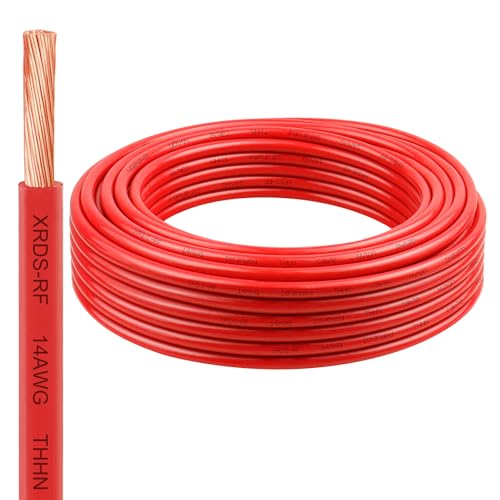
XRDS-RF 14 AWG stranded copper wire, 25 ft
Stranded insulated antenna wire that survives being hauled into a tree and left there.
Check priceUnder $25

Paladin
Paladin 14 AWG stranded copper wire, 500 ft
A larger spool for anyone building several antennas or a radial field.
Check priceUnder $100

Maxwel
Self-amalgamating rubber splicing tape
Self-fusing tape for the feedpoint. Water in the connector is the failure you cannot see from the ground.
Check priceUnder $25

Easy Up
Easy Up 20 ft telescoping push-up mast
When there is no tree, a telescoping mast provides the support point, and it comes back down alone.
Check priceUnder $250

Bonison
UV-resistant heavy duty zip ties, 100-pack
UV-rated ties for dressing the coax. Ordinary ties turn to dust in a year and drop the feedline.
Check priceUnder $25
Common questions
Questions people ask about this
How high does a wire antenna need to be in a tree?
Aim for 30 to 40 ft if the tree allows. On 20 metres that is around half a wavelength and produces a genuinely good low-angle pattern. On 40 metres it is a quarter wavelength, which works but favours regional contacts. Below about 20 ft, a horizontal wire radiates mostly upward. Any height is workable and more is always better.
Will hanging an antenna hurt the tree?
Not if the rope runs over a branch rather than being tied around it. A rope tied tightly around a growing limb girdles it over a few years. Running the rope free over the branch, with a counterweight at the far end, applies no constricting load and lets you lower the antenna without climbing. Never drive anything into a tree for this.
Should the wire be tight or loose?
Loose. A visible sag costs essentially nothing in performance and absorbs the several feet of movement a tree makes in strong wind. A wire tensioned tight has nowhere to give, so wind load goes straight into the feedpoint connection, which is where these antennas actually break. Use a counterweight rather than a fixed tie-off wherever you can.
Does insulated wire work as well as bare wire?
Yes, with one adjustment. Insulation slows the wave slightly, so an insulated wire resonates a few percent lower than a bare wire of the same length and needs to be cut two to four percent shorter. Insulated wire is more durable, safer where anything might touch it, and easier to handle. Cut long, measure the resonance, and trim.
What do I do if there are no trees?
A telescoping mast provides the support point for a sloper or an inverted L, and a ground mounted vertical avoids the need for height entirely at the cost of needing a radial field. A single 20 ft push-up pole at the far corner of a garden, with a wire running back to the house, is a perfectly good HF antenna and needs nothing overhead.
Keep going
Related on this site
- Full wave loop calculator Loop length and shape, if you are hanging a loop rather than a dipole.
- Your first HF antenna Which of the three shapes suits your lot.
- Antenna installation safety Read this before the first throw.
- Antenna wire chart Gauge, strength and span by application.
- Dipole length calculator Cut length for your frequency and wire.
Disclaimer Researched guidance for planning purposes, not professional engineering, electrical or legal advice. Antenna work, RF exposure, mast and tower work, grounding and battery handling all carry real risk that depends on your specific site and installation. Verify anything safety-critical against current FCC rules, the National Electrical Code and the manufacturer's own documentation, and hire a professional where the job calls for one. We research equipment from published specifications, regulatory documents and verified owner reviews rather than claiming hands-on testing we have not done.