Best Antenna Analyzer for Ham Radio (2026)
The short answer · Updated 2026
The best antenna analyzer for most hams is the NanoVNA H4: 9 kHz to 1.5 GHz, a 4 inch touchscreen, and an open, short and load calibration kit in the box. It sweeps resistance, reactance and SWR so you can see whether an antenna is too long, too short or broken. For rugged field work the RigExpert AA-650 Zoom (0.1 to 650 MHz) is the step up.
A meter tells you there is a problem. An analyser tells you what it is.
Picks at a glance
Antenna analyzers and meters compared
| Tool | Range | Shows | In the box |
|---|---|---|---|
| NanoVNA H4 vector network analyzer | 9 kHz to 1.5 GHz | SWR, R, X, Smith chart, TDR | Open, short, load cal kit |
| RigExpert AA-650 Zoom antenna analyzer | 0.1 to 650 MHz | SWR, R, X, Z, return loss | Bluetooth, N connector |
| Surecom SW-102 digital VHF/UHF SWR meter | 125 to 525 MHz | Power and SWR, inline | Meter only |
Ranges and contents from the manufacturer listings. An analyzer and an inline meter do different jobs, and most stations end up with one of each.
- Best first buy
- NanoVNA H4
- What it shows
- R, X and SWR swept
- Handheld alternative
- RigExpert AA-650
- Inline meter
- Different job
- Calibration
- Required, per range
- Never connect to
- A live transmitter
An SWR meter answers one question at one frequency: how much power is coming back. An analyser answers the question you actually have, which is why. It sweeps a range and shows you the shape, and the shape tells you whether the antenna is too long, too short, badly matched at resonance, broken, or fine and being ruined by a connector.
The arrival of inexpensive vector network analysers changed this category completely. A tool that cost thousands a decade ago now costs less than an evening out, and it does more than the handheld analysers it replaced. Everything here is researched from published specifications and verified owner reports rather than hands-on testing we have not done.
What an analyser measures that a meter does not
- Resonant frequency
- The frequency where reactance goes to zero. An SWR meter reading at one frequency cannot tell you whether the antenna is too long or too short, and the resonant frequency answers that immediately.
- Resistance and reactance separately
- A 2 to 1 SWR caused by 100 ohms of resistance is a different problem from a 2 to 1 caused by reactance. The first is usually antenna height or a missing radial field; the second is length.
- The whole band at once
- A sweep shows the shape of the response. A clean deep dip means a healthy antenna; a shallow one means the feedpoint impedance is wrong; a flat line means an open or a short.
- Cable characteristics
- A two-port instrument measures the loss of a feedline directly, which is how you find a cable that has taken water without cutting it open.
- Choke and balun impedance
- A common mode choke is specified in ohms of impedance across a frequency range, and an analyser is how you confirm your winding actually achieves it.
- Filter and trap response
- Useful for confirming a trap is still resonant where it should be, which is the usual failure on a trapped vertical or beam.
Three tiers
Three levels of measurement
They do different jobs. Most stations end up with two of the three.
Confirming the radio is doing what you think

Surecom
Surecom SW-102 digital VHF/UHF SWR meter
An inline digital meter reading forward power, reflected power and SWR at real transmit power. This is the tool that tells you the radio is actually transmitting and the antenna is actually connected, which is the first question in every diagnostic sequence.
- Type Inline
- Reads Power and SWR
Tradeoff
One frequency at a time, and it tells you nothing about why.
Anyone who builds or trims an antenna

AURSINC
NanoVNA H4 vector network analyzer
A full vector network analyser for less than most SWR meters. Sweeps the band, shows resistance and reactance separately, measures cable loss and choke impedance, and saves the result. It is the single most useful instrument an antenna builder can own.
- Range To 1.5 GHz
- Type VNA
Tradeoff
Needs calibration for each frequency range and the interface takes an evening to learn.
Measuring at the antenna, in the weather, repeatedly

RigExpert
RigExpert AA-650 Zoom antenna analyzer
A rugged handheld with a real display, a proper battery and no computer needed. When the measurement has to happen at the top of a mast or in a field, a purpose-built instrument that survives being carried is worth the difference.
- Range HF to UHF
- Build Field rugged
Tradeoff
Costs several times a NanoVNA and does less on the bench.
Comparison
Comparison
Measurement tools compared
| Tool | Measures | Swept | Best for |
|---|---|---|---|
| NanoVNA H4 vector network analyzer | R, X, SWR, loss, phase | Yes | Antenna building and troubleshooting |
| RigExpert AA-650 Zoom antenna analyzer | R, X, SWR, loss | Yes | Field and mast top work |
| Surecom SW-102 digital VHF/UHF SWR meter | Forward, reflected, SWR | No | Confirming real transmit conditions |
| Daiwa CN-501H cross-needle SWR and power meter | Forward and reflected simultaneously | No | Watching a tuner work in real time |
| XRDS-RF 100 W dummy load, 50 ohm | Nothing, it is a reference | No | The known good load in every test |
| Daiwa CS-201A two-position coax switch | Nothing, it is a switch | No | Comparing two antennas back to back |
The inline meters and the analysers are complementary rather than competing. An analyser cannot be left in line during operation; an inline meter cannot sweep. Most active stations own one of each.
Using an analyser without damaging it
- Never connect an analyser to a live transmitter. Its input is a milliwatt-level receiver and a transmit burst destroys it instantly. This is by far the most common way these instruments die.
- Calibrate for the frequency range you are about to use. Open, short and load at the end of whatever cable you will measure through. Calibration is what makes the reading mean anything.
- Calibrate at the far end of any adapter chain, so the adapters are included in the calibration rather than in the measurement.
- Measure the antenna at final height. A reading taken with the antenna on the ground is not the antenna you will use.
- Save the sweep. A baseline from when everything worked is the fastest possible diagnosis when something later does not.
- Use a known good load to sanity check before believing a surprising result. An XRDS-RF 100 W dummy load, 50 ohm should read close to a flat 50 ohms across the range.
Reading the sweep
Interpretation
What each sweep shape means
| What you see | Cause | Fix |
|---|---|---|
| Clean dip below the band | Antenna too long | Trim, using the trim table |
| Clean dip above the band | Antenna too short | Add wire |
| Shallow dip, never reaches low SWR | Feedpoint impedance not near 50 ohms | Height, or more radials |
| Flat and high everywhere | Open or short circuit | Check continuity, inspect connectors |
| Flat and low everywhere | Very lossy feedline masking reflections | Measure cable loss directly |
| Dip moves when it rains | Water in a connector or a trap | Replace the connector, reseal |
| Reading changes when you touch the coax | Common mode current | Fit a choke at the feedpoint |
The full diagnostic sequence is in reading SWR and fixing a bad match, and the trimming procedure is in how to tune an antenna with an SWR meter.
Everything else worth having
The measurement bench
A reference load, a switch and the connectors to reach anything.
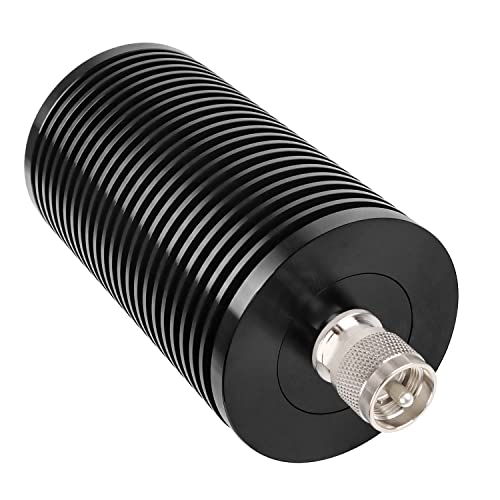
XRDS-RF
XRDS-RF 100 W dummy load, 50 ohm
A known good 50 ohm load. The first substitution in every diagnostic sequence and the reference for every calibration check.
Check priceUnder $50

Daiwa
Daiwa CN-501H cross-needle SWR and power meter
A cross-needle meter showing forward and reflected power at once, which makes tuner behaviour visible.
Check priceUnder $250

Daiwa
Daiwa CS-201A two-position coax switch
A two-position coax switch for comparing two antennas back to back on the same signal.
Check priceUnder $50

exgoofit
SO-239 barrel couplers, 6-pack
Barrels for splitting a feedline run in half to isolate which section carries the fault.
Check priceUnder $25

Fanbalunke
PL-259 solder connectors with reducers, 6-pack
Spare connectors, since the fault is very often a connector rather than an antenna.
Check priceUnder $25

Fair-Rite type 31
FT-240-31 ferrite toroid core
A choke core, whose impedance you can now actually measure rather than assume.
Check priceUnder $25
Common questions
Questions people ask about this
What is in an antenna analyzer kit?
An antenna analyzer kit is the analyzer plus the parts you need to trust its readings: an open, short and load calibration set, SMA to SO-239 adapters, a short test lead and usually a case. The NanoVNA H4 ships as a kit with all of that in the box, which is why it is the pick over bare-board NanoVNA listings that leave you buying the calibration standards separately.
What is a cable and antenna analyzer?
The same instrument, used on the feedline as well as the antenna. A cable and antenna analyzer sweeps the whole system and can run a time domain reflectometry (TDR) measurement to find where a coax run is damaged, water-logged or badly terminated, and it measures the loss of a cable when the far end is shorted or open. The NanoVNA H4 does both jobs; an inline SWR meter does neither.
Do I need an antenna analyser or is an SWR meter enough?
They answer different questions. An SWR meter tells you at one frequency how much power is coming back, which confirms the antenna is connected and roughly right. An analyser sweeps a range and shows resistance and reactance separately, which tells you whether an antenna is too long, too short or badly matched at resonance. If you build or trim antennas, the analyser saves far more time than it costs.
Is a NanoVNA good enough or should I buy a proper analyser?
A NanoVNA is a proper analyser. It is a genuine two-port vector network analyser measuring magnitude and phase, which is more capability than the handheld antenna analysers it displaced. Its weaknesses are ruggedness and the interface, so a purpose-built handheld is worth the difference when measurements happen up a mast or in the rain.
Why does my analyser give different readings than my SWR meter?
Usually calibration and cable. An analyser calibrated at its own connector measures through the feedline, so it reports the impedance at the shack end rather than at the antenna, and feedline loss makes a mismatched antenna look better than it is. Calibrate at the far end of the cable you are measuring through, and remember an inline meter reads under real transmit conditions.
What comes in an antenna analyzer kit?
A NanoVNA H4 kit includes the analyzer with a built-in battery, an SMA calibration set (open, short and 50 ohm load plus a barrel), two short SMA cables and USB leads. What it does not include is an SMA to UHF (SO-239) adapter, which you need to reach a PL-259 on most ham antennas, so budget a few dollars for one. Calibrate through that adapter, not before it.
Can I damage an analyser?
Easily, and the usual way is connecting it to a live transmitter. Its input is a milliwatt-level receiver and a transmit burst destroys it immediately. Disconnect the antenna from the radio completely before connecting the analyser, and never leave one in line where somebody could key up. Static discharge from a large antenna is the second cause.
What should I measure first with a new analyser?
A known good dummy load, to confirm the instrument and your calibration are honest. Then every antenna you own, saved as a baseline. Those saved sweeps become the fastest diagnosis you will ever have, because a year later when something is wrong you can compare the new sweep against the one from when everything worked.
Keep going
Related on this site
Sources
- NanoVNA H4 range, display, TDR and included calibration kit: the AURSINC and Hugen NanoVNA-H4 product specification.
- RigExpert AA-650 Zoom range, impedance systems and SWR range: RigExpert published specifications.
- SWR, return loss and impedance interpretation: The ARRL Antenna Book, transmission lines and antenna measurement chapters.
Disclaimer Researched guidance for planning purposes, not professional engineering, electrical or legal advice. Antenna work, RF exposure, mast and tower work, grounding and battery handling all carry real risk that depends on your specific site and installation. Verify anything safety-critical against current FCC rules, the National Electrical Code and the manufacturer's own documentation, and hire a professional where the job calls for one. We research equipment from published specifications, regulatory documents and verified owner reviews rather than claiming hands-on testing we have not done.