Best SWR and power meters
The instrument that stays in the feedline and tells you the station is behaving.
The short answer
A cross-needle meter such as the Daiwa CN-501H shows forward and reflected power simultaneously, which makes SWR readable at a glance and tuner behaviour visible in real time. A digital inline meter such as the Surecom SW-102 is smaller, works on VHF and UHF, and suits a portable kit.
- Cross-needle
- Shows both at once
- Digital inline
- Compact, wideband
- Typical accuracy
- Plus or minus 10 percent
- Dummy load
- Reads a flat 1:1
- Insertion loss
- Negligible
- Leave in line
- Yes
An inline meter is the one instrument that stays connected. Its job is not precision measurement but continuous reassurance: the radio is putting out what it should, the antenna is still connected, and nothing has changed since yesterday. That last point is what actually catches faults, because an antenna problem almost always announces itself as a reading that is different from usual.
These are researched from published specifications and verified owner reports rather than hands-on testing we have not done. Prices were researched at time of writing.
Cross-needle versus digital
- Cross-needle analogue
- Two moving coil meters with overlapping scales. Forward power on one needle, reflected on the other, and SWR read from the point where they cross on a printed arc. The advantage is that you see all three quantities simultaneously and continuously, which makes dynamic behaviour such as a tuner searching or an antenna arcing immediately obvious.
- Digital inline
- A sampling head and a numeric display. Smaller, usually wider in frequency coverage, and often battery powered. Excellent for a portable kit and for VHF and UHF where analogue meters are less common. The numbers update in steps rather than continuously, so fast changes are harder to see.
- Radio built-in meter
- Convenient and generally the least trustworthy, because it measures at the radio output behind whatever is in the signal path and its scale is often nominal rather than calibrated. Useful for relative comparisons and not for absolute figures.
Three tiers
Three meters
One for the shack, one for the field, one for the truth.
A portable kit or a VHF station

Surecom
Surecom SW-102 digital VHF/UHF SWR meter
A compact digital inline meter covering VHF and UHF as well as HF, battery powered, small enough to live in a field bag. It tells you the radio is putting out power and the antenna is connected, which resolves most problems on a park activation.
- Type Digital
- Power Battery
Tradeoff
Digital sampling makes fast changes harder to see than on a needle.
A permanent HF station

Daiwa
Daiwa CN-501H cross-needle SWR and power meter
Forward and reflected on separate needles at the same time, with SWR read from where they cross. Leave it in line permanently and you will notice a change in the antenna the day it happens rather than a month later.
- Type Cross-needle
- Reads Both, live
Tradeoff
HF focused, and it takes up real desk space.
Anyone who wants to know why, not just what

AURSINC
NanoVNA H4 vector network analyzer
Not an inline meter at all, and the instrument that answers the question a meter raises. Sweeps the band and shows resistance and reactance separately, so a bad reading becomes a diagnosis rather than a mystery.
- Type VNA
- Swept Yes
Tradeoff
Cannot be left in line, must never see transmit power, and needs calibration.
How accurate are they really
Amateur grade meters are typically specified to around 10 percent of full scale, and that is fine for every purpose a station has. Nobody needs to know their output is 97 W rather than 100 W. What matters is repeatability, and even inexpensive meters are far more repeatable than they are accurate.
- Use the meter to compare today against yesterday, not to certify an absolute figure.
- A meter reading a different power on the same setup is telling you something changed, and that is the useful signal.
- Directional couplers are frequency dependent. A meter calibrated for HF reads inaccurately at VHF, which is why wideband digital meters exist.
- Check any meter against a XRDS-RF 100 W dummy load, 50 ohm, which should produce a flat 1 to 1 at every frequency. Anything else indicates a meter problem rather than an antenna one.
- SWR readings taken through a lossy feedline are optimistic, because the loss attenuates the reflected wave twice. Very good readings from very long thin cable are suspicious.
Where to put the meter
- Between the radio and the tuner, to see what the radio is producing and what it is looking into.
- Or between the tuner and the antenna, to see what is actually happening on the feedline. This is the more informative position and the one an experienced operator picks.
- Ideally both, which is why cross-needle meters are often found in pairs in serious stations.
- Never after a switch that could be left on an unused port, since transmitting into an open circuit is how finals fail.
- Keep the run between radio and meter short, and use good connectors. See how to install PL-259 connectors.
- A Daiwa CS-201A two-position coax switch switch lets you compare two antennas through the same meter, which is the only fair comparison there is.
The full measurement kit
What a well equipped station keeps in line
Meter, load, switch and the connectors to arrange them.
Daiwa
Daiwa CN-501H cross-needle SWR and power meter
The cross-needle meter that lives permanently between radio and antenna.
Check priceUnder $250
Surecom
Surecom SW-102 digital VHF/UHF SWR meter
A digital inline meter for portable work and for VHF and UHF where analogue meters are scarcer.
Check priceUnder $100
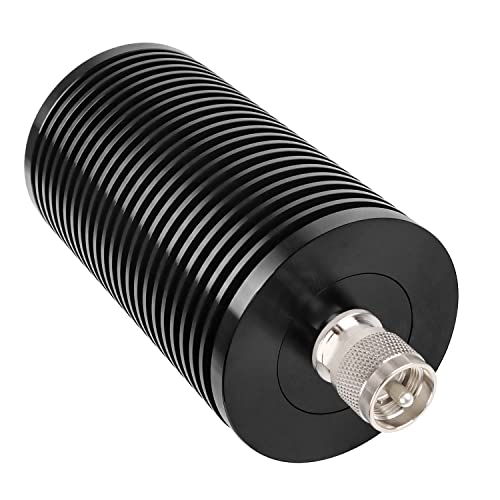
XRDS-RF
XRDS-RF 100 W dummy load, 50 ohm
The reference load. Every diagnostic sequence starts here.
Check priceUnder $50

Daiwa
Daiwa CS-201A two-position coax switch
A coax switch for comparing two antennas on the same signal, which is the only comparison that means anything.
Check priceUnder $50
AURSINC
NanoVNA H4 vector network analyzer
The instrument that turns a bad reading into a diagnosis.
Check priceUnder $100

Rydocyee
Rydocyee RG-58 coax jumper, 25 ft
Short jumpers for arranging the bench, where flexibility matters and loss does not.
Check priceUnder $25

exgoofit
SO-239 barrel couplers, 6-pack
Barrels for splitting a run to isolate a fault section.
Check priceUnder $25

Fanbalunke
PL-259 solder connectors with reducers, 6-pack
Spare connectors, because the fault is very often a connector.
Check priceUnder $25
Common questions
Questions people ask about this
Should I leave an SWR meter in line all the time?
Yes. Insertion loss is negligible, and a meter that is always there is how you notice the day something changes. Antenna faults almost always announce themselves as a reading that differs from usual, and a meter connected only when you suspect a problem cannot give you that comparison. A cross-needle meter is ideal for this because it shows everything at a glance.
How accurate are amateur SWR meters?
Typically around 10 percent of full scale, which is entirely adequate. Nobody needs to know whether their output is 97 or 100 watts. What matters is repeatability, and even inexpensive meters are far more repeatable than they are absolutely accurate, which is exactly what you need for spotting a change. Check any meter against a known good dummy load.
Why does my SWR read differently on my radio than on my meter?
The radio measures at its own output behind whatever is in the signal path, and its scale is often nominal rather than calibrated. An external meter measures at a defined point in the feedline. Neither is wrong; they are measuring different things at different places. Trust the external meter for absolute readings and both for spotting changes.
Where should the meter go, before or after the tuner?
After the tuner is more informative, because it shows what is actually happening on the feedline rather than the matched condition the tuner is presenting. Before the tuner shows what the radio sees. Serious stations often use two meters for exactly this reason, since the difference between the two readings is what the tuner is doing.
Do I need a dummy load?
Yes, and it is the cheapest useful instrument in the shack. It is the known good reference that starts every diagnostic sequence: if SWR is not close to 1 to 1 with the load connected directly to the radio, the problem is the radio or the meter and nothing downstream matters. It is also how you set up and test without radiating.
Keep going
Related on this site
Disclaimer Researched guidance for planning purposes, not professional engineering, electrical or legal advice. Antenna work, RF exposure, mast and tower work, grounding and battery handling all carry real risk that depends on your specific site and installation. Verify anything safety-critical against current FCC rules, the National Electrical Code and the manufacturer's own documentation, and hire a professional where the job calls for one. We research equipment from published specifications, regulatory documents and verified owner reviews rather than claiming hands-on testing we have not done.