HF band characteristics: what each band does
One table that tells you which band to try, and why it is behaving that way.
The short answer
Forty metres is the most reliable HF band in the country and works day and night out to about 1,500 miles. Twenty metres is the main worldwide daytime band and works in every year of the solar cycle. Ten and fifteen metres are spectacular near solar maximum and largely closed near minimum.
- Most reliable band
- 40 m
- Main DX band
- 20 m
- Best at solar max
- 10 m
- Quietest band
- 17 m
- Noisiest in summer
- 80 m
- Magic band
- 6 m
Bands have personalities. Not in a poetic sense: each one behaves differently because of how the ionosphere treats its frequency, how large an antenna it needs, and what kind of operator has therefore gathered there. Knowing that in advance saves a great deal of tuning around.
This table is the summary. The physics behind it is in HF propagation basics, and where the modes live within each band is in the US amateur band plan.
The HF bands
Band by band
Range, timing and antenna size for every HF band
| Band | Best time | Typical range | Half wave | Character |
|---|---|---|---|---|
| 160 m | Winter nights | Regional to worldwide | 246 ft | A specialist band, big antennas, dedicated crowd |
| 80 m | Nights, best in winter | 300 to 1,500 miles | 125 ft | Regional nets, rag chews, noisy in summer |
| 60 m | Nights and dawn | 200 to 800 miles | 87 ft | Five channels, low power, emergency use |
| 40 m | Evening and night | 300 to 2,500 miles | 66 ft | The most reliable band, always active |
| 30 m | Day and night | 500 to 3,000 miles | 46 ft | CW and data only, quiet and stable |
| 20 m | Daylight, all year | Worldwide | 33 ft | The main DX band, busiest in the afternoon |
| 17 m | Daylight | Worldwide | 26 ft | Quiet, relaxed, no contests permitted |
| 15 m | Daylight, good years | Worldwide | 22 ft | Excellent at solar maximum, dead at minimum |
| 12 m | Daylight, good years | Worldwide | 19 ft | Underused, rewarding when open |
| 10 m | Daylight, and sporadic E | Worldwide or local | 17 ft | Spectacular at solar max, empty otherwise |
| 6 m | Warm months, sporadic E | 500 to 1,500 miles | 9 ft | The magic band, sudden dramatic openings |
| 2 m | Any time | 30 to 100 miles | 3 ft 2 in | Repeaters, satellites, weak signal work |
| 70 cm | Any time | 20 to 60 miles | 1 ft 3 in | Repeaters, digital voice, satellites |
Range figures assume a typical station with a wire antenna at moderate height. A good antenna at height and open conditions produce much more; a compromise antenna in a noisy location much less. Half wave lengths are from the dipole length chart.
Choosing a band by what you want
- Talking to people 100 to 300 miles away
- Eighty metres at night, or 40 metres during the day with a low antenna that radiates at a high angle. This is the range where regional nets and emergency traffic live, and where a low dipole is the correct antenna rather than a compromise.
- Worldwide contacts on a normal station
- Twenty metres in the afternoon, every day of the solar cycle. Forty metres in the evening. Those two bands carry most of the worldwide contacts made by ordinary stations with wire antennas.
- A quiet band for a long conversation
- Seventeen metres. Contests are not permitted there, so it stays civil, and it is open worldwide in daylight in most conditions.
- Something dramatic
- Six metres in the warmer months. Sporadic E openings appear without warning and produce strong signals over 500 to 1,500 miles for minutes or hours. It is the reason the band is called magic.
- Reliable local communication
- Two metres through a repeater, at any time, in any conditions. It is the band that works when nothing else does because it does not depend on the ionosphere at all.
- Working the world with a compromise antenna
- Twenty metres on FT8. The band is open most days and the mode tolerates a signal 20 dB weaker than voice needs.
Noise by band
Noise
What limits reception on each band
| Band | Dominant noise | Seasonal pattern |
|---|---|---|
| 160 and 80 m | Atmospheric static and household devices | Much worse in summer thunderstorm season |
| 40 m | Atmospheric plus broadcast splatter at night | Worse in summer |
| 30 and 20 m | Man-made, switching supplies and LED drivers | Constant year round |
| 17 to 10 m | Man-made, and often very quiet | Constant, lowest of the HF bands |
| 6 m | Man-made and ignition noise | Constant |
| 2 m and 70 cm | Local electrical and intermodulation | Worst near commercial transmitters |
The lower the band, the more the noise floor is set by nature and the less you can do about it. The higher the band, the more it is set by devices in your own house, which you can do a great deal about. See radio noise and RFI hunting.
Antennas for each band range
Matching the antenna to the band
The lower the band, the bigger the antenna and the more the compromises bite.

JYR
JYR8010 8-band end fed half wave, 150 W
A 40 metre based end fed covers 40, 20, 15 and 10 from one 66 ft wire, which is the core of the HF spectrum for a normal lot.
Check priceUnder $100
MFJ
MFJ-1982LP 80 to 10 m end fed half wave
An 80 metre end fed for a lot with the span, adding the regional night band to the set.
Sold by MFJ Enterprises, not Amazon. The link searches the category.
Comet
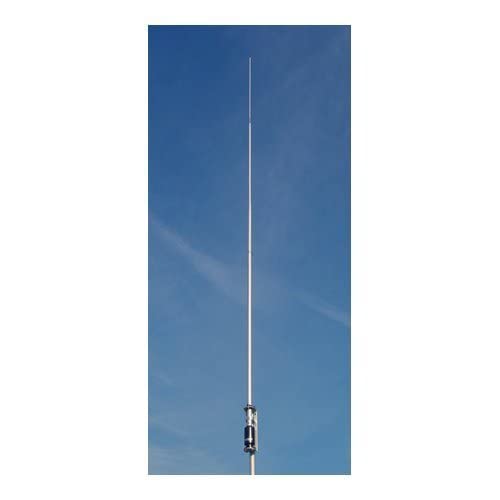
Comet CHA-250B broadband vertical
A no-radial vertical covering 80 through 6 metres where there is no room for wire.
Check priceUnder $500
Hustler
Hustler 4-BTV trap vertical
A trapped vertical with a proper radial field, for a station chasing distance on the mid bands.
Sold by Hustler, through amateur radio dealers, not Amazon. The link searches the category.
Arrow Antenna
Arrow II 3-element 2 m handheld Yagi
A small beam for 2 metres, which turns satellite and weak signal work from difficult into practical.
Check priceUnder $250

Diamond Antenna
Diamond X50A dual-band base antenna
A dual-band base vertical for the two bands that work regardless of the ionosphere.
Check priceUnder $250

Icom
Icom IC-7300
A spectrum scope that shows at a glance whether a band is open or simply empty.
Check priceUnder $2,500

AURSINC
NanoVNA H4 vector network analyzer
Confirms your antenna is resonant on the band you are trying to use rather than the one next to it.
Check priceUnder $100
Common questions
Questions people ask about this
Which HF band should a beginner start on?
Forty metres in the evening and twenty metres in the afternoon. Between them they carry most of the activity a normal station will find, they work in every year of the solar cycle, and both need an antenna a typical garden can support. Twenty metres in particular is reliable worldwide in daylight even when solar activity is low.
Why is 80 metres so noisy in summer?
Because atmospheric noise from distant thunderstorms is far stronger at low frequencies, and thunderstorm activity peaks in the warm months. That noise is natural and there is very little you can do about it beyond a directional receive antenna or a noise blanker. Eighty metres becomes a much better band in winter for exactly this reason.
What is the magic band and why is it called that?
Six metres, at 50 MHz. It sits at the boundary between HF and VHF behaviour, so most of the time it behaves like VHF and reaches only line of sight. Then a sporadic E patch forms and it suddenly delivers strong signals over a thousand miles for twenty minutes. The unpredictability is the appeal, and it is genuinely dramatic when it happens.
Why is 17 metres quieter than 20?
Partly because it is a narrower band with fewer stations and partly because contest operation is not permitted there by band plan convention. That keeps the activity conversational rather than competitive. It is open worldwide in daylight under most conditions, so it is an excellent band for a long relaxed contact.
Can I use 10 metres when solar activity is low?
Occasionally. F layer propagation on 10 metres largely closes at solar minimum, but sporadic E in the warmer months still produces openings over 500 to 1,500 miles, and those can be very strong. It is also worth watching because 10 metres is where the improvement shows first when the cycle turns upward.
Keep going
Related on this site
Disclaimer Researched guidance for planning purposes, not professional engineering, electrical or legal advice. Antenna work, RF exposure, mast and tower work, grounding and battery handling all carry real risk that depends on your specific site and installation. Verify anything safety-critical against current FCC rules, the National Electrical Code and the manufacturer's own documentation, and hire a professional where the job calls for one. We research equipment from published specifications, regulatory documents and verified owner reviews rather than claiming hands-on testing we have not done.